Earthquakes
S


Seismograph

Huge earthquake strikes Ring of Fire: Papua New Guinea hit by shallow 7.5 magnitude quake - at least 100 dead (UPDATE)

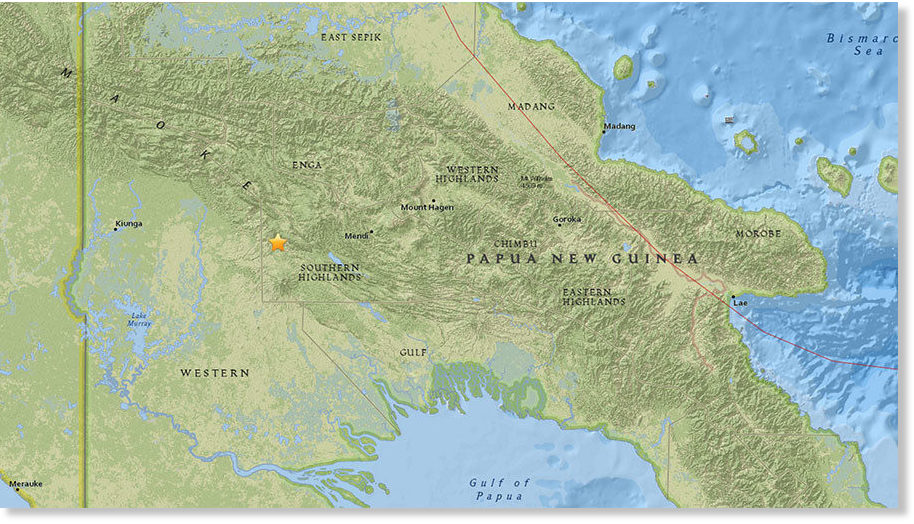
map map
Papua New Guinea has been rocked by a huge 7.5magnitude earthquake just moments after a smaller seismic event struck Japan, increasing fears of a natural disaster impacting the dangerous region dubbed the 'Ring of Fire'.

The 7.5 magnitude earthquake struck the heart of the island near the near the Southern Highlands area, with tremors felt across the nearby region.

The phenomenon hit at a depth of two kilometers at roughly 4am local time (6pm GMT).

It is currently unclea rif any damage or injuries were cause by the substantial siesmic event.

Comment: On the 26th the local newspaper the Post-Courier reported:
A huge 7.6 magnitude earthquake severely hit Hela and Southern Highlands last night.

Although communication networks into the two provinces have been cut off, reports through satellite communication by Hela Provincial Administrator William Bando reveal that about 10 people have been killed while thousands of properties have been destroyed.

Mr Bando said it is a very severe disaster as many lives have reportedly been lost.

It is believed that the earthquake started around Kiunga and affected lives and properties in Hela and Southern Highlands while other provinces also felt the effect of the quake.

Mr Bando said the Komo Airport is believed to be damaged as half of the airfield has been destroyed.

The PA is now meeting with the department of inter-government relations in relation to the disaster.

According to new information received at (11:30am) the quakes have resulted in homes and properties being buried as the ground opened up and sank. Reports are yet to be confirmed but the situation looks severe.
Update - 27th of February, 2018:

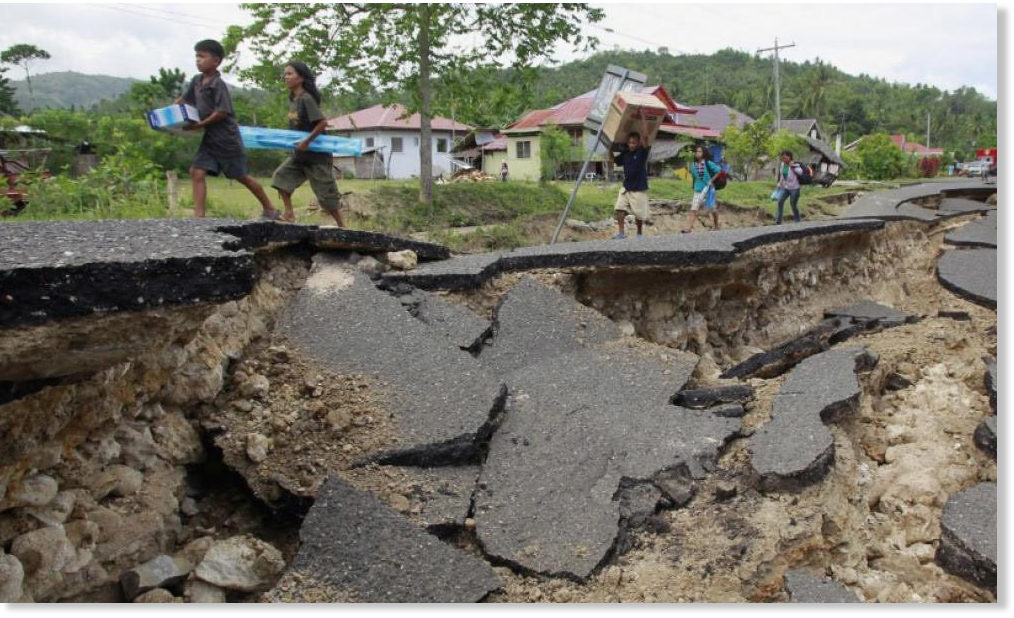
More than 30 people are now feared dead in the 7.5 magnitude earthquake that shook Papua New Guinea on Monday, local media outlets have reported. Hela Provincial Administrator William Bando noted that the earthquake led to the appearance of landslides and sinkholes. Over 300 people have been reportedly injured. Numerous properties have suffered damage and the electricity has been cut off in some of the affected areas.


Update - 5th of March, 2018:

The latest via the Loop news website:
As of midday today, 55 people have been confirmed dead in parts of Hela and Southern Highlands provinces.

This is according to the Catholic Bishops' Conference based on reports received from the Mendi Diocese in SHP.

General Secretary for Catholic Bishops' Conference of Papua New Guinea and Solomon Islands, Father Victor Roche, said coordination amongst authorities, churches and parties on ground is key during this trying time.

Initial reports provided by the Mendi Diocese following the earthquake confirm 20 deaths in Hela Province and 35 in parts of Mendi.

These figures account for just fractions of both provinces while attempts to update these statistics are ongoing.

Father Victor said coordination from the government right down to people on site at the impacted areas is crucial to enable swift coordination of relief efforts.

"Schools, houses, clinics, roads and bridges have been affected and people are finding it difficult to move around and relief efforts are also hampered by this, so it is good that we coordinate more," Fr Roche stated.
Update - 6th of March, 2018:

RNZ reports:
The death toll in Papua New Guinea following last week's magnitude 7.5 earthquake has risen to 75.

The Highlands region was badly damaged in that tremor, and continues to be rattled by aftershocks as high as magnitude 6.

Much of remote Hela and Southern Highlands provinces were cut off by massive landslides, which has hampered the delivery of much-needed aid.

PNG journalist, Scott Waide, has just visited the region closest to the epicentre, including a village where 11 people died when the mountainside came crashing through.

He said he heard of a story about a boy whose whole family was killed in the quake.

"There's a chap who is in grade 5. He goes to school in Margarima - Margarima is very far away from his village. He came back to ask his parents for school fees [but] on his way back his whole family was wiped out - his siblings, his mother, his father and an uncle have all died. So he's the only one in the family left."
Update - 9th of March, 2018:

Local newspaper the Post Courier reports:
More than 100 people have lost their lives and many others remain unaccounted for 10 days after the 7.5 magnitude earthquake struck the resource rich provinces of Southern Highlands, Hela, Enga and Western Province.

Prime Minister Peter O'Neill said this yesterday after he visited the remote disaster devastated communities and people on Wednesday.

"Authorities have estimated that over 100 have lost lives and or are missing, families who are stranded in remote communities because our accesses to them especially the road links have been closed off by landslips," he said.

"As we are clearing up the existing landslips, new ones are coming up because the aftershocks are causing new landslips so it is a huge challenge which will require a lot of effort and time so that we are able to take the relief supplies to these communities." He said the work of rebuilding the affected communities is going to be difficult will take some time.

"Our government's efforts are being supported by many countries like China, the Chinese government is one of the large contributors to that, the Australian government, New Zealand government, organisations like Oil Search, PNG LNG, many Chinese businesses right throughout the country and off course many of our development partners like the World Bank and ADB (Asian Development Bank) who have supported the relief effort," he said. Mr O'Neill said this yesterday when receiving a cheque of K1.006 million from the China Enterprise Association, comprising China's state-owned companies currently operating in Papua New Guinea, towards the disaster relief efforts.

"China and PNG are very historic friends, there are many generations of Chinese who have lived and work and families have lived in Papua New Guinea and will continue to be part of our country's history for many years to come so all these support and contributions is very much appreciated by our families who are suffering the loss," he said.

"We are trying to help rebuild their lives and the funds that you contributed will immediately go to providing food, water, medicine and shelter to many of these communities who are left homeless and without food and water.

"K1 million is a lot of money in these difficult economic times and to raise that kind of money in a matter of days is something we truly appreciate."


Seismograph

Shallow magnitude 7.1 earthquake hits east of Papua New Guinea island

earth
An earthquake of magnitude 7.1 struck 135 km (85 miles) east of the town of Rabaul, on the eastern tip of Papua New Guinea's island of New Britain, at 3.39 a.m. on Friday, local time (1739 GMT on Thursday), the U.S. Geological Survey said.

Although the quake was under the seabed at a relatively shallow depth of 10 km, the Pacific Tsunami Warning Center said there was no threat of a tsunami.

A quake of magnitude 7.5 struck the rugged highlands of the Papua New Guinea mainland on Feb. 26, killing more than 100 people.

Source: Reuters

Comment: See also: Huge earthquake strikes Ring of Fire: Papua New Guinea hit by shallow 7.5 magnitude quake - at least 100 dead (UPDATE)


Seismograph

Papua New Guinea struck by shallow 6.7 magnitude earthquake 9 days after deadly temblor - at least 18 killed (UPDATE)

earth
A 6.7 magnitude earthquake struck Papua New Guinea just after midnight local time Wednesday morning, jarring an area that's still recovering from a 7.5 tremor in late February.

The U.S. Geological Survey said the quake struck at 12:13 a.m. local time Wednesday morning (9:13 a.m. EST Tuesday morning) about 70 miles southwest of Porgera. The temblor struck at a depth of about 20 miles and was located about 20 miles southwest of the Feb. 26 quake, which killed at least 67 people, according to the Guardian.

It wasn't immediately known if the latest earthquake caused additional damage or injuries. The U.S. Tsunami Warning System said it did not expect a tsunami to be generated from the quake.

Comment: Update - 7th of March, 2018:

Reuters reports:
A magnitude 6.7 earthquake struck Papua New Guinea's mountainous Southern Highlands on Wednesday killing at least 18 people, an official said, a week after a larger quake flattened villages and killed at least 55 people.

The tremor, shortly after midnight local time, struck just 31 km (19 miles) southwest of the epicentre of last Monday's magnitude 7.5 quake that has left government and aid agencies scrambling to provide emergency supplies to the remote region.

Australia and New Zealand said on Wednesday they would increase aid to Papua New Guinea.

Australia will deploy three helicopters this week to deliver aid, while New Zealand will send a second military plane to distribute medical equipment, hygiene kits and tarpaulins.

Wednesday's quake was the most severe of a series of aftershocks that have rattled the resource-rich region, about 600 km (370 miles) northwest of the capital Port Moresby.

William Bando, the administrator of Hela Province, said initial reports put the death toll from the aftershock at 18.


"It appears Hides was hardest hit. We haven't heard about potential casualties there yet, but it is a big village with many people," he added.

Manasseh Makiba, Papua New Guinea's Vice Minister for Petroleum & Energy who represents parts of Hela Province in parliament, said victims were still being found.

"People are still being extracted from mud. People are still being taken to hospitals," he said.

Local media outlets reported the death toll from the original quake had risen to 75,
after government officials said previously that 55 people had been killed.

A spokeswoman at Papua New Guinea's National Disaster Centre said on Wednesday that authorities were finalising a final report into the casualties from the first quake.

James Komengi, a United Church project officer, speaking from Tari, the capital of quake-affected Hela province, said his church's assessment and response centre had counted up to 67 deaths in that province alone.

Aid efforts are being hampered as rescue workers struggle to reach the highlands area as many roads are either badly damaged or blocked.

The International Red Cross warned the situation could deteriorate if heavy rains hit the region.

"We are anxious to reach communities while there is a lull in what is usually a season of heavy rain. A big downpour could bring landslides in hillsides already destabilised by the earthquake, cause floods and contaminate water," said Udaya Regmi, Director the International Red Cross in Papua New Guinea.

The Red Cross said its initial assessments indicate that as many as 143,000 people could have been affected, with an estimated 500 people injured and 17,000 people displaced from their homes. Even in more accessible areas of the country, health facilities have been damaged.

ExxonMobil, which shut its $19 billion PNG liquefied natural gas (LNG) project after the first quake, said on Wednesday its facilities in Hides, where it runs a gas conditioning plant, were safely shut in. All employees and contractors were safe.
See also: Huge earthquake strikes Ring of Fire: Papua New Guinea hit by shallow 7.5 magnitude quake - at least 75 dead (UPDATE)


Seismograph

Shallow magnitude 6.0 aftershock rattles Papua New Guinea

earthquake
Strong aftershocks have rocked Papua New Guinea's remote and rugged highlands, as the death toll climbed to 55 from a 7.5-magnitude earthquake a week ago, and is expected to rise further.

Three aftershocks of magnitude greater than 5 shook the mountainous Southern Highlands, about 600km northwest of the capital Port Moresby early on Monday, the US Geological Survey said, including a shallow magnitude 6 quake.

"We haven't slept. It's been shaking all through the night," William Bando, provincial administrator of Hela Province, said by telephone from Tari, about 40km from the site of the shocks.

"What we experienced this morning could have caused more damage, but we don't know ... it almost threw me out of bed."

Comment: See also: Huge earthquake strikes Ring of Fire: Papua New Guinea hit by shallow 7.5 magnitude quake - at least 55 dead (UPDATE)


Attention

Bosavi volcano in Papua New Guinea dormant for centuries shows recent signs of activity

Mt Bosavi
Mt Bosavi
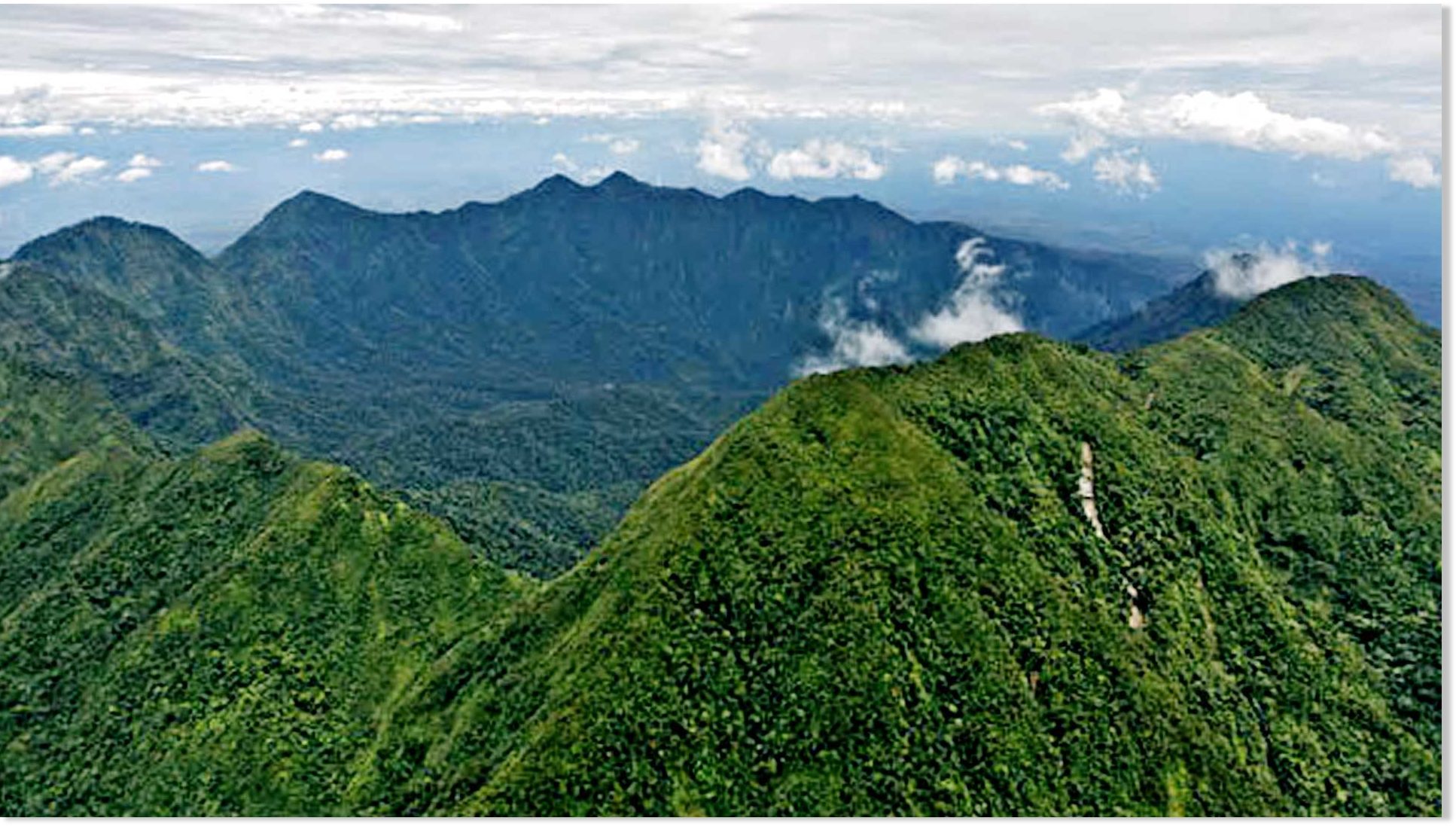
For centuries, Mt Bosavi in Nipa-Kutubu electorate in Southern Highlands Province has never shown signs of volcano existence.

However, the recent earthquake which destroyed many of the villages including food gardens and an environment in both the Hela and SHP has strike Mt Bosavi to show shines of its volcano existence.

Former PNG basketball representative player Colin Pine speaking from Kutubu said Mt Bosavi is showing signs of the volcano and the entire villages along the mountain are in fear it can blow anytime.

"Mt Bosavi is showing signs of a volcano and as we speak we are seeing smoke building up at the top of the mountain. We had never seen Mt Bosavi as a volcanic mountain but now it's showing signs," Pine said.

Seismograph

Fresh shallow earthquake of magnitude 6 rocks Papua New Guinea

earth
An earthquake measuring 6 on the Richter Scale hit Papua New Guinea on Wednesday, officials said.

The fresh earthquake was felt just two days after 7.5 magnitude earthquake hit the area.

The earthquake triggered landslide which left at least 31 people dead and another 300 injured.

As per the US Geological Survey (USGS) website, the fresh earthquake hit at a depth of 10 kms.

The earthquake was felt at 2:45 local time.

No casualty has been reported so far.

This region is located on the so-called Pacific Ring of Fire.

This region is known for intense seismic and volcanic activity.

Seismograph

3.2 magnitude quake rocks Northern England shaking houses - the second to strike in 2 weeks

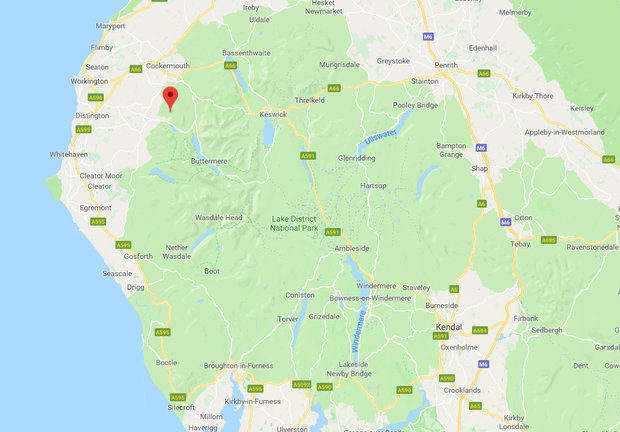
MAPPED: The quake's epicentre was on the edge of Cumbria's famous Lake District park
An earthquake has hit Cumbria, shaking the north of England.

The tremor had a magnitude of 3.2, the British Geological Survey said. While that is relatively weak, it can be enough to cause some damage to buildings.

Today's tremor is the second earthquake to hit the UK in as many weeks. Earlier this month, an earthquake near Swansea caused some confusion and problems, with shakes and noises spreading across the south-west.

Comment: As noted in: UK struck by 21 earthquakes in 50 DAYS including biggest in 10 years
Following last week's 4.6 magnitude earthquake in the UK, which was felt from Cornwall to Liverpool, a British Geological Survey tweet stated that, "Events of this magnitude only happen in the UK every 2-3 years."

Actually, there have been about 7 similar-strength quakes in the UK in the last 3 years alone...

22 May 2015 - A 4.2 magnitude earthquake 'causes homes to shake' in Kent, UK
25 May 2015 - Magnitude 3.0 earthquake recorded in North Wales
29 Jan 2015 - Britain's second earthquake in 48 hours strikes in East Midlands
7 Mar 2016 - Earthquake 'shook houses' in south-east England
3 Jan 2017 - 3.9 magnitude tremor strikes off UK coast - biggest quake for nearly a decade
4 July 2017 - Earthquake recorded off Shetland was largest in UK for nine years
5 Aug 2017 - Scottish Highlands are rocked by their biggest earthquake for 30 years

We are seeing a marked increase in seismic activity around the world lately, could it be related to scientists' predictions that major earthquakes for 2018 due to slowdown in Earth's rotation?
Whether earthquakes, volcanoes, sinkholes or landslides, there appears to have been a surge in activity recently:


Seismograph

Shallow 6.2 magnitude earthquake recorded in Papua New Guinea

graph
6.2 magnitude earthquake 58 km from Mendi, Southern Highlands, Papua New Guinea

2018-02-26 15:17:59 UTC

USGS page: M 6.2 - 56km SW of Mendi, Papua New Guinea
USGS status: Reviewed by a seismologist
Reports from the public: 1 person

13 km depth

Comment: This latest shake occurred in the same region of the world less than 24 hours after this major event: Huge earthquake strikes Ring of Fire: Papua New Guinea hit by shallow 7.5 magnitude quake - at least 10 dead (UPDATE)


Seismograph

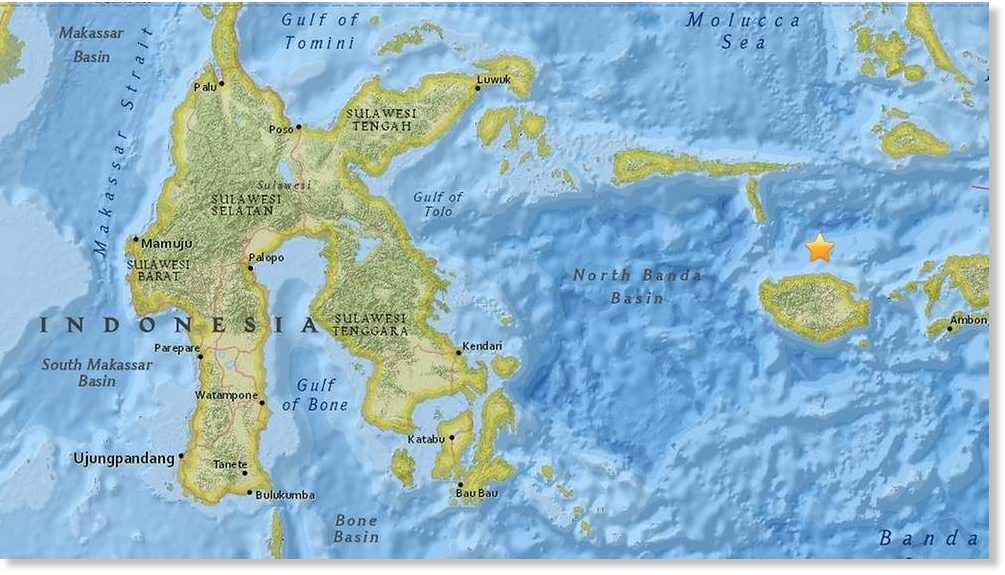
Shallow 6.1-magnitude earthquake strikes off eastern Indonesia

An earthquake with a magnitude of 6.3 hit eastern Indonesia on Monday (Feb 26).
© United States Geological SurveyAn earthquake with a magnitude of 6.3 hit eastern Indonesia on Monday (Feb 26).
A 6.1-magnitude earthquake struck off eastern Indonesia late Monday (Feb 26), the United States Geological Survey (USGS) said, but no tsunami warning was issued.

The quake had a depth of 11.9 kilometres and its epicentre was in the Seram Sea around 194 kilometres northwest of Ambon, capital of Maluku province, according to USGS.

There were no immediate reports of damage or casualties.

Source: AFP/aa

Seismograph

UK struck by 21 earthquakes in 50 DAYS including biggest in 10 years

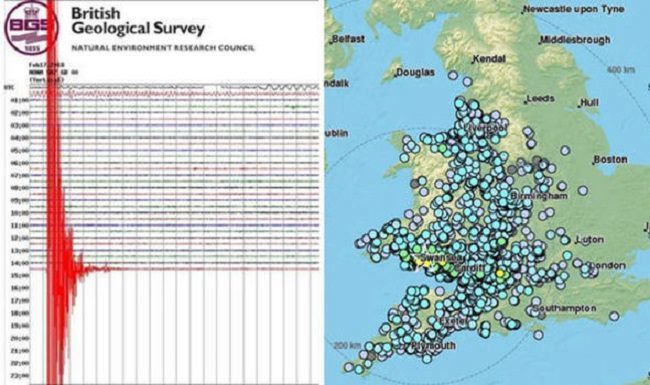
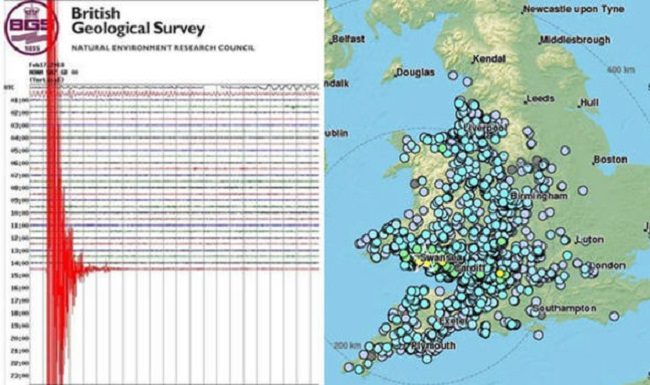
British Geological Survey chart
© BGSA British Geological Survey chart shows the seismic activity during the UK earthquake last week
SHOCKING figures show there have been 21 earthquakes in the UK in the last 50 days, including the biggest in ten years, with the majority striking Wales.

The news that Brits are living on shaky ground comes after a 4.6 quake struck in Wales last week, and was reported to be the strongest to have hit the UK in 10 years.

The British Geological Survey has registered the specific location of the quake to be the village of Cwmllynfell near Swansea.

BGS figures show that four others struck in Cwmllynfell the same day.

The 4.6 quake at 2:31pm was followed by a 1.8 quake at 2.35pm, a 1.2 quake at 3.09pm, a 1.5 quake at 4.27pm and a 2.2 quake at 11.17pm.

The most recent quake to send shockwaves across our shores struck in Llanfechell in Wales on February 18.

It measured just 1.1 on the richter scale.

Out of the 21 quakes 10 of them were in Wales, with an assortment of villages that make up the area of Llanwenog feeling a 0.9 magnitude quake on January 11, and the village of Llangybi experiencing a 1.0 earthquake on January 6.

There were three earthquakes in England with Shropshire feeling a 1.5 quake on February 10, and Cumbria feeling a 1.0 quake January 29.

Comment: Following last week's 4.6 magnitude earthquake in the UK, which was felt from Cornwall to Liverpool, a British Geological Survey tweet stated that, "Events of this magnitude only happen in the UK every 2-3 years."

Actually, there have been about 7 similar-strength quakes in the UK in the last 3 years alone...

22 May 2015 - A 4.2 magnitude earthquake 'causes homes to shake' in Kent, UK
25 May 2015 - Magnitude 3.0 earthquake recorded in North Wales
29 Jan 2015 - Britain's second earthquake in 48 hours strikes in East Midlands
7 Mar 2016 - Earthquake 'shook houses' in south-east England
3 Jan 2017 - 3.9 magnitude tremor strikes off UK coast - biggest quake for nearly a decade
4 July 2017 - Earthquake recorded off Shetland was largest in UK for nine years
5 Aug 2017 - Scottish Highlands are rocked by their biggest earthquake for 30 years

We are seeing a marked increase in seismic activity around the world lately, could it be related to scientists' predictions that major earthquakes for 2018 due to slowdown in Earth's rotation?