
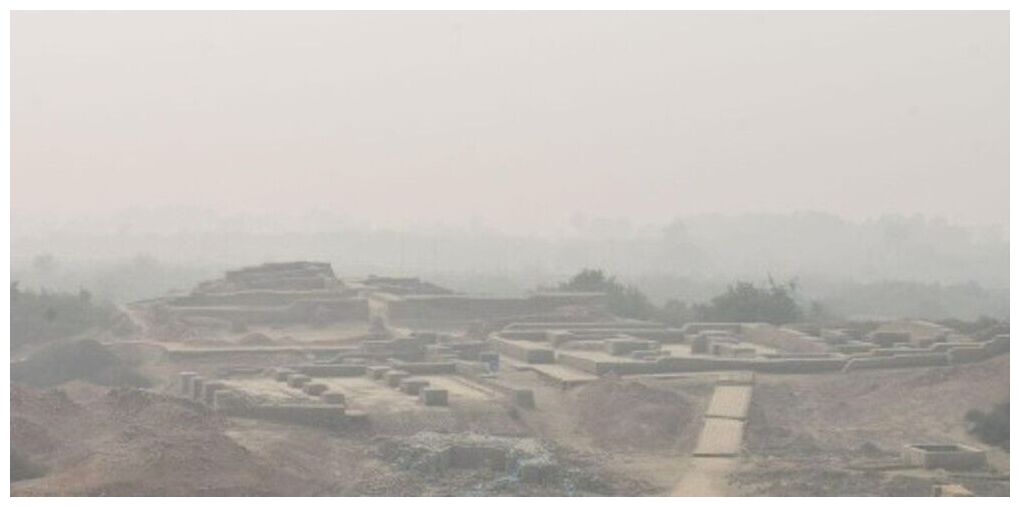
© University of YorkMohenjo-daro was the Indus civilisation’s largest city.
But a new study at the University of York delves into the archaeology of Mohenjo-daro, the Indus civilisation's largest city, and shows the opposite was true. By analysing house sizes across the ancient city, researchers found that Mohenjo-daro was not only more equal than its neighbours in Mesopotamia and Greece, but it actually became more egalitarian over time.
Entirely different
The lead author, Dr Adam Green from the University of York's Department of Archaeology and Department of Environment and Geography, said: "Legacy data from the ancient city shows that as the city matured, the gap between the largest and smallest homes narrowed. In fact by its later years, the wealth gap in this massive urban centre had dropped to levels typical of the first farming villages.
"While ancient Egyptians were building pyramids for god-kings, and the Greeks were constructing massive palaces at Knossos, the people of the Indus were building something entirely different.
"Instead of gold-filled tombs and huge temples, Mohenjo-daro focused on sophisticated brick-lined drains and organised street layouts. Instead of allowing the perks of society to accumulate with a tiny elite, the city's amenities were widely distributed amongst the everyday households."
Indus seals
This was particularly true with regard to the distribution of the famous Indus seals, which were tools of business and trade. Indus seals were typically found in ordinary homes and not in public buildings, with no palaces to monopolise these tools of government.
It was evident that rather than a single ruler hoarding resources, the city's inhabitants worked together to ensure fair access to a good standard of life.
Investment in very practical things, like drainage and street maintenance, was also a sign of working collectively for the public good. The use of a standardized system of weights and measures across the region ensured that exchange remained fair for all citizens.
Rising productivity
The findings, published in the journal Antiquity, challenge the modern assumption that rising inequality is an unavoidable side effect of economic growth. Mohenjo-daro, the researchers say, stands as proof that a society can be technologically advanced and highly productive whilst also ensuring its prosperity is shared by the many, rather than the few.
Dr Green said: "Mohenjo-daro is often cited as being famous for what it doesn't have, such as the absence of palaces for kings, gold-filled tombs, and no statues of rulers. But what it does have is so important.
"In the period when inequality appears to be lowest, productivity appears to rise. It challenges the idea that prosperity requires us to concentrate decision-making powers in the hands of the few.
"It is quite an interesting lesson for modern societies, as the Indus civilisation demonstrates clearly that an urban society can be highly productive and inventive at scale, whilst also ensuring that resources and power are shared equitably. In fact, doing so may even have been essential to sustaining prosperity over the centuries."



Reader Comments
Sounded like a nice civ, surrounded by aggressive alpha civilizations. What brought it to its end.
[Link] image says it all.
Its religion seems pluralistic, not centralized or monotheistic. After this turning point, Deluge or Flood — the rise of intensive agriculture and stratified city-states — societies shift toward hierarchy: kings, priests, large tombs, slavery, and permanent warfare become the norm. That transformation sets the pattern that continues through history to the present.
Of course, we could call this
Synarchy (syn = together arkhē = rule) : a state in which the system is governed in a distributed and coordinated manner.
Those who desire power must prove themselves through poverty, service to others, and self-forgetfulness (even if it means subjecting them to hazing and humiliation to make us accept that we are giving them a portion of our sovereignty) in order to gain leadership.
Humans work together for one another, but a total rejection of power, domination, and competition, I believe, is necessary to achieve this state.
Then move on to the next ...