
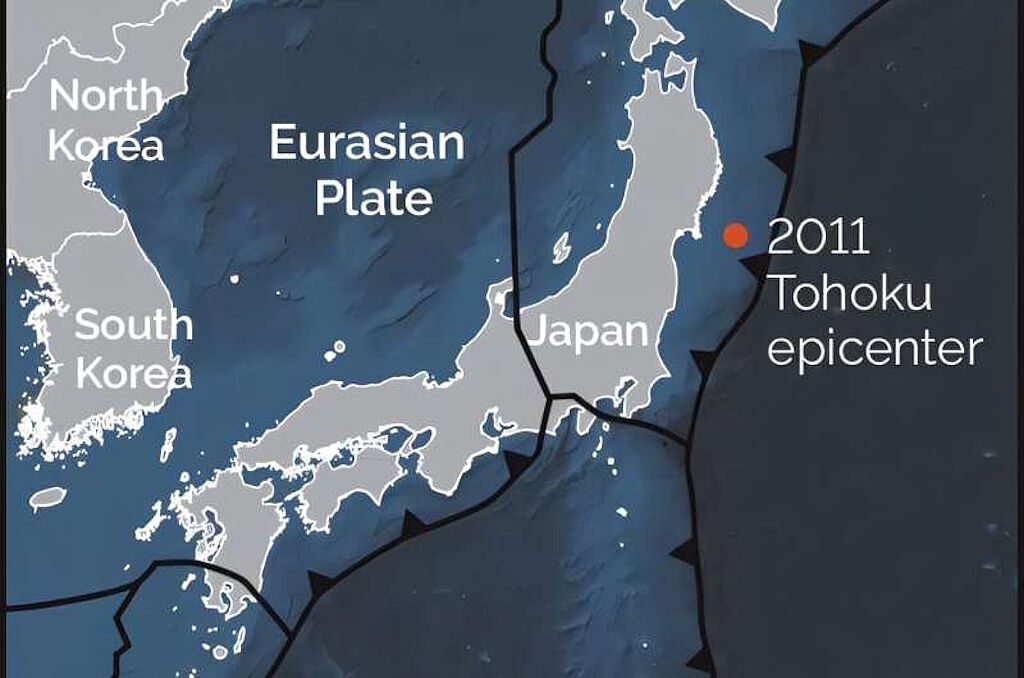
© K. Cantner/American Geosciences InstituteJapan rests at the intersection of four different tectonic plates.
A new analysis of data from the quake, led by University of Chicago geophysicist Sunyoung Park, suggests an extraordinary answer: The waves from the earthquake traveled downward to the Earth's core and then back up, displacing the tectonic plates further. This permanently moved the entire island of Japan eastward by up to 6 millimeters.
Seismologists knew that large waves from earthquakes can travel through the Earth and even reverberate off the core. But this is the first time the phenomenon has been identified as causing tectonic plates to slip near the Earth's surface. "It's striking because this is both an unprecedented length and area for a seismic event, and it is a previously unrecognized source of seismic hazard," said Park.
The study was published in Science on June 18.
Traveling to the core and back
The 2011 earthquake, localized off the coast of the Tohoku region of Japan, ranks among the strongest ever recorded; the combination of quake and tsunami killed 20,000 people.
It was also one of the most thoroughly documented. Because Japan has a long history of earthquakes, the country has thousands of monitoring stations. Scientists immediately began poring over the data to try to understand what happened, and hundreds of papers were published.
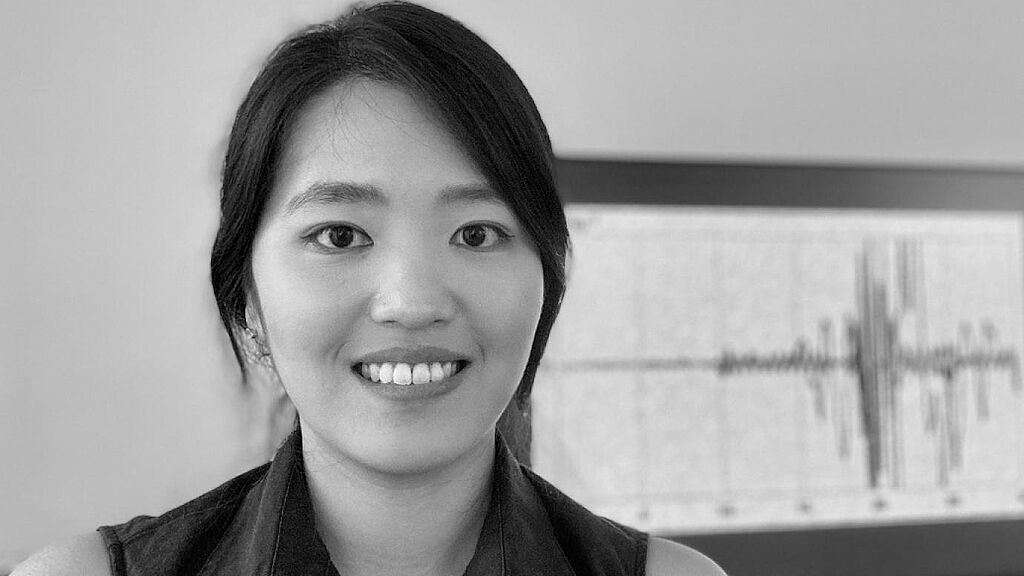
University of Chicago geophysicist Sunyoung Park. She has a wide range of interests in seismology, including the Earth’s internal structure, from the surface to the core; earthquake rupture processes; and seismic hazard assessment.
After the quake itself, but before the major aftershocks, GPS stations had picked up a sudden shift eastward. This shift didn't correlate with any of the aftershocks registered at the surface. But, strangely, it was registered at precisely the same time by stations across Japan.
"Most of the time, we would see an offset like this when there's an actual earthquake happening. But here there was no known aftershock at this time, so we were quite curious," Park said.
With collaborators Hiroo Kanamori of Caltech and Luis Rivera of the University of Strasbourg, Park began to rule out possible causes. An undersea landslide didn't fit the data — too localized. The same problem held for a slow slide at one of the faults.
Instead, the team came to believe it was due to a wave of energy from the quake that had radiated downward through the planet, struck the Earth's outer core — which is a liquid metal alloy — and reverberated back up to the crust. There, it triggered another slip along two major plate boundaries around Japan.
The journey down and back up, about 3,600 miles (5,800 kilometers) round trip, took about 15 minutes.
Broadest seismic event on record
Even as we get better at understanding and predicting hurricanes or tornadoes, earthquakes have remained difficult to study. They occur infrequently — especially large quakes — and take place over a very large area. And of course, most of the action takes place deep below ground, or worse, under the ocean, where few measurements are possible.
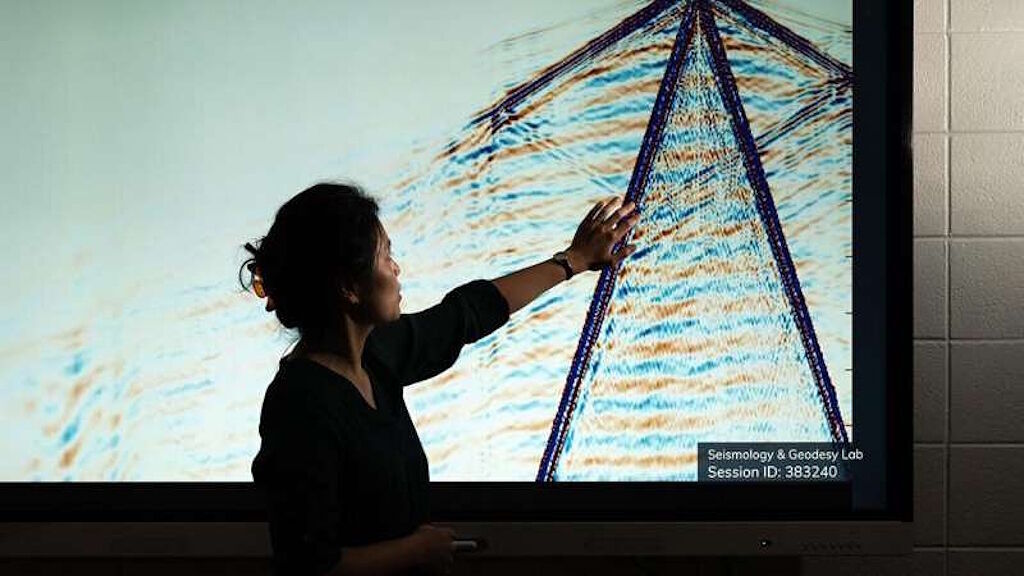
© Jason SmithUniversity of Chicago geoscientist Sunyoung Park shows seismic wave simulations from a new technique that uses 3D metal printers to better understand earthquake shaking.
Taking place over an area stretching about 1,800 miles (3,000 kilometers), the newly identified event is the broadest seismic event ever recorded. It released about the same amount of energy as a magnitude 7.5 earthquake.
It is also the first on record to involve multiple major tectonic plate boundaries; it took place both at the intersection of the Pacific and Okhotsk plates and at the one between the Philippine Sea and Eurasian plates.
It wasn't immediately noticed, the authors said, because seismic sensors are designed to look for the shorter, high-frequency signals that accompany more typical quakes felt on the surface. "There was also a ton of noise going on in the aftermath of the 9.0 quake," Park said.
But by comparing both GPS and seismic data from stations across the country, the researchers were able to tease out the signal.
Park thinks it's likely that vigorous shaking from the original quake weakened the plate boundaries, which then made it easier for the later-arriving wave from the core to reactivate the area around the main quake, as well as trigger new movement along plate boundaries farther away.
"This indicates that large earthquakes can influence the fault even after the main shaking is over," Park said.
Overall, the scientists said, it's clear we still have much more to understand about large quakes and tectonic plate behavior. "This is adding an entirely new angle of seismic hazard we didn't know about before," Park said.
Reference:
Sunyoung Park et al, ScS-triggered slip on megathrust interfaces after the 2011 M W 9.0 Tohoku-Oki earthquake, Science (2026). DOI: 10.1126/science.aec4190




Reader Comments
to our Newsletter