
© Unknown1 "Diplomacy is to do and say the nastiest things in the nicest way." -Isaac Goldberg
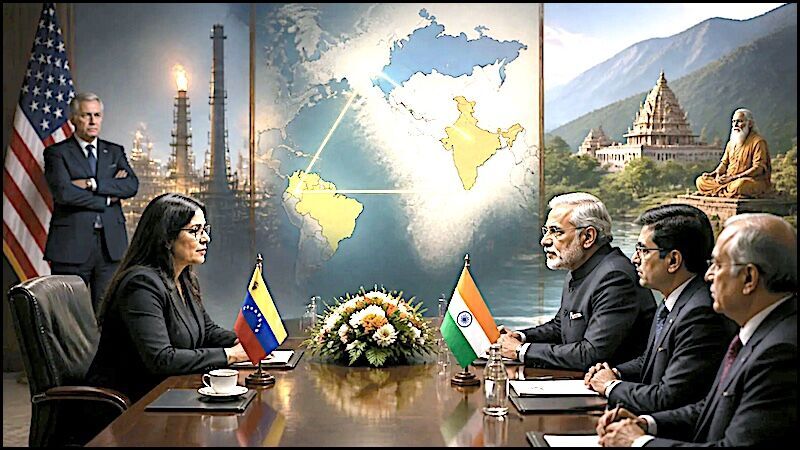
When diplomacy is linked with spirituality, even the most hawkish relations can be fixed. The Venezuelan acting president, Delcy Rodriguez, visit to India, from 3-6 June 2026, is its best manifestation, where diplomatic meetups were centered around energy, religion, and geopolitics.
Since the arrival of President Trump in 2025, American geopolitical strategy has witnessed a sharp shift from traditional liberalism to modern conservatism. The unlawful abduction of Venezuelan President Nicolas Maduro, the capture and control of Venezuelan oil, and sanctions on countries buying Russian oil are all beads of a single thread that were intentionally carried out to create a place for evading the American monopoly in the international arena. Delcy's visit to India could be considered a small but significant part of this strategy.
Historical Perspective
The connection between Venezuela and India is not recent, and they have had bilateral relations for almost 66 years. Amongst the strongest Asian purchasers of Venezuelan crude oil in 2012, India took the top spot. However, India was forced to reduce its purchase of Venezuelan crude in 2020 due to US sanctions on the Venezuelan economy. This is when India started looking towards Russia to meet its energy needs.
Delcy Rodriguez in India
The ongoing US-Iran war has disrupted global energy shipping. Due to the closure of the Strait of Hormuz and the resultant hampered supply from the Gulf, India has faced a serious energy backlash. Venezuelan acting President Delcy Rodriguez just paid a five-day visit to India despite the tumultuous geopolitical situation to make use of this opportunity and try to strengthen the bilateral relationship between the two countries.
Since India had turned to Russia to meet its energy needs during the sanctions on Venezuela, the Venezuelan government was unable to pay dividends to the Indian investment companies. Dividends and profits totaling over 500 million dollars are stranded - unable to flow back. Such actions created uncertainty on the part of investors, who became discouraged from investing in Venezuelan oil resources. However, even during this high-level visit, this specific issue was not resolved. The talks mainly focused on opening the Venezuelan oil market to India after years of disruption.
The most advanced refineries in India, such as the Jamnagar refinery controlled by the Reliance group of Gujarat, are made to refine heavy oil. These are exactly the kind of oils found in abundance in Venezuela. For that reason, Rodríguez's visit to Jamnagar held utmost significance. Since India wants to diversify its energy supplies due to global energy instability, Venezuela fits right into Modi's plan. Moreover, the Venezuelan delegation also consisted of high-level officials working in the fields of healthcare, critical minerals, transportation, technology, etc., which clearly shows that the unfolding of relations between the two is not restricted merely to Venezuelan crude oil.
Sai Baba's Influence
It's quite clear that the Indians are aware of the fact that it's actually the US controlling the Delcy administration. To appease the Indians, Delcy gave her visit a spiritual touch. She visited Prasanthi Nilayam, the ashram and spiritual headquarters of Sri Sathya Sai Baba in Puttaparthi. Venezuelan President Nicolás Maduro and his wife, Cilia Flores, have long been associated with the Sai Baba movement and visited the ashram in 2005. This strategy not only bridges the gap between India, Venezuela, and the US, but also signals to the Venezuelans that Delcy's administration is still carrying their motto of 'survival through faith.' For Venezuelans and most Latin Americans, politics is not merely licit; it is also fervent. Therefore, this spiritual touch could project the strategic compromise as an ethical revival.
Washington's Clandestine Diplomacy
The ongoing Indo-Venezuelan reunion is not restricted to just their bilateral relations - it finds its actual roots in Washington. Although US Secretary of State Marco Rubio had already visited India in late May 2026, it was nevertheless Rubio (and not India's Ministry of External Affairs, which would have made sense) who first publicly disclosed that Venezuela's Acting President Delcy Rodríguez would be visiting India the following week, an unusual diplomatic development. This diplomatic anomaly signaled two things. To the world, it declared that it's the US that now controls Venezuelan foreign affairs. And, for India, it signaled that any deal with Venezuela simply means a deal with the US. Moreover, during the visit, Delcy also met with the US Ambassador to India, Sergio Gor, who further clarified the fact that now, Venezuela will not make any moves without a go-ahead from the US first.
Options for India
The ongoing tussle between the US and India revolves around American sanctions, due to which India is unable to buy Russian oil freely. Therefore, Washington is providing India with an alternative that, in one way or another, only affects the Indian economy. The Trump administration knows the fact that India can't be coerced or ignored. Therefore, the provision of Venezuelan oil to India actually means the rapprochement between India and the US. However, India must move with caution as the situation in Venezuela is unstable.
Foreign investors are already reluctant to move in due to high risks and instability. Opposition parties are also strengthening their foothold. What if the Delcy government falls? Will the ongoing agreements and understandings be affected? Undoubtedly, all states have the right to search for alternatives, but completely sidelining their solid partners for historically unstable ones will most likely result in failure. Therefore, India must give priority to Russian energy, which is cheap, steady, and accessible, while developing relationships with other suppliers.
Conclusion
Although this visit did not result in a major breakthrough, it can't be ignored that an Indo-Venezuelan revival of relations is now in the pipeline, and both will probably move forward in good faith. But if both countries dance to the tune of the Americans, the eventual beneficiary of this will only be the US. Therefore, it's now upon India to keenly traverse through these major powers' tussle in a way that it does not deteriorate relations with any while also maintaining its strategic autonomy. The path is tough, and backlash is inevitable - but here's to hoping that sense prevails.



Reader Comments
to our Newsletter