
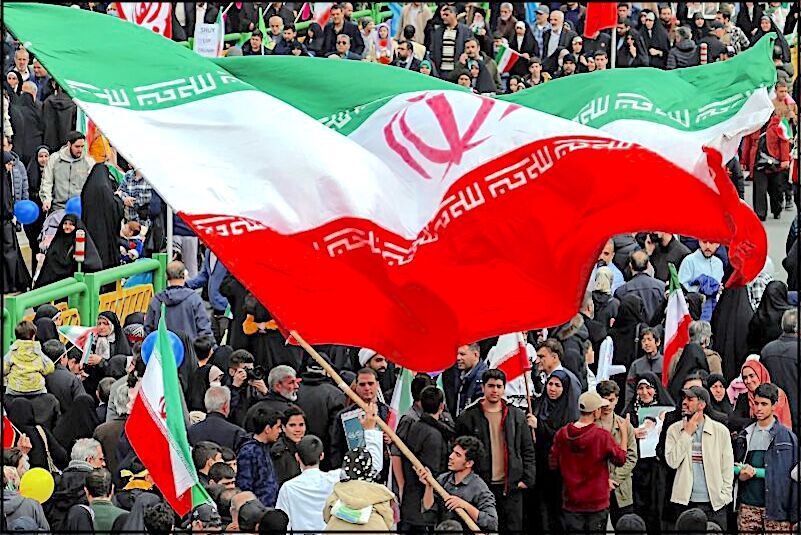
© unknownIran: The gathering under its flag
From its earliest years, the Islamic Republic of Iran developed a worldview and strategic thinking. The recent war declared against it by Israel and the United States led it to coordinate its armed forces and diplomacy, while its military achievements allowed it to consider how to pursue its revolutionary goals while protecting its population.The vision of Imam Khomeini
1. Imam Ruhollah Khomeini was not an expert in international relations. However, it was clear to him that the United Kingdom and the United States were Iran's traditional adversaries. Furthermore, he believed that Israel was an Anglo-Saxon outpost in the Middle East [ 1 ] .
2. When confronted with the "war imposed" by the West from Iraq, he was horrified by the use of missiles firing on Iranian cities and spreading poison gas. He believed that his country would never stoop to using weapons of mass destruction like these, or atomic bombs. In 1988, with the war having lasted a decade and victory still elusive, he issued a fatwa ordering the dismantling of the military nuclear program inherited from the Shah and France. It was a difficult decision that prolonged the war even further.
This fatwa was adopted by Ayatollah Ali Khamenei. It seems foolish to believe that the Revolutionary Guards — this heavily indoctrinated body — would agree to violate it or even allow it to be violated by other Iranians.
3. A third position of Imam Khomeini was that he had to defend the unity of Islam (Ummah) before any victory. He agreed to a non-aggression pact with Hassan al-Banna, the founder of the Muslim Brotherhood. He met him in 1938 and agreed to a pact with him in 1947 [ 2 ] . However, the two men never shared the same vision of Islam, and from 1949 onward, the Brotherhood became a secret society partially controlled by the British.
Today, Iran maintains relations with the Brotherhood and invites it to its annual pan-Islamic congresses, but at the same time, Tehran is fighting organizations like al-Qaeda and Daesh, all of whose leaders have been, or are, Muslim Brothers.
In 2005, President Mahmoud Ahmadinejad industrialized his country, which until then had relied solely on oil revenues. He then launched a vast scientific program to master nuclear fusion. His aim was to revive the anti-imperialist revolution of Imam Khomeini by discovering an energy source that would end the domination of oil companies and liberate the Third World. This project was never fully realized, as Israel assassinated the leading scientists in the field in Iran.
The right to retaliate against aggression and the liberation of occupied states
The war imposed by Israel and the United States on February 28, 2026, triggered strategic reflection in Iran. Unable to retaliate against the United States, 10,000 kilometers away, Iran's Revolutionary Guard attacked US military bases in the Gulf. They were stunned by the far-reaching consequences of their actions: without its regional bases, the aggressor was defenseless. To continue firing, it had to do so from Diego Garcia (Mauritius) and Germany.
Coming to the rescue, their diplomats pointed out that international law recognized the legitimacy of their action. They unearthed United Nations General Assembly resolution 3314 (XXIX), which affirmed that the right to resist aggression also extended to States that host foreign military bases used for aggression [ 3 ] .
Some of these states, like the United Arab Emirates, which for nearly fifty years circumvented the US siege (inaccurately termed "sanctions" by the West), were allies of Iran. The vast majority of Western strategists considered it inconceivable that Iran would attack its own allies. However, the Revolutionary Guards decided to attack their own allies to demonstrate that they were not protected by the United States but, on the contrary, were exposed by it. Iranian diplomats reminded their Arab neighbors that, according to international law, they were obligated to prohibit the use of the bases they hosted for acts of aggression; otherwise, they were complicit in the aggression.
However, the Arab political elites, and particularly those of the Persian Gulf, remain subservient to the former colonial powers. Often, they even admire them. The United Arab Emirates has only been independent since 1971. Until then, they were dominions of the British Empire, part of the British Raj.
The Iranian attacks therefore came as a shock:
(1) The United States, the leading military power of the Cold War, was unable to defend them;
(2) The United Nations was also unable to defend them, since Resolution 2817 (March 11, 2026) violates international law;
(3) The Arab Gulf nations were thus defenseless, as none possessed a significant army (the armies of Saudi Arabia and Qatar are primarily composed of foreign fighters).
Faithful to the teachings of Imam Khomeini, the Revolutionary Guards adjusted their fire both to disrupt the Arab societies of the Gulf and to lead their states to free themselves from the Anglo-Saxons.
Control of the Strait of Hormuz and the liberation of foreign banks subject to the Treasury Department
The first country to take this step was the Sultanate of Oman. Admittedly, it did not host any US bases, but it closed its airspace to US aircraft and its maritime space to US Navy ships.
Seeing the panic this caused among Western shipowners, the Revolutionary Guards realized that control of the Strait of Hormuz allowed them to fight the Western economy, which had been supporting the Anglo-Saxon siege of Iran for half a century. Coming to the rescue once again, Iranian diplomats emphasized that international law permits the closure of the strait, not to everyone, but to aggressors.
The Revolutionary Guards therefore decided to prohibit ships flying the Anglo-Saxon flag, or chartered by Anglo-Saxon companies, from transiting the strait. Diplomats then argued that while international law did not permit the collection of tolls for transiting a strait, it did allow littoral states to take precautionary environmental measures. For example, Iran and Oman could jointly demand guarantees from oil tankers in the event of a disaster like the Amoco Cadiz oil spill.
By creating the Persian Gulf Straits Authority (PGSA) on May 1st, without even waiting for Oman's approval, the Islamic Revolutionary Guard Corps (IRGC) transformed the Gulf War into a theater for their anti-imperialist revolution. To transit the strait, Westerners must deposit assets in Iranian banks, which will be returned to them once they have crossed. The problem is that Iran's Anglo-Saxon headquarters also operates through the SWIFT banking system. All Western banks have pledged to the US Treasury not to trade with Iran, under penalty of astronomical fines. Thus, BNP Paribas, which traded with Iran and Cuba, was recently forced to pay a $9 billion fine. Therefore, no Western bank will violate Iran's Anglo-Saxon headquarters...unless, of course, the shipping companies pressure political leaders to break free from Anglo-Saxon influence.
The issue of the Strait of Hormuz is therefore not the establishment of a toll — which has never existed — but the submission of the allies of the United States to the Foreign Account Tax Compliance Act (FATCA); a submission which makes them accomplices of the United States.
Let us remember that the West, as a civilization, was forged in the Middle Ages around the condemnation of military sieges by the Catholic Church and that the latter still opposes the siege of Cuba, Iran and North Korea.
Furthermore, Iran has asked Ansar Allah to block the Bab el-Mandeb Strait to the aggressor's ships. According to the army of this Yemeni faction, Israeli and American ships could be targeted. However, for the moment, these threats have not been carried out.
The ceasefire in Lebanon and the decoupling of Washington and Tel Aviv
While the question of Western complicity with Anglo-Saxon powers remains unresolved, the Iranians were surprised to see the United States, which had accepted the principle of a ceasefire on all fronts, including in Lebanon, in Islamabad on April 11, fail to react to Israeli operations in Lebanon, even though President Trump had proclaimed a ceasefire between Israel and Lebanon on April 16 [ 4 ] . The Iranians began to question the relationship between Washington and Tel Aviv.
A third of them thought that the United States and Israel were pursuing the same goal of domination, but by different means. Another third believed that they divided the roles between them — the "good cop" and the "bad cop" — while the last third believed that Donald Trump and Benjamin Netanyahu were no longer on the same page.
In any case, they all decided together to try to separate the two nations. They announced that the resumption of fighting in Lebanon contradicted the preliminary Islamabad agreements and therefore the ceasefire. Consequently, they threatened to resume bombing the Jewish state. The President of the United States, for whom support for Israel is a historical and non-negotiable issue, could therefore not achieve peace in the Gulf because of Benjamin Netanyahu's operations in Lebanon.
Initially, he imposed peace negotiations on Israel and Lebanon in Washington. Talks began in the presence of Elbridge Colby, Under Secretary of War and principal architect of the US attack on Iran. The Israelis demanded the complete demilitarization of Hezbollah, while the Lebanese government, sharing this objective, demanded above all the implementation of the "mechanism" (i.e., the ceasefire of November 27, 2024).
However, in 1948, several Arab states launched a war against the State of Israel after David Ben-Gurion proclaimed it, in violation of the United Nations plan known as the "partition of Palestine."
Lebanese forces, commanded by Emir Magid Arslan, won several victories, but the United Kingdom, coming to the aid of the Jewish community in Palestine (the Yishuv), deployed the West Bank army, commanded by General John Bagot Glubb (known as "Glubb Pasha") and his British officers, to repel the Arabs. This Arab-Israeli war is falsely presented by Western powers as an Israeli victory, when in fact it was a British victory.
Nevertheless, in 1965, the League of Arab States decided to sever all contact with the self-proclaimed State of Israel. Lebanon then adopted a law prohibiting Lebanese citizens from entering into any agreement — whether financial, cultural, or intellectual — or any other relationship of any kind with Israeli entities or individuals. It stipulates penalties of three to ten years of forced labor and a fine of 5,000 to 40,000 Lebanese pounds for any violator.
Furthermore, Articles 273, 275, and 285 of the Penal Code criminalize any "contact with the enemy," punishable by death.
Yet, delegations from both countries met in Washington without the Lebanese Parliament repealing this law.
At the very moment, on May 29, when a new round of illegal Lebanese-Israeli negotiations began in Washington, the Israelis launched new attacks, ordering civilians to flee and bombing their homes. This offensive culminated in the occupation of the Crusader castle, Beaufort, on May 31. The Revolutionary Guards, realizing that Israel was only negotiating to buy time, resumed their bombing campaign against the Jewish state.
Furious, President Trump initially threatened Iran with dire consequences, then relented. He forced Israel to cease hostilities and accepted Iran's main demands. Iran had just severed ties with Washington and Tel Aviv, creating a hierarchical rather than a coordinated relationship.
References:
[ 1 ] " Who is the enemy? ", by Thierry Meyssan, Voltaire Network , August 4, 2014.
[ 2 ] " The Muslim Brotherhood as assassins ", by Thierry Meyssan, Voltaire Network , June 21, 2019.
[ 3 ] " International law or foreign military bases: a choice must be made ", by Thierry Meyssan, Voltaire Network , April 7, 2026.
[ 4 ] " In Lebanon, a fragile ceasefire between Israel and Hezbollah ," Luc Bronner and Hélène Sallon, Le Monde , April 17, 2026


Comment: Given correct interpretation of motives, actions and events, the pieces lock into place.