
© Heritage Daily
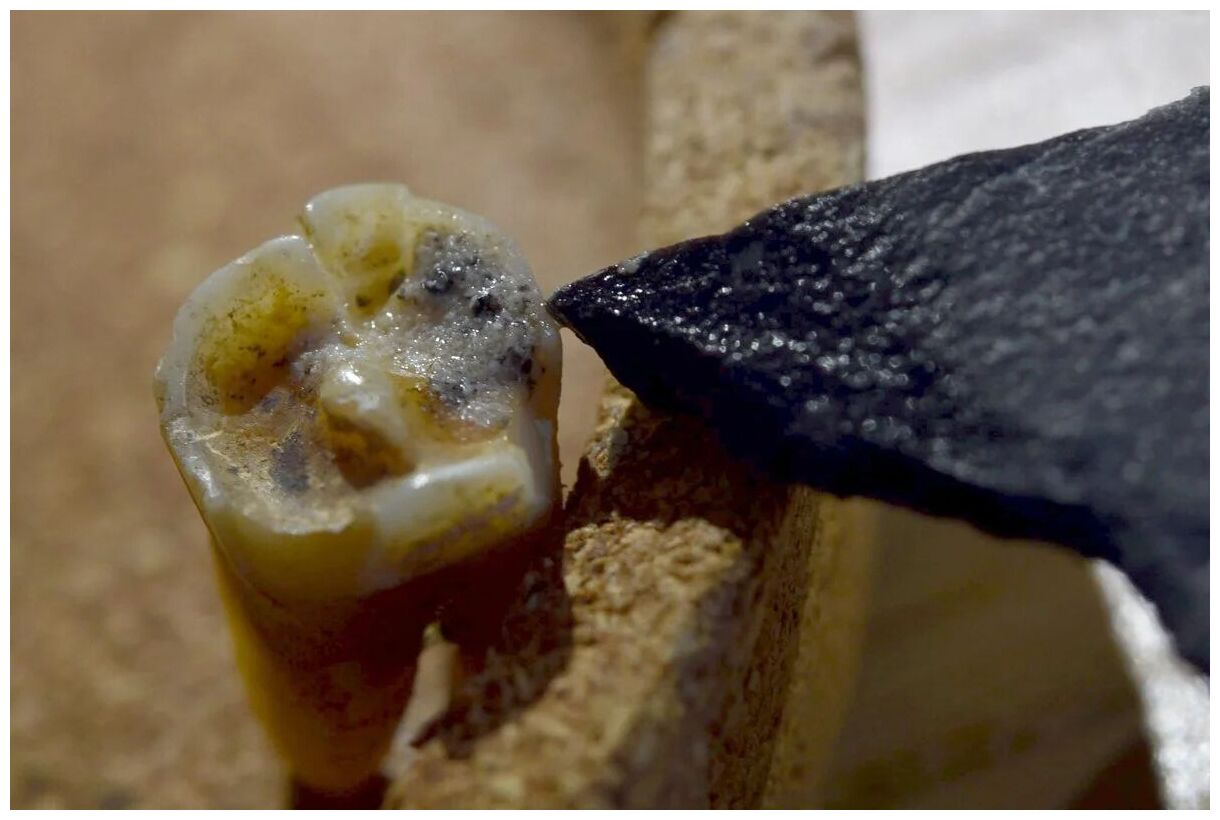
Researchers examined a lower molar recovered from Chagyrskaya Cave in the Altai Mountains of southern Siberia. The tooth, labelled Chagyrskaya 64, belonged to an adult Neanderthal who lived roughly 59,000 years ago.
What caught the attention of researchers was a large cavity cut deep into the chewing surface of the molar. After analysing the tooth under microscopes and carrying out CT scans and drilling experiments, the team concluded the hole was probably made deliberately using a sharp stone tool.
The cavity reaches into the pulp chamber and contains a series of grooves and microscopic scratches that the researchers say are difficult to explain through natural wear alone.
"The morphology of the depression suggests intensive dentin removal," the authors wrote, arguing that the work was likely aimed at exposing or clearing diseased tissue inside the tooth.
The molar already showed signs of severe decay. CT scans revealed areas of demineralised dentine extending through the crown and root canal system, consistent with advanced caries. The researchers argue that ordinary tooth wear could not have produced the unusual shape of the cavity, particularly its widened upper section.
To test how the marks may have formed, the team recreated the process on modern human molars using small jasper tools similar to those found in the cave's archaeological layers.
They found that scraping had little effect during the early stages, while rotating a pointed stone tool by hand cut into the dentine much more efficiently. The experimental drilling produced grooves and fine parallel striations comparable to those preserved inside the Neanderthal molar.
In some cases, researchers reached the pulp chamber in less than an hour.
The tooth also preserves evidence of repeated toothpicking. A groove along the side of the molar appears to have formed through repeated insertion of a thin object between the teeth, possibly to remove trapped food or relieve irritation.
Toothpicking has been documented before in Neanderthals and earlier human ancestors, but the authors argue the Chagyrskaya molar goes further because it appears to combine two separate responses to dental pain.
The cavity itself consists of three overlapping depressions. Researchers believe at least two of them penetrated the pulp chamber, while the third may represent an earlier attempt or a less effective pass with the tool.
There are also signs that the individual continued using the tooth after the procedure. The edges of the cavity are smoothed and polished, suggesting the molar remained in function for some time afterwards.
That detail is important because it shows the modification happened during life rather than after burial.
Until now, the oldest recognised evidence for treatment of dental caries came from a modern human site in Italy dating to around 14,000 years ago. In that case, researchers identified scraping marks on decayed enamel made with stone tools.
The Siberian tooth is far older and appears to involve deeper drilling into the dentine itself.
Neanderthals have long been associated with care for injured or elderly members of their groups, but direct evidence for medical treatment has remained rare. Earlier studies have suggested they may have used medicinal plants and carried out basic forms of dental cleaning, though researchers continue debating how much planning and understanding those behaviours involved.
The authors of the new study believe the Chagyrskaya tooth points to a more deliberate procedure. Carrying it out would have required fine hand control, careful use of tools and a willingness to endure pain.
Chagyrskaya Cave is one of the most important Neanderthal sites in North Asia. Excavations have uncovered more than 70 Neanderthal fossils along with stone tools linked to the Micoquian tradition, a technology associated with late Neanderthal populations across parts of Europe and western Asia.
Genetic work has already shown that the Chagyrskaya Neanderthals were closely related to European groups rather than earlier populations from nearby Denisova Cave.
Researchers say the new findings add to growing evidence that Neanderthals possessed more complex technical and behavioural abilities than they were once given credit for.
While questions remain about how common such procedures may have been, the Chagyrskaya molar offers a rare glimpse into how one Neanderthal may have tried to deal with serious tooth pain nearly 60,000 years ago.
Sources : PLOS ONE - Zubova AV, Zotkina LV, Olsen JW, Kulkov AM, Moiseyev VG, Malyutina AA, et al. (2026) Earliest evidence for invasive mitigation of dental caries by Neanderthals. PLoS One 21(5): e0347662. https://doi.org/10.1371/journal.pone.0347662



Reader Comments
Were they charged for missed appointments too?
Bet ya there was no fluoride found in the sample.