
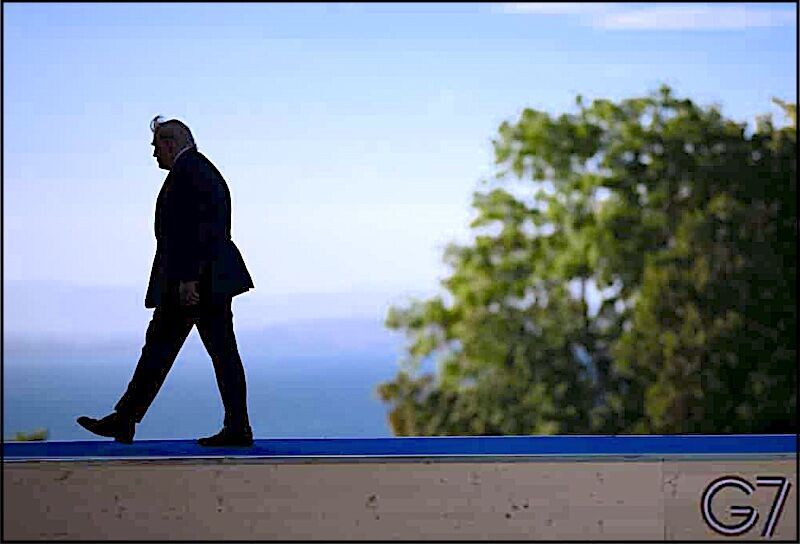
© Official White House Photo • Daniel TorokUS President Donald Trump • G7 • June 15, 2026 • Évian-les-Bains Commune • Auvergne-Rhône-Alpes, France
There is a concerted effort to undermine a potential peace deal with Iran. That is not surprising. What is concerning about it is that it is not only coming from the pro-Israel right but also from liberals and some parts of the progressive left.
There needs to be a sober assessment of the potential deal on the table, which is far from concluded. Right now, that isn't what we're getting.
The Memorandum of Understanding (MOU) commits to only a few specifics. The rest is aspirational and depends on talks between the U.S. and Iran. There are many pitfalls, including the fact that, to the extent that any deal includes sanctions relief, the law gives Congress the potential to torpedo it.
As things stand now, there's every reason to believe it will do so, and that is because Democrats are not only blasting the deal while grudgingly accepting it as necessary to end the war, but they're being supported by liberal and even some more left-wing discourse in doing so.
Is Iran getting too much?
Iran has enormous leverage that it did not have before. That means American concessions are inevitable. They have the power to close the Strait of Hormuz, and neither threats nor protestations, from enemies or allies, can dissuade Iran from using that leverage. They refrained from playing that card for decades because the threat of doing so deterred the United States from attacking it or supporting Israel in doing so.
Now that such an attack has happened, twice, that card is fully in play, and there's no putting it back in the deck.
But while that reality dictates some concessions, some will ask whether it justifies the package that the MOU potentially promises.
The MOU addresses the lifting of sanctions, the redeployment of American forces from the Gulf, the unfreezing of Iranian assets, and a fund for rebuilding both Iran's infrastructure and its economy.
Most of the American political leadership and punditry — even including left-wing comedians, such as Jon Stewart or John Oliver, where so many Americans get their news these days — have ridiculed this deal, implying, or even outright stating, that Iran is getting too much.
Take the comments from Chris Murphy of Connecticut, for example. Murphy is more reasonable than most members of Congress on foreign policy, and he grudgingly accepts the deal as the inevitable consequence of losing the war. But he still considers it overly generous to Iran. Murphy said in his June 17 statement on the Senate floor:
"I knew the deal was likely going to be humiliating for the United States of America, but I didn't know it was going to be this humiliating. I didn't know the deal was going to be this bad."Murphy argues the war was such a disaster that he is "prepared to swallow basically any deal to end (it)." He then rails about how awful the deal is.
For Murphy, and most Democrats, the idea that sanctions would be lifted from Iran, that it would be granted access to its own money, and that it would be allowed to defend itself is an intolerable prospect that they are forced to accept on pain of an unprecedented global economic meltdown.
Murphy argues:
"[W]e went to war with Iran for 100 days, and on the back side of it, they still have their nuclear program, they still have their missiles, they still have their drones, they're still supporting terrorism. It didn't work, and most of us knew it wasn't going to work. Most of us said that if you go to war with Iran, we will end up in a worse position, and here we are in a fundamentally worse position. The entire scope of this agreement basically boils down to a multi-billion-dollar payment to Iran, so that Iran opens the Strait of Hormuz. What a disaster that is."Other, more moderate Democrats have also expressed reservations about the deal. Cory Booker, for instance, said, "Let's be clear. I do not support this deal that he made, which was an abject surrender." Figures like Richard Blumenthal, Adam Schiff, and Seth Moulton have echoed Booker.
Elizabeth Warren, considered among the most progressive among U.S. senators (although that is a very low bar), also criticized the deal, saying that:
"Iran would end up in much better financial shape than they were on the other side of it. I'm still waiting for the part that explains how the American people are better off."In that framing, it certainly sounds disastrous. But that framing does not entirely reflect reality.
Sanctions relief
Iran was first sanctioned mere months after the start of the Iranian revolution and the seizure of the American embassy in 1979. In 1995 and 1996, Bill Clinton instituted a series of trade sanctions on Iran that not only closed off all U.S.-Iran trade but also imposed penalties on any firms making major investments in Iran. This was contemporaneous with the rising concerns about "weapons of mass destruction."
Both Iran and Iraq (which had, when it was a U.S. ally, developed WMDs) were accused of pursuing WMDs as part of the strategy of "dual containment," in which sanctions played a key role. But Iran had not developed such weapons until Iraq used them against it in their war, and has abandoned all WMD programs since then.
In December 2006, the UN Security Council imposed nuclear sanctions on Iran after Iran refused to heed a call to cease all enrichment of uranium and had been found to be enriching in secret.
The following year, the American National Intelligence Estimate (NIE) concluded, for the first time, that Iran had halted all efforts toward a nuclear weapon in 2003.
Two crucial points need to be made about this:
One, every subsequent NIE has confirmed that Iran never restarted a nuclear weapons program.It has never been proven that Iran ever sought WMDs at all, aside from their retaliatory and long since abandoned chemical weapons program in the 1980s. Yet despite that fact, UN sanctions were tightened in 2007.
Two, and less commonly known, is that it is not clear that Iran was pursuing an actual weapon rather than what is known as "breakout capacity," wherein a state can quickly produce a nuclear weapon. Japan, South Korea, Germany, Brazil, Australia, and Taiwan all have that capacity.
Concurrently, the U.S. and its allies froze over $100 billion worth of Iran's assets.
Yet Chris Murphy thinks these freezes and sanctions should not be eased. Most of his colleagues take even stronger positions.
In fact, regardless of the war, these sanctions are unjust and counterproductive. They cripple the lives of ordinary Iranians and have done nothing, for 47 years, to alter Iran's policies. They were built on anger at Iran for the hostage crisis, irrational fear, and hysterical propaganda that was not at all limited to the rantings of neoconservatives.
Iran's right to self-defense
Some of the sanctions are connected to Iran's arbitrary designation as a "state sponsor of terror," a phrase which is often invoked to claim that Iran leads the world in this regard.
The entire accusation is of dubious merit.
There is no doubt that Iran sponsors militias of various kinds. But the United States has supported rogue militias in Iraq, Afghanistan, and Syria just in recent years, building on a legacy of supporting Cuban insurgents and criminal militias such as the Contras in Nicaragua, among many others. That's not to mention the support it gives to some of the most draconian governments in the world, as well as ignoring allies such as United Arab Emirates as it funnels weapons to the Rapid Support Forces in Sudan. The list goes on, even if we don't consider Israel and its genocide and other major crimes against the Palestinians.
The point is that what we dismissively, and incorrectly, refer to as Iran's "proxies" are no different in kind than many armed groups we support or allow others to support. Indeed, whatever one thinks of Hamas or Hezbollah, it was the United States that created groups like ISIL and al-Qaeda through our support of armed insurgencies in Afghanistan, Iraq, and Syria.
Iran has suffered these sanctions based on a double standard and sheer hypocrisy.
For all the paranoia about Iran's "malign influence," the Islamic Republic has never attacked another country. Iran has been far more responsible in its handling of the weapons it has than either the United States, Israel, Saudi Arabia, or the UAE.
Given all of that, it is only just that Iran should be able to maintain its ability to defend itself; pursue its own foreign policy interests in competition with other powers; sell its oil and other products freely on the global market; recover its frozen assets; and be compensated for the enormous damage needlessly inflicted on its infrastructure by a mendacious American-Israeli attack. Losing a war, especially an unprovoked war of choice, started with a surprise attack, has consequences. The ones the MOU proposes are just and rational.
The practical argument
But this is about more than doing what's right.
There is an unprecedented opportunity at hand, one even stronger than the opportunity presented by the JCPOA, for reducing regional tensions and promoting cooperation.
In 2015, it was not only Israel that was kicking and screaming over the JCPOA. Though its influence in Washington and, at that time, with the American public made Israel the logical choice to try to undermine the deal, the Gulf Arab states, especially Saudi Arabia, were just as passionately opposed to the deal as Israel was.
That simply isn't the case now. Qatar has been instrumental in mediating the talks, and Saudi Arabia, along with Egypt and Pakistan, has worked behind the scenes to build regional support for it. Even the UAE has fallen silent.
The change is due to a realization among Gulf Arab states that they need to find an accommodation with Iran. There will always be competition and tensions. There are interests that sometimes conflict, as well as cultural, ethnic, and even religious differences.
But the Gulf states know there is no military option with Iran; there is only a diplomatic one. Iran has always taken a posture of avoiding war whenever possible. This is why the United States stands at a crossroads.
The GCC countries, Iraq, and Iran all have a stake in regional stability. Iran sometimes upsets that, as the one state in the region that has a revolutionary ideology that it exports.
But Iran is pragmatic, as they have demonstrated quite clearly throughout the past year of war. The image of a fanatical, even suicidal state, always completely wrong, has been exposed for the sham it is.
An Iran that can develop freely will be much more inclined to use its relationships, rather than force by its allies, to pursue its goals. Such an Iran can become a partner in the region, following the process that was showing gradual progress between Saudi Arabia and Iran before the war.
An Iran that is no longer in a cold war with the United States will allow the U.S. to remake its posture in the region. This, of course, is exactly what Israel fears more than anything else, as such a reorientation must inevitably lead to a normal, rather than a special relationship between it and the United States.
Iran can work with the Arab League to renew an offer akin to the Arab Peace initiative of 2002, coordinating it with Palestinians it knows well, including Fatah, Hamas and all parties, to update it according to Palestinian desires, and put it back in the diplomatic arena with the weight of most, perhaps all, of the Arab states behind it. Combined with a different American posture, that offers a peaceful path to realizing Palestinian rights at long last.It is entirely possible that Iran has something like this in mind for the long term. They clearly are leaving the question of Palestine for a later date in order not to overplay their hand, but it is likely that they have a long-term plan to address it.
All of this is possible under the terms of the Trump MOU. It is a long way from where we are today to that kind of future, but that's the future that ending this standoff with Iran could lead to. If that holds appeal for progressives, we should stop denigrating the deal Trump so clumsily, but fortunately, stumbled into.


Comment: Israel captured the US long ago. Iran: The wake-up call.