
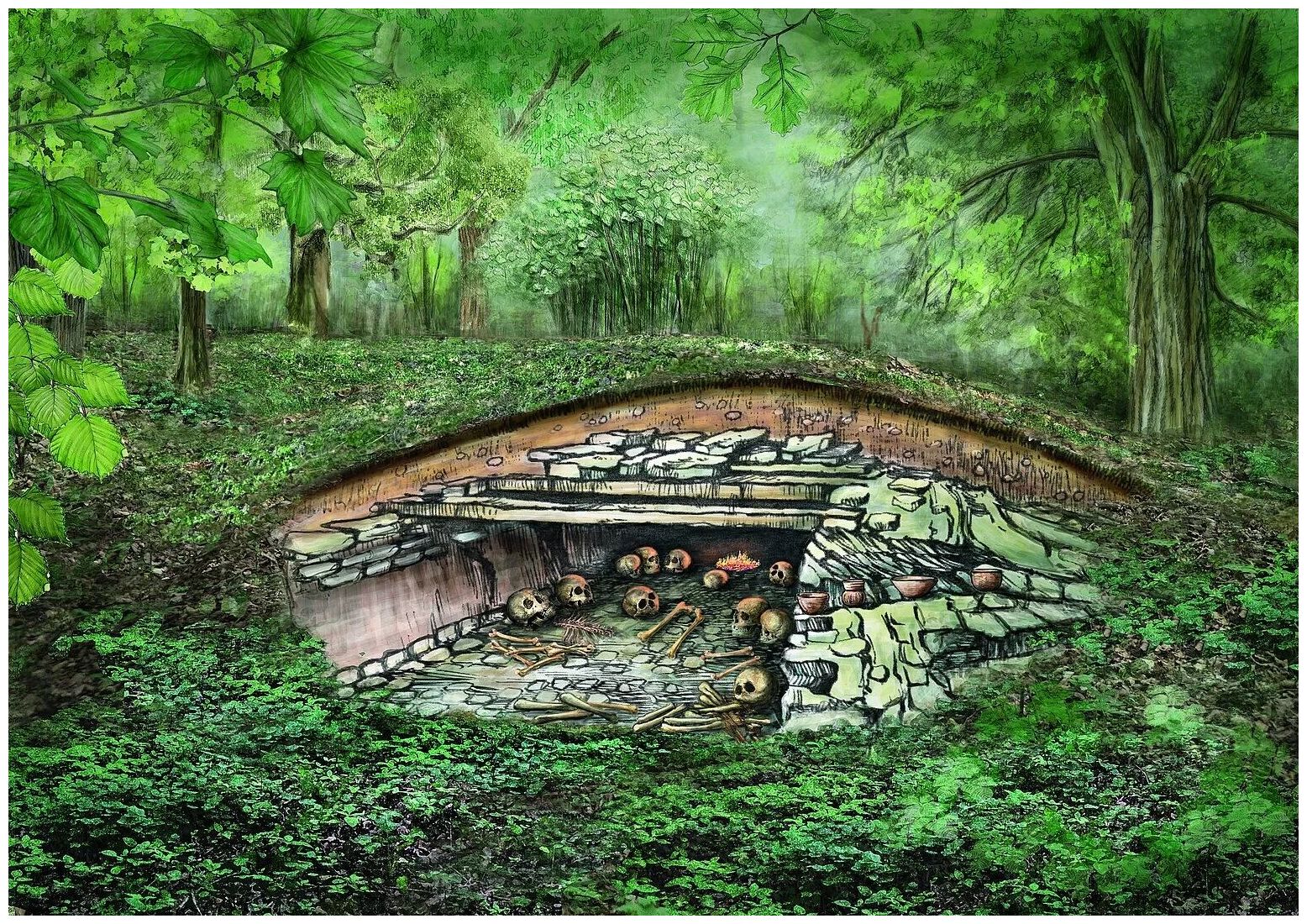
© Susanne Beyer, Inst. UFG/Uni KielAround 3100 BCE, the Sorsum megalithic tomb served as a communal burial site for local farming communities. Genetic analyses now reveal that among those buried there was, among others, the son of a family from the Wetterau region, located approximately 250 kilometers to the south.
Impressive and still a mystery
The Neolithic period marks a fundamental turning point in human history. For the first time, communities settled down and practised agriculture and livestock farming. Between 3600 and 2800 BCE, early farming communities in Central Europe also erected monumental architecture structures and burial chambers from massive stones, known as megalithic sites.
"Where they have survived, these structures continue to be impressive to this day. At the same time, this fascinating era still presents us with many mysteries. How did megalithic architecture spread across Europe? Was a specific population group responsible for this and did they spread the idea? Or was the concept of megaliths passed on from group to group? How far did the contacts between the individual communities extend? And who was actually buried in these tombs?", questions Professor Johannes Müller, prehistoric archaeologist at the Institute for Prehistory and Early History of Kiel University (CAU) and co-author of the study.
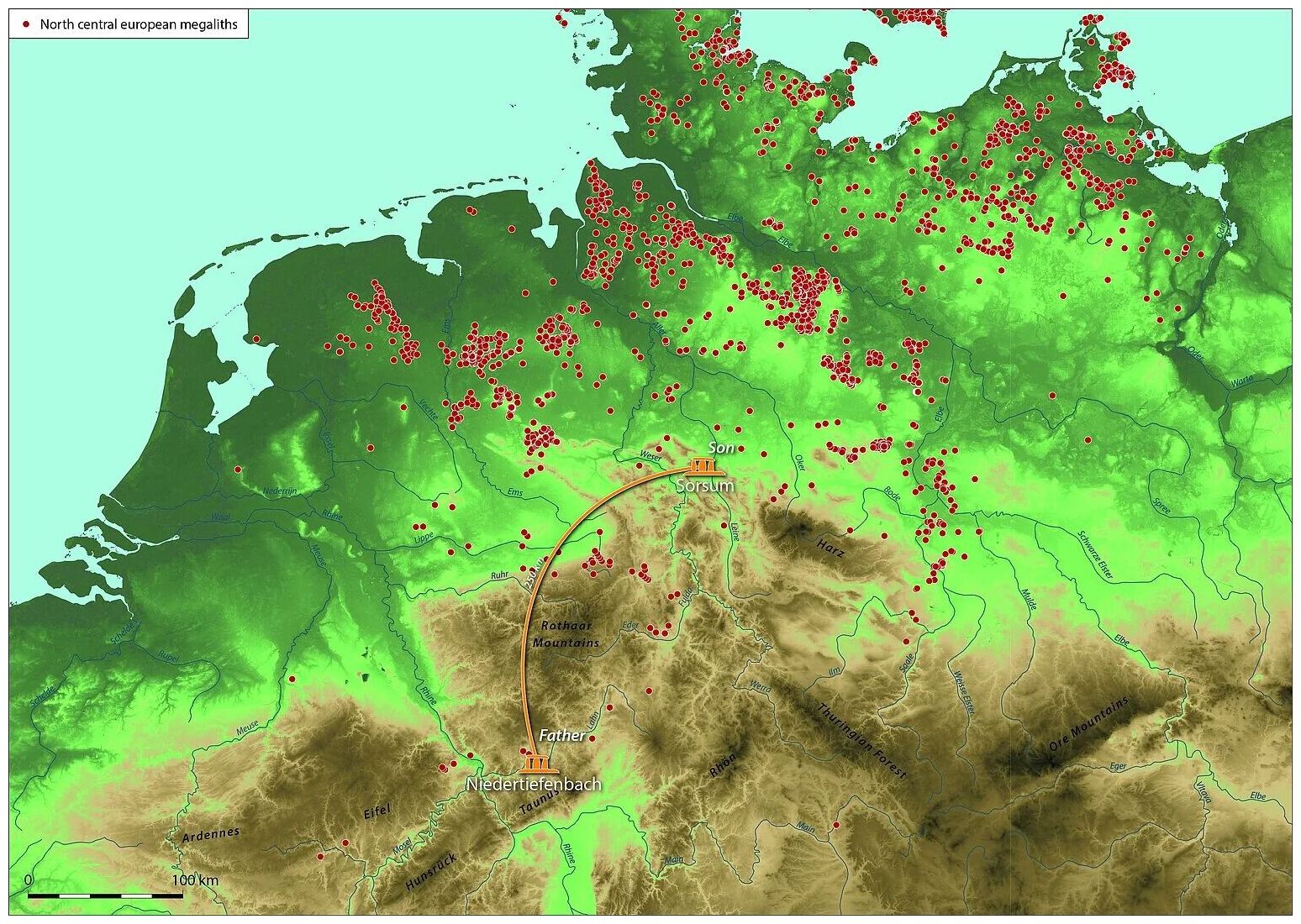
© Ralf Opitz, Inst. f. UFG/Uni KielMap of Neolithic megalithic tombs in Northern Central Europe. Using DNA analysis, researchers were able to identify the various relationships within six gravesite complexes of the Wartberg culture in present-day Lower Saxony, Hesse, and North Rhine-Westphalia. One particularly spectacular finding: at the Sorsum site, the son of a man was buried whose bones were found at the Niedertiefenbach site. The two sites are located about 250 kilometers apart.
To get closer to answering these questions, the participating scientists analysed aDNA from the bones of a total of 203 Neolithic individuals. The remains come mainly from megalithic tombs of the so-called Wartberg culture in what is now Lower Saxony, Hesse and North Rhine-Westphalia.
The analyses show that people buried in the same megalithic tomb were not necessarily biologically related. "Social ties also appear to have played a role in determining who was buried together in a tomb. This is surprising. Studies of megalithic tombs in Ireland or Sweden suggest communal burials of biological nuclear families," explains co-author Professor Almut Nebel from the IKMB, "In the sites we investigated, we are evidently dealing with graves of patchwork communities."
Several hundred kilometres in a single generation
These Neolithic patchwork communities were, moreover, significantly more mobile than previously assumed. In the megalithic tomb at Sorsum, the northernmost of those examined, a young man was buried whose biological father had been buried in the megalithic tomb at Niedertiefenbach - 250 kilometres further southwest.
"We do not know whether the son lived in Sorsum or was staying there as a traveller. However, we now know that people covered distances of several hundred kilometres within a single generation - long before domesticated horses were used as a means of transport in Central Europe," says Ben Krause-Kyora.
Not only the father-son pair, but other data from the study also shows that close relatives often lived and died far apart. Girls and women proved to be particularly mobile. Previous studies had assumed significantly smaller ranges of movement over a lifetime during the Neolithic period.
Diversity in the Neolithic period
Furthermore, the team compared the DNA from the examined graves with previously published analyses from Western Europe. This revealed that the Wartberg communities did not belong to the same populations as other groups in Western Europe who built megalithic tombs. "This in turn suggests that the custom of erecting monuments from large stones was culturally disseminated - not through direct migration," explains Dr Nicolas da Silva from the IKMB, the study's lead author.
"The more data we have from the Neolithic period, the more diverse the picture of early farming communities in Europe becomes. Following these new investigations, at the very latest, we must also rethink our understanding of family structures and mobility patterns in prehistory," says ROOTS co-speaker Johannes Müller, summarising the findings.



Reader Comments
Hmm...
This is exhausting me.