
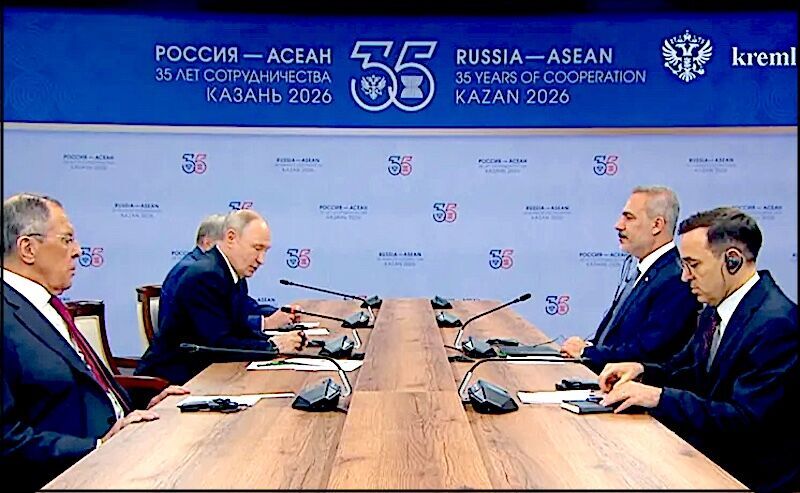
© Unknown1 Russian President Vladimir Putin • Foreign Minister Sergey Lavrov • Turkish Foreign Minister Hakan Fidan Kremlin, Russia
The Overall Dynamics of Turkish-Russian Relations
Since the early 2000s, Russian-Turkish relations have undergone drastic changes, evolving from a simple regional neighbourhood into an active strategic partnership across all azimuths of interstate ties - including the economy, especially energy, tourism, and construction, as well as culture, politics, and security. The two sides based these transformations on the principles of pragmatism, good-neighbourliness and mutual benefit. Over the course of a quarter of a century, the upward trajectory of these relations has produced a considerable number of tangible results.
On highly favourable terms, Russia built Turkey's first nuclear power plant, Akkuyu, in Mersin, and constructed the second TurkStream gas pipeline, with two branches and an annual capacity of 31.5 billion cubic metres of gas, one of which (15.75 billion cubic metres) transits Turkish territory to countries in Southern Europe. After the well-known sanctions imposed by the Western coalition, the Russian trade market has welcomed numerous Turkish companies and goods.
A particularly notable aspect of our bilateral relations has been active cooperation in geopolitics and security. First and foremost, Turkey throws its support behind the Russian course towards the formation of a multipolar world order, which aligns with Turkish national interests. The Turkish Republic, as the heir to the Ottoman Empire, does not rule out for itself a strategy of revanchism and of reducing its total dependence on the West. In the new century, Ankara has, in fact, revived, in coordination with its oldest ally London, the geopolitical project of 'Turan' as an integral part of the British 'Great Game' in Asia. In the context of a multipolar world strategy, Turkey lays claim to leadership in the Turkic world - that is, to the Turanian pole.
In this regard, Turkey abandoned the tactic of escalating conflict with Russia because the experience of two world wars in the twentieth century demonstrated the futility of such an approach, and replaced it with a partnership that serves its own interests. Turkey's flexible diplomacy has enabled Ankara to achieve substantial successes in relations with Moscow.
Turkey between Russia and NATO
At the same time, despite declaratory criticism of Europe, the United States, and NATO, Turkey both remains a member of the North Atlantic Alliance and intends to expand its diverse ties with the EU.
Neither has the Ukrainian crisis left Turkish partners on the sidelines. On the one hand, Turkey, in accordance with the Montreux Convention regarding the Straits, does not allow NATO warships into the Black Sea basin - though Turkey per se, together with the Black Sea states of Bulgaria and Romania, is a member of that alliance; Ankara has not officially joined Western economic sanctions against Russia, pursuing its own advantage; Turkish diplomacy seeks to act as a mediator in the negotiation process between Moscow and Kyiv, and the Istanbul platform for Russian-Ukrainian talks has become a reality. On the other hand, Turkey provides military-technical support to the Kyiv regime and backs the strengthening of the Crimean Tatar ethno-political factor in Crimea.
Nevertheless, the format of Russian-Turkish partnership ties is developed to such an extent that the parties, while maintaining divergent stances on a number of complex geopolitical issues, nevertheless find resolutions and, through economic links, attempt to smooth over disagreements.
What Motivated the Two-Day Visit of Turkish Foreign Minister H. Fidan to Russia?
On 16-17 June, the Turkish Foreign Minister made a working visit, first to Moscow and then to Kazan, for negotiations with his Russian counterparts. The length of the trip and the numerous meetings Hakan Fidan held with Russian partners - including President Vladimir Putin - indicate that this visit was by no means accidental and covered a comprehensive range of bilateral and regional issues.
In Moscow, the Turkish guest held intensive talks with Russian Foreign Minister Sergey Lavrov, Security Council Secretary Sergey Shoigu, Presidential Aide Vladimir Medinsky, Presidential Adviser Igor Levitin, and Turkish businessmen, having also been awarded an honorary doctorate from MGIMO University. The sides have obviously touched upon many subjects, including the Ukrainian question, regional agendas for the South Caucasus, Central Asia, and the Middle East. On the instruction of Turkish President Recep Tayyip Erdoğan, Fidan requested a meeting with President Putin. On the margins of the anniversary summit in Kazan marking thirty-five years of Russia's relations with ASEAN members, Hakan Fidan's meeting with the Russian President did take place.
The Turkish chief diplomat received a high-level reception and respect in Russia, which corresponds to the level of Russian-Turkish partnership and possibly reflects particular attention to Hakan Fidan personally. The latter possesses many years of experience in contacts with Russian colleagues in his capacities as head of Turkish intelligence and diplomacy.
Through all the official channels, it was outlined that the key topic of Hakan Fidan's negotiations in Russia was the conflict in Ukraine. Turkey once again confirmed its willingness to act as a platform for resuming talks between Moscow and Kyiv. However, this Turkish proposal is hardly big news. Moreover, the platform per se does not determine the course of negotiations, let alone their outcomes. Still, credit must be given to the Turkish side for providing comfortable conditions and security arrangements for the negotiation process.
Turkey advocates for Armenia's swift accession to the 'Greater Caspian' project (C5+2) for a large-scale outlet into Turan through the Zangezur Corridor project, the so-called 'Trump Road.' In this regard, Russia and Turkey may hold divergent positions, because otherwise Turkey and the West would come to dominate Russia's southern and south-eastern borderlands - that is, the South Caucasus and Central Asia. It is possible that Erdoğan is embarking on yet another round of bargaining, reminding Russia of calm in the Black Sea in exchange for access to the Caspian.
In any case, Russia is ready for a fruitful partnership with Turkey, taking due account of its own interests.

Reader Comments