
Western Europe is hot this week because the jet stream has locked into an omega block.
Eastern Europe and Scandinavia, by contrast, have held cool. The 500 hPa setup shows a large high-pressure ridge over western and central Europe, boxed in by lower pressure to the east and west. The flow bends into the shape of the Greek omega.
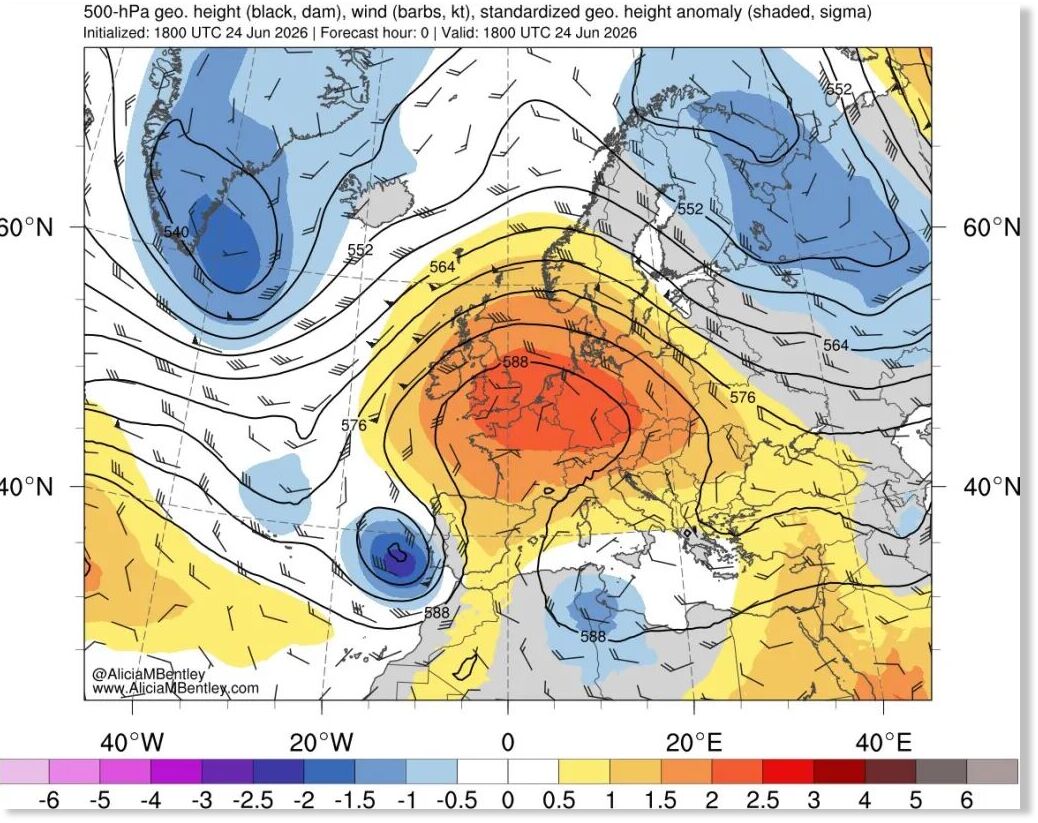
This is a circulation event. Not a "climate emergency". And western Europe is not the globe. While France and the UK bake, cool anomalies sit across the High Arctic, North America, parts of Asia and Australia, South America, the Southern Ocean and Antarctica.
As for the records, the UK Met Office shouldn't be trusted.
Early week, the media cycle, fueled by the office, leaned heavily into 39C to 40C. Fingers hovered over red "Danger To Life" alerts. But Wednesday's high, by the Met Office's reckoning, came in at 36.1C (97F) at Gosport Fleetlands.
That made for a new June record for the UK, but Gosport is a poor place to hang a national climate headline. The station is an automatic site at Fleetlands, a low-level heliport and aviation maintenance site. Station-audit material lists it as installed in 2011, so the site has no long June climate record behind it. It is also reported as a Met Office CIMO Class 3 temperature site, not a pristine Class 1 reference station. Class 3 is known to give error readings of up to 1C.
Netweather's top 20 list from Wednesday is dominated by aviation sites. No less than 16 of the top 20 readings came from airports, airfields, RAF bases or aviation-linked weather centers: Heathrow, Hurn/Bournemouth Airport, Charlwood, Middle Wallop, Jersey Airport, Boscombe Down, Southampton Weather Centre, Gatwick, Exeter Airport, Fairford RAF Base and Farnborough.
If national records are sold to the public by tenths of a degree, stations deserves scrutiny.
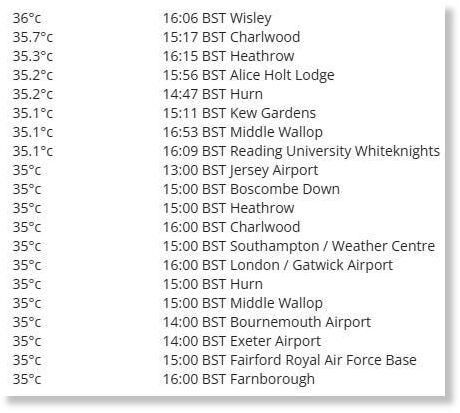
Hottest temperatures in UK on June 24, 2026 [netweather]
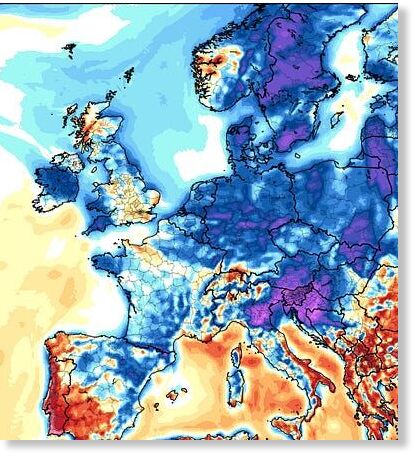
Looking ahead, the ridge weakens and Atlantic influence pushes back into Europe by early July.
Outputs are showing anomalously cool temperatures dominating by July 5, but the media won't care about that.
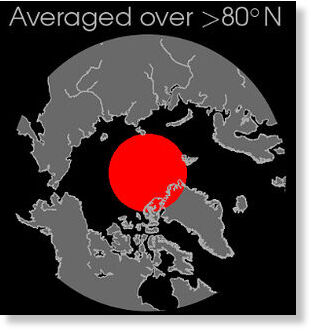
Nor is it reporting on the record-cold run over the past six weeks (and counting) in the High Arctic (+80N):
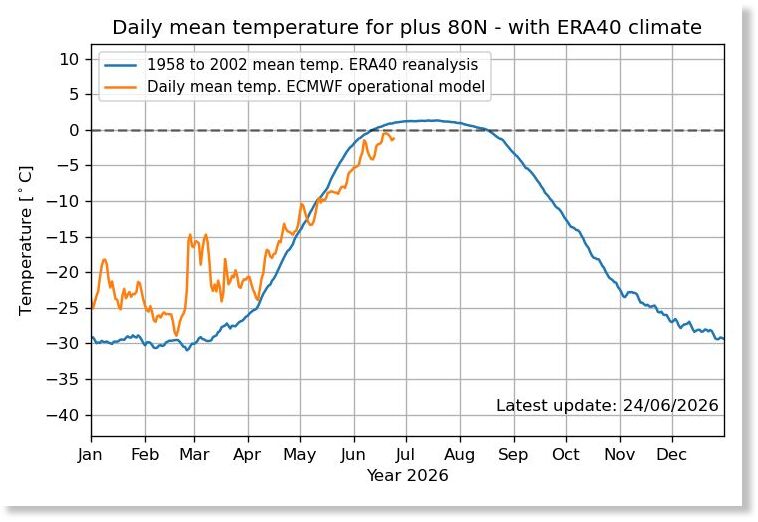
Daily mean temperature and climate north of the 80th [DMI]
The planet is NOT burning up. And despite the headline heat in Europe, global temperatures actually fell on Wednesday (from 0.325C to 0.285C vs 1991-2020):
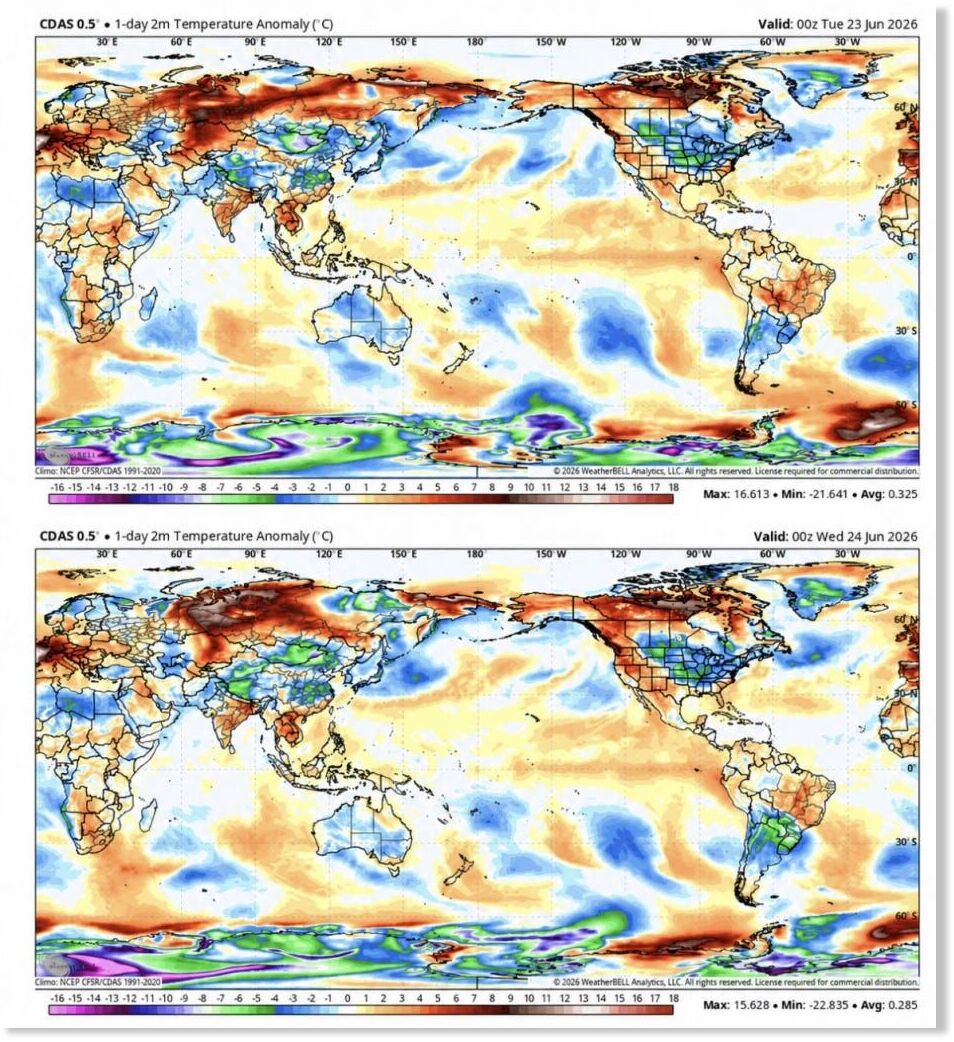
Global temps fall (CDAS).
While western Europe gets the red-map treatment, the western United States is forecast to plunge into summer cold.
By Sunday, the ECMWF shows a broad cold pool running from the Pacific Northwest down through California, Nevada, Utah, Arizona, Idaho, Montana, Wyoming and the Rockies, with large swathes crashing 16C below normal:
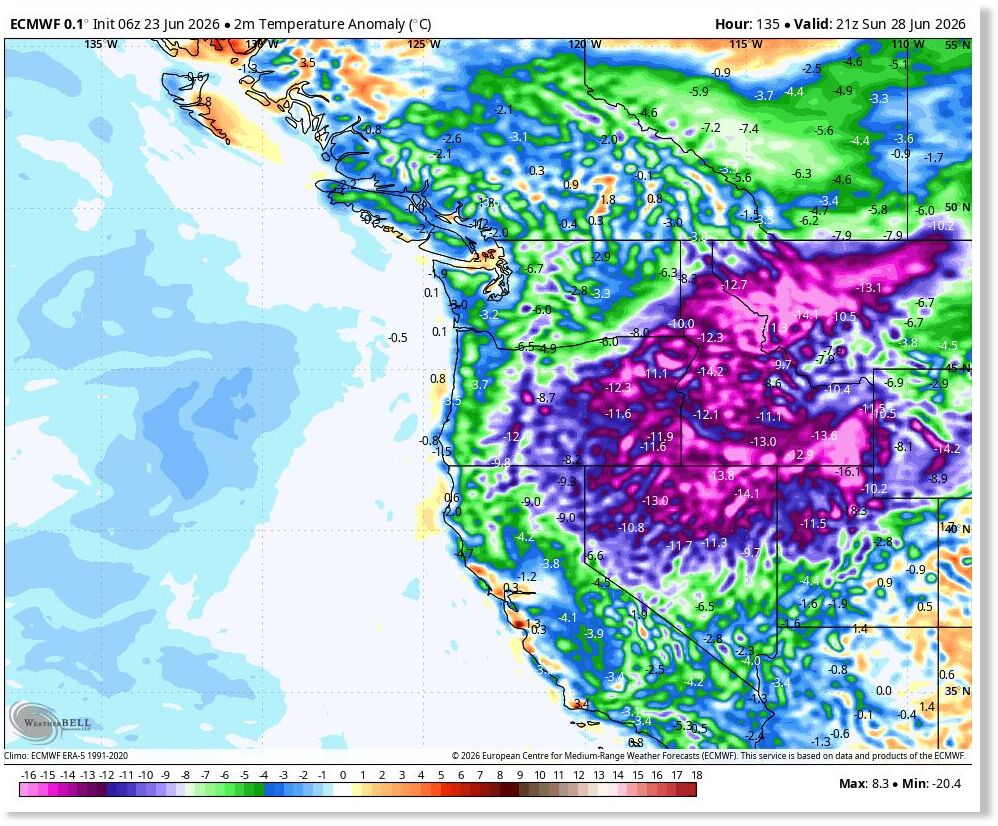
ECMWF western U.S. cold anomaly map.
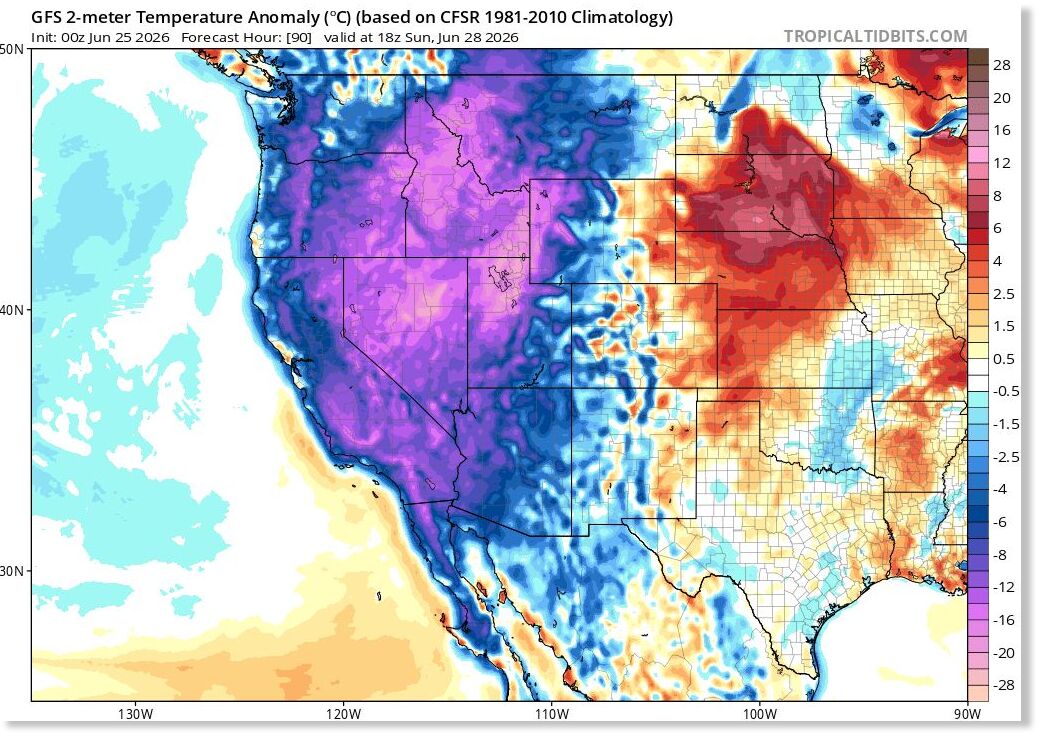
GFS 2m Temperature Anomalies (C) for June 28 [tropicaltidbits.com]
Note: The western U.S. is larger than the area gripped by heat in western Europe.
Note: The media again won't care.
The mechanism is just as simple....
A ridge over western Europe is dragging African air north and compressing it under sinking high pressure. A trough over the western U.S. is dragging colder Arctic/Pacific air south, lowering heights, lifting air and turning late June unstable.
Records will be under threat come the weekend. But this event will not be sold like the European heat.
Falling Seas Kill Reefs
A new Global Change Biology study from the northern Red Sea points to a harder problem than rising water: falling water.
Researchers drilled reef cores from the Gulf of Eilat/Aqaba in the Red Sea and found that coral growth began at least 6,700 years ago, during the mid-Holocene, when global sea level stood around 2-3 m (6.6-9.8 ft) higher than today.
At Eilat, coral growth continued for the next 2,000 years, until around 4,500 years ago, then largely stopped for thousands of years due to falling sea level. As the sea fell, the authors explain, reef flats became squeezed. Some areas were exposed. Others were left too shallow or too cramped for continued growth. Receding sea levels caused mass mortality among the corals.
And this was not just a local oddity.
The paper identifies a broader reef-growth hiatus between roughly 4,000 and 2,300 years before present, with few fossil corals dated from that interval across sites in the Atlantic, Indian and Pacific oceans.
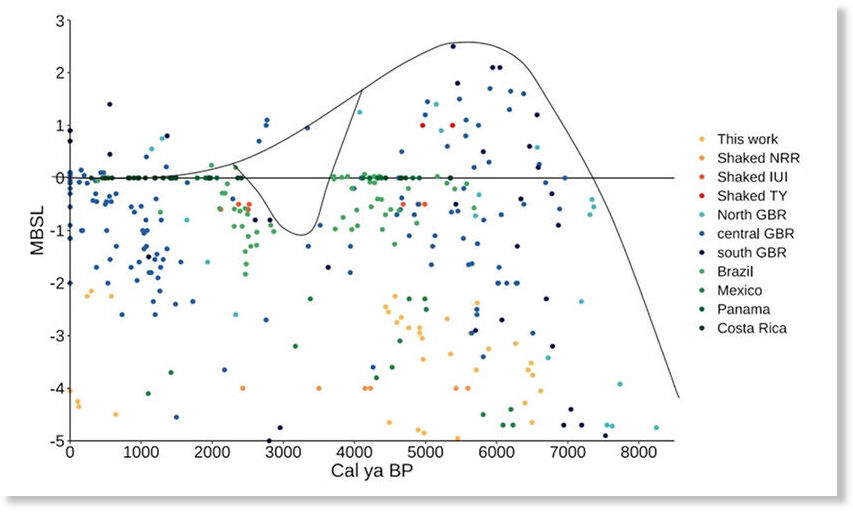
Then, around 700 years ago, the Eilat reef returned. Local subsidence lowered part of the reef flat, creating fresh space for coral growth. The same coral community then re-established after a gap of nearly 4,000 years, likely seeded from deeper reef refuges.
These reefs did not live in a stable ocean, is the point. They grew under higher seas, struggled as seas fell, halted for millennia, and recovered when the seas returned.
The authors go so far as to note that any future sea-level rise will likely give currently constrained reef systems more accommodation space, potentially leading to a significant increase in coral cover.


Reader Comments
to our Newsletter