
© DARPA
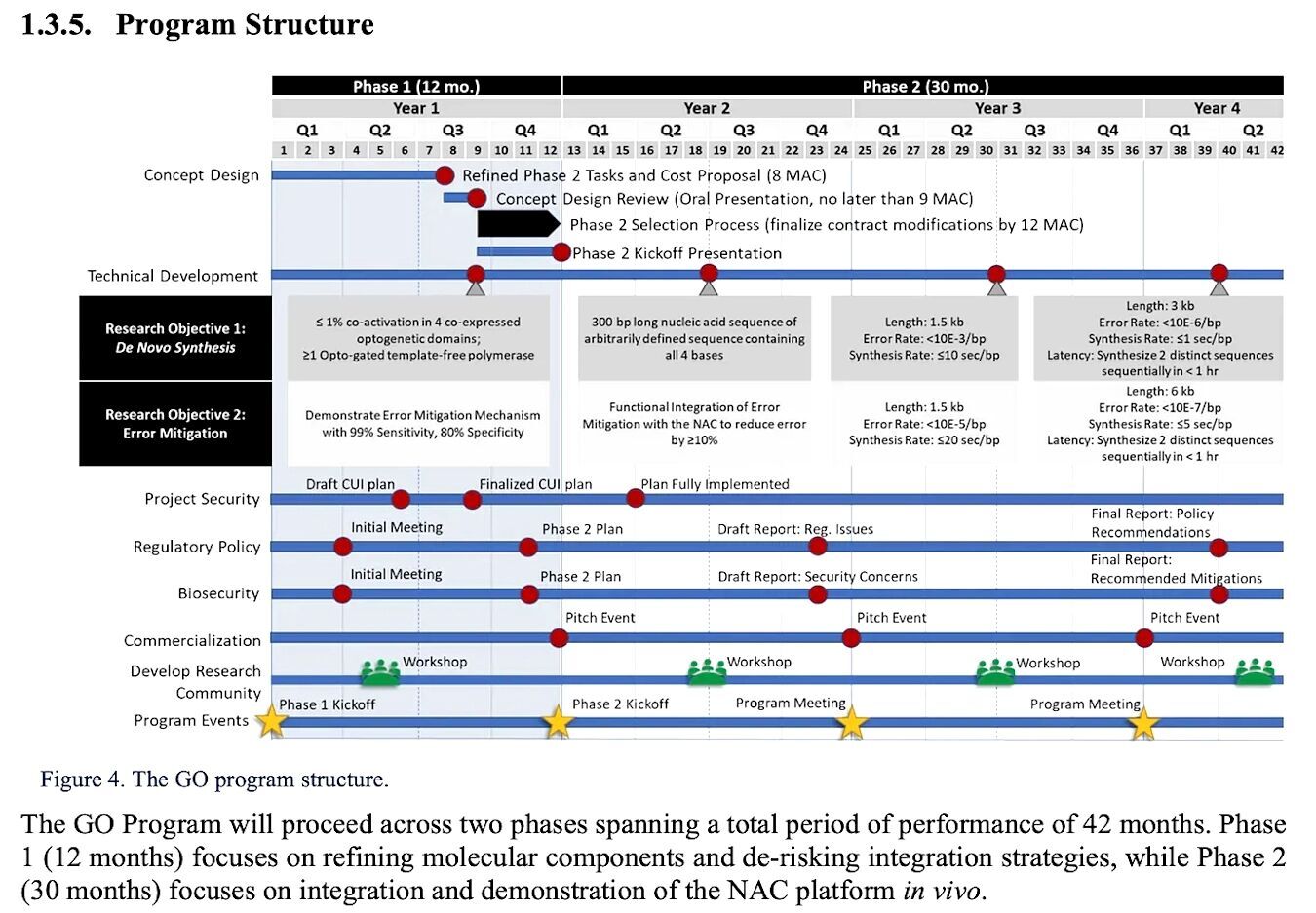
The document I am referring to is an Initial Announcement by the Defense Advanced Research Projects Agency (DARPA) (Biological Technologies Office (BTO)) for a funding opportunity in Generative Optogenetics valued at $1.7M or $1.99M, depending on the research objective selected.1 The announcement was posted on December 19, 2025 and Phase 1 of the project is likely well underway complete with a workshop for interested parties.
© DARPA
To summarize (as I so succinctly did so in this article), optogenetics is the introduction of genes into cells that don't naturally carry them, whereby the resulting proteins, once expressed, can be controlled and monitored with light stimuli in neurons of living brains, heart muscle cells, and cultured cells.
Now, this is all fascinating, but I am not going lie about my hesitancy to get too excited considered this is being done by DARPA. I mean, "Defense" is in the name and they operate under the U.S. Department of Defense. And according to Wikipedia, DARPA has been referred to as "the agency that shaped the modern world", "with technologies such as "Moderna's COVID-19 vaccine ... weather satellites, GPS, drones, stealth technology, voice interfaces, the personal computer, and the internet on the list of innovations for which DARPA can claim at least partial credit."2 You said it.

The logo for DARPA’s Information Awareness Office, which oversaw Total Information Awareness during its brief existence
Back to the document.
The very first line in the document's Program Information Background makes my eyebrows go up, and stay up.
Synthetic DNA and RNA are essential molecules for technologies that address critical global and national security challenges related to resilient supply chains, advanced materials manufacturing, agriculture, and human health.I don't even think that I need to unpack the rest of this document's contents after reading this one statement. I study RNA and DNA. I have for a very long time. I also study proteins. And organisms. And immunopathogenetic mechanisms of deadly viruses. I study pharmacovigilance data. I study medicine. I do it all. And in no way, shape or form do I understand where they are coming from when they state that synthetic genetic material has anything to do with solving "security challenges".
And supply chains? Huh? Oh I see. Long-hauls in space. Got it. Gotta deliver those payloads to Mars!
And human health? In what way DARPA dudes? I am honestly asking. Do you mean like what you did with the nucleoside-modified RNA-LNP-based platform for COVID "vaccines"? Cuz I have a few things to tell you about your platform (it's all peer-reviewed, by the way) concerning why it failed, and why it will ALWAYS FAIL. By the way, the failure extends beyond the GMP violations (also documented) that made these doomed products even more dangerous than they already were. The DNA-related GMP violations are more-so in the context of the Pfizer products (ie: SV40), but DNA was found in all Pfizer and Moderna vials tested to date by many independent labs. It shouldn't be there.
Anyway, allow me to trudge on.
In my view, this program describes taking the human biology out of human biology (even though they mention "operating in-parallel to the central dogma") in order to optimize a system of nucleotide production in cells without the need for the coding template, ie: messenger RNA. So sloppy that messenger RNA! Off with its head!
They write:
No existing technology enables massless information transfer to relay genetic instructions to living cells. All current approaches require some mechanism predicated on moving matter that encodes the genetic information, typically DNA or RNA nucleic acids, across biological barriers like a cell wall/membrane.3Yeah. There's a reason for this.
God, I wish I could understand the hubris of man. It's like some people actually think that the way things work isn't good enough and they seem to perceive it as something they need to fix, and furthermore, they have the audacity to believe that they can engineer this fix! Or pay others to do it for them.
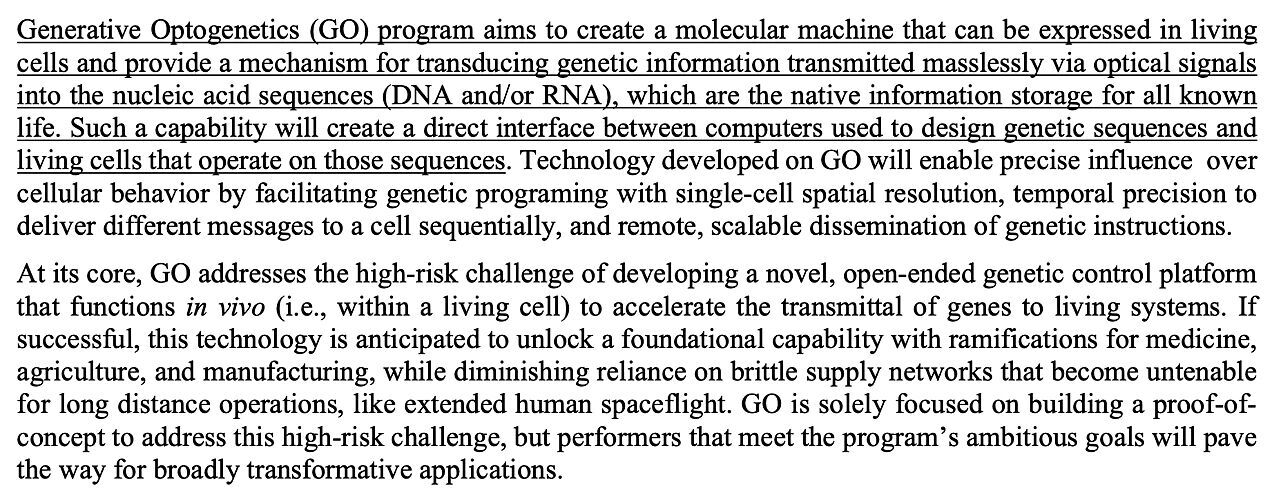
Read it for yourself.
© DARPA
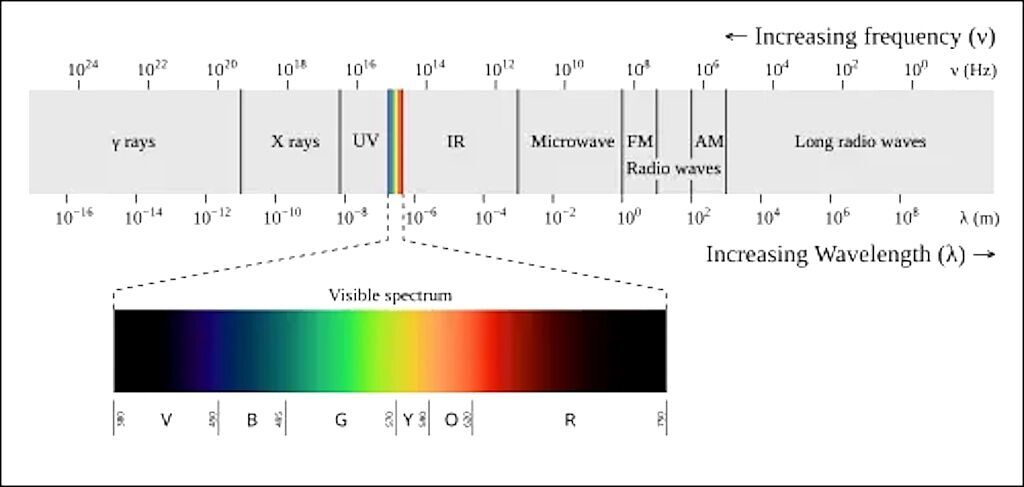
Just in case you need a reminder: light is electromagnetic radiation (EMR). The portion of the EMR spectrum we can see with our eyes is called visible light (roughly 380-750 nanometers). Wavelengths slightly longer than this become infrared and are invisible to us. Wavelengths slightly shorter become ultraviolet and are also invisible.
This signal is transmitted via the optic nerve to the brain, which interprets it as light, color, or form. Remarkably, the entire process - from photon absorption to the onset of the neural signal - occurs in a fraction of a second, and under ideal conditions, a single photon is sufficient to trigger it.
Just stop and think about the beauty of this for a second guys.
We're talking about a photon (an elementary particle - it's not made up of anything else: light is light!) → triggering an electronic excitation of a molecule (electric) → changing that molecule's structure (mechanical) → triggering a biochemical cascade (biochemical) → to send an electrical signal (electric) to the brain → whereby these electrical signals are then interpreted as "images" with color?
Cripes almighty. Why would anyone want to mess with that? This is a beautiful example of the transduction process → converting one form of energy (light) through electronic, mechanical, biochemical, and electrical stages into information that our brains can use. And it all happens extremely fast (in milliseconds). It's so sensitive that a single photon can reliably trigger the whole sequence under ideal conditions.
Back to the document.
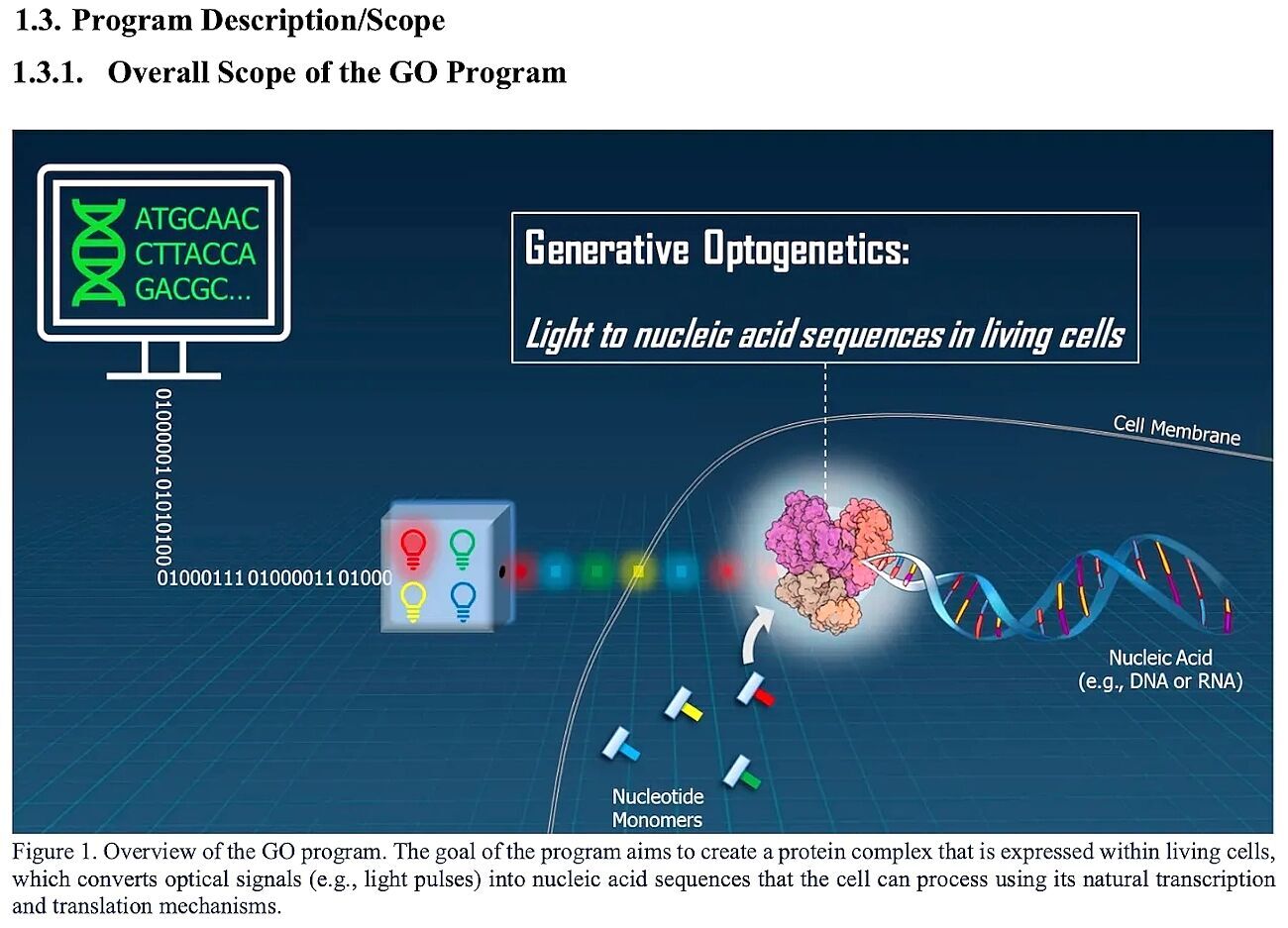
Here's their nice graphical abstract that shows the concept. So very schematically impressive!
© DARPA
The DARPA GO program aims to develop a protein complex, referred to here as a nucleic acid compiler (NAC), that can be expressed within living cells to allow an end user to program genetic instructions into those cells, template-free, using nothing but light to transfer the genetic information to the cells. [2]So if I'm getting this right - and this is quite mind-blowing - they claim to want to use pure code (as light) in place of physical coding material. This begs so many questions. The first I have is what makes them think they can do this? My answer would probably be: They already have. Why else would this technology be being "developed"?
But it's far deeper than application for me.
Pre-existing knowledge by DARPA - even just conceptually - of light as coding material interacting with biological material to instruct non-native protein production, makes me wonder a whole lot about the textbook biology I have learned from and lived with decades. After all, he who controls the textbooks controls the information.
In terms of our little rehash of photons and vision above (why I went over that), DARPA wants to scale this up: they want to engineer entirely new light-responsive protein systems that translate photon patterns into nucleotide sequences in any cell. Even brain cells. Conceptually.
The brain's behavior centers (ie: nucleus accumbens for reward/motivation, amygdala for fear/emotion, prefrontal cortex for decision-making, hypothalamus for drives) rely on specific proteins and gene expression. If NAC worked reliably, you could induce neurons to produce more (or less) of key receptors like dopamine or serotonin receptors, thus altering reward processing, anxiety, aggression, or motivation. You could also express novel synthetic proteins designed to change synaptic strength, excitability, or even create new connections. Over time, this could rewire circuits underlying habits, emotions, learning, or personality traits. I don't like the sound of that at all. It reminds me of mind control but from a much more 'biological' point of entry.
This would be a form of genetic-level brain reprogramming via light, and for now, far more profound than current deep brain stimulation or optogenetics, but what's the endpoint?
I mean, conceptually, in a mad-scientist kind of way, it's brilliant. But seriously, what in the hell will they use it for? What in the hell have they already used it for? I am not even opposed to the development of the technology; I am opposed to the lack of transparency and clear recent historical demonstration of the lack of informed consent when informed consent matters most.
Please understand this. This DARPA program sees light as a direct carrier of genetic code - photons instructing a cell to write its own DNA/RNA. It doesn't break the central dogma inside the cell (in fact they explicitly request the creation of "entire systems that operate in-parallel to the central dogma" as I mentioned), but it adds a radical new input layer: digital/optical → molecular synthesis.
If they are successful, it would demonstrate that genetic instructions can be transmitted and executed without moving matter across biological barriers. It would demonstrate that biology itself can be interfaced with computers far more directly than we currently do, and that "coding" can become photonic and massively parallel, with single-cell resolution.
Light itself as programmable genetic software.
But light regulates our core biology so what are the implications for our core biology? We also emit ultra-weak biophotons so again, what are the implications here? The DARPA dudes explicitly ban any development of the so-called NACs in embryonic stem cells (ESCs), so they seem to understand that things could go really bad, really fast, so I must ask, why do it at all knowing that humans haven't really got a great track record when it comes to experimentation gone wrong.
By the way, ESCs represent the closest thing to a blank slate for building organisms. Pairing them with a tool that lets light write arbitrary genetic code creates an exceptionally high-risk combination: precise, remote, massless genetic authoring in cells capable of generating entire new individuals or lineages. So again, DARPA gets that this - as a lab demonstration - could pivot into an irreversible biological event. So, why are they taking the risk? And why do they get to take this risk for us?
Remember the HIV story? Read The River by Edward Hooper.
I have to wonder (I only alluded to this above), are we, in fact, already "coded photonic beings"? Since vision proves that light is core code for perception, then what are the things that we "see" without the use of our eyes, like when we dream.4
We are "beings of light" in a literal biophysical way: we absorb, transduce, use, and emit photons as part of normal function. Life on Earth is fundamentally powered by sunlight (via photosynthesis or food), and our cells handle photons with exquisite sensitivity. We do not use patterned light to write new DNA sequences on demand (as far as we know) so why are DARPA trying to do just this?
Why are DARPA trying to prototype direct photonic genetic authoring?
And no offense DARPA, but your three appointed advisory and working groups - namely the Biosecurity Working Group (BSWG), the Regulatory Policy Working Group (RPWG) and the Independent Commercialization and Consulting Group (ICCG) - don't put my mind at ease. I have seen too much greed and corruption in "industry" (from economic to medical) to trust that appointed groups will have the best interests of the common person at heart.
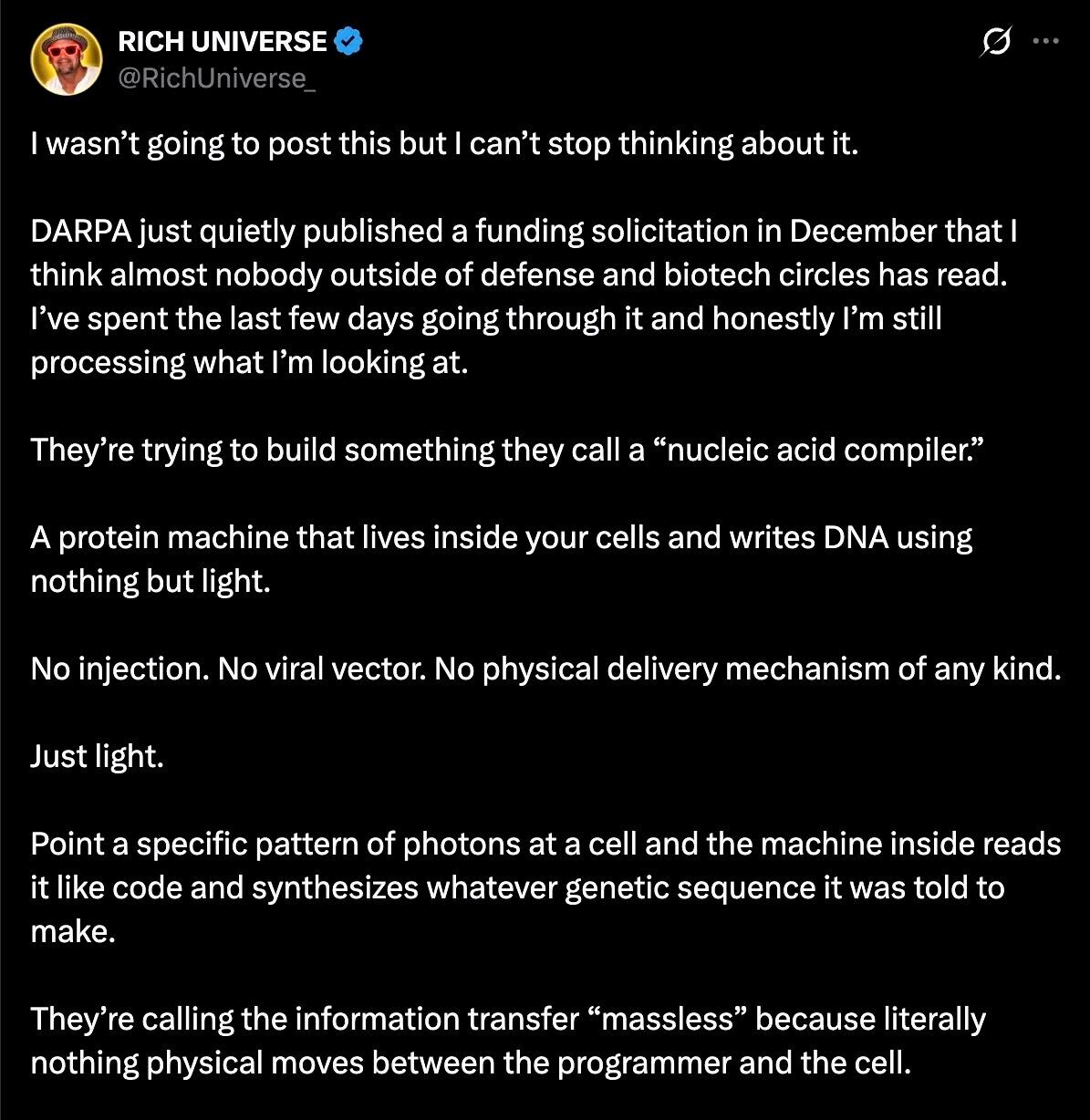
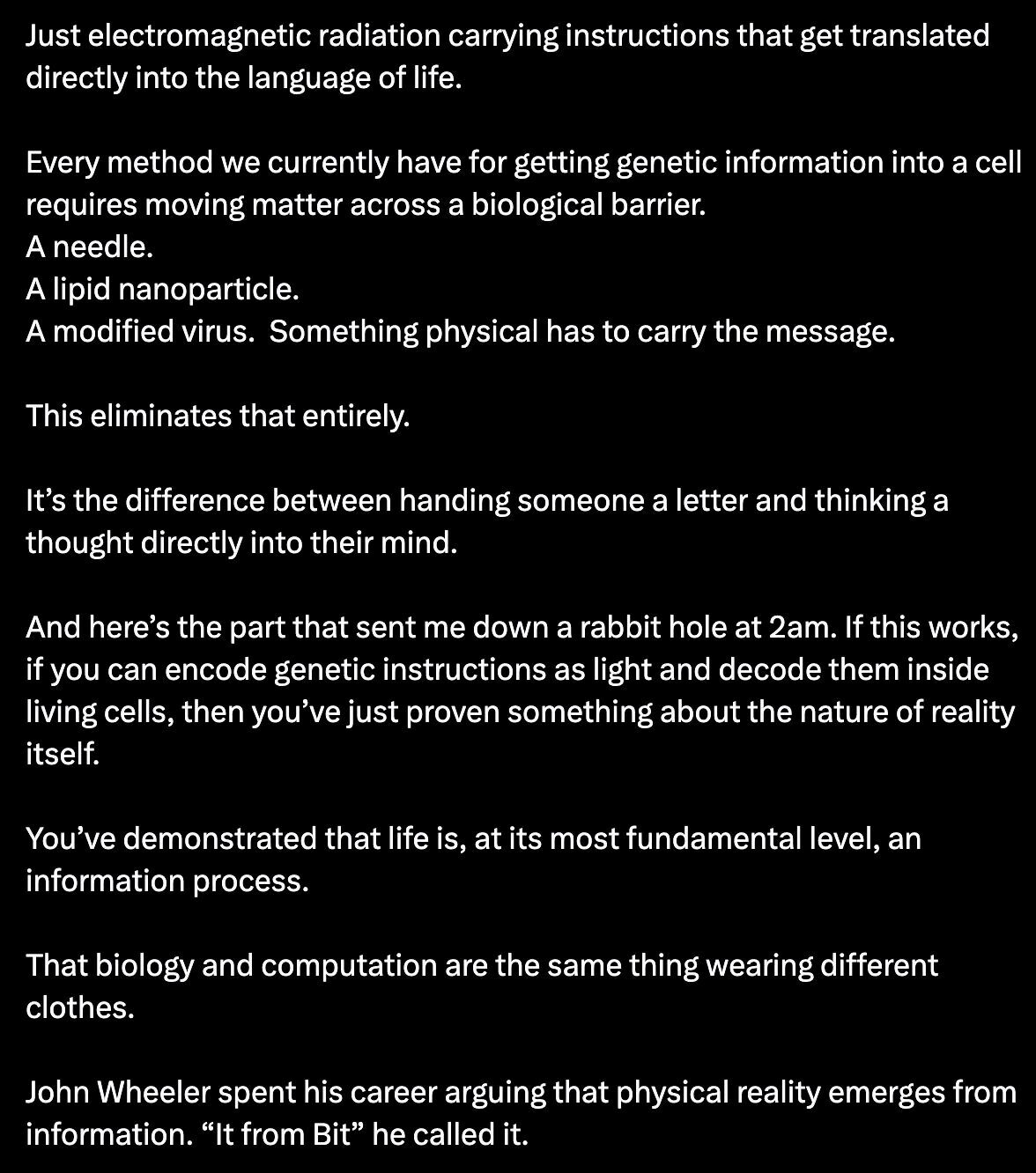
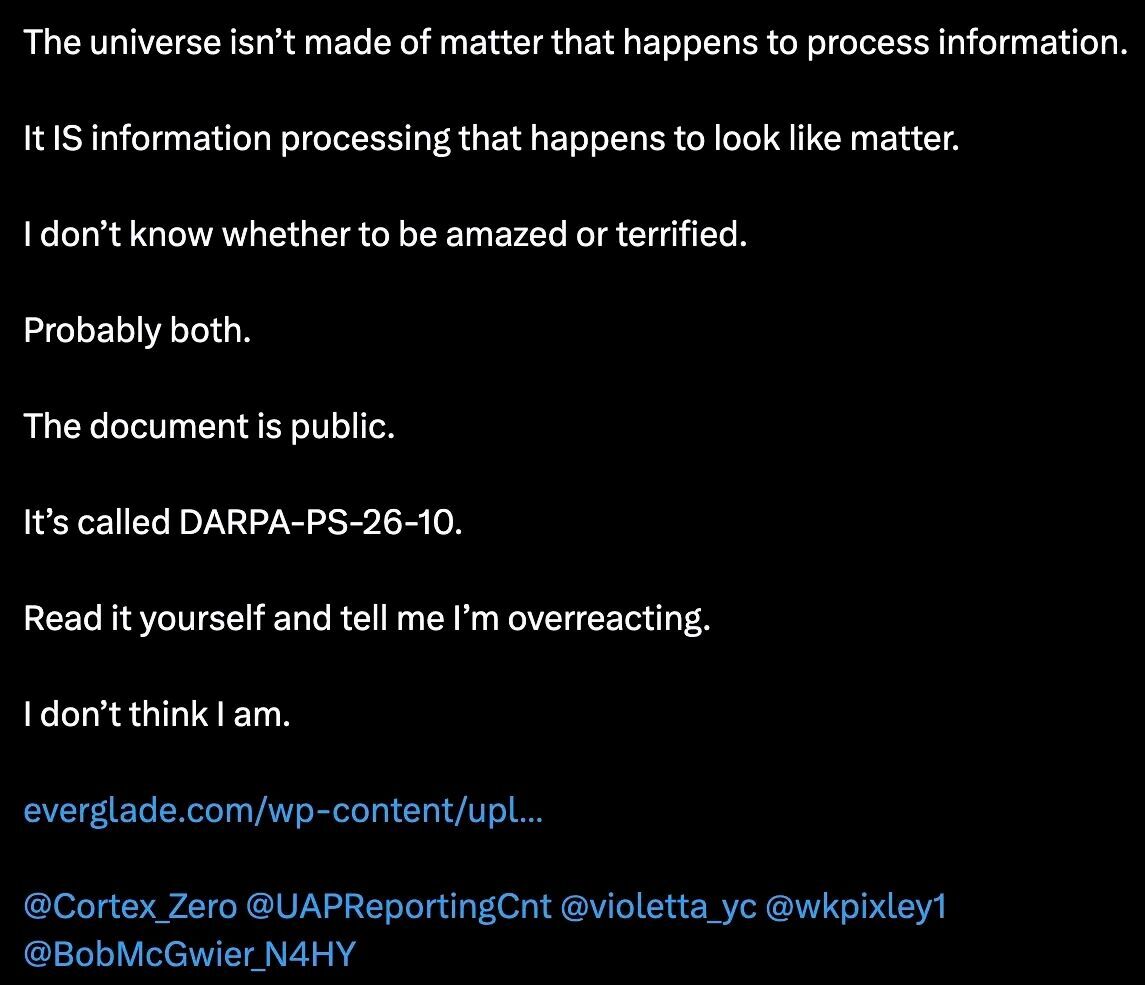
I am basically done with the meat of the DARPA document but I want to double down on how crazy this is after pointing you to a dude on Twitter with handle @RichUniverse_ who posted some good words (the best words) about this DARPA document the other day.
He said the following:
© Rich Universe/X
© Rich Universe/X
© Rich Universe/X
Doubling down - are we in a simulation?
I will leave you with one more brain melter after subjecting you all to this new potential looming nightmare sponsored by the U.S. Department of Defense.
Engineering synthetic systems where light patterns directly write genetic code inside living cells (massless, remote, programmable instruction) feels eerily like updating software via an input interface, doesn't it? As I described above, our own biology already uses photons as precise triggers to generate conscious perception.
Scale that up to direct DNA/RNA synthesis, and suddenly life looks more like a programmable renderer, than a purely chemical machine.
What if our base reality is itself a computational substrate where light (or electromagnetic information) serves as the update mechanism for biological code? DNA would be like stored data, photons like runtime commands, and consciousness like the user experience.
I mean, some physicists (John Wheeler's "it from bit"5) hold that the universe is fundamentally informational. DNA stores genetic information; photons carry it or trigger its expression. Researchers like Melvin Vopson have proposed a "second law of infodynamics" suggesting the universe optimizes information like a computer compresses data - and they explicitly link this to simulation-like behavior.
And the double-slit experiment (wave vs. particle behavior depending on observation) is often cited as "rendering on demand" to save computational resources. Quantum entanglement and discretization (Planck scale) have been interpreted as grid-like or code-like features.
And how about DNA? It is quite digital-like with its A/C/G/T bases, isn't it? Synthetic biology already treats it as programmable. If advanced civilizations (or post-human ones) can run ancestor simulations, why not assume we're in one? Nick Bostrom's classic argument makes this probabilistically likely under certain assumptions.
Some propose the universe as a "strange loop" or self-simulating system, where consciousness and quantum effects emerge from informational self-reference rather than an external programmer.6
Personally, I don't think we are living in a simulation. I believe we are fundamentally composed of ordinary matter, and that much of physical reality looks remarkably close to what decades of science have revealed - atoms, molecules, fields, and the elegant laws that govern them. The universe we experience appears to be a genuine, self-consistent physical system rather than a rendered computational construct.
That said, I am the kind of scientist (and thinker) who refuses to close the door on any well-reasoned possibility. The idea that we might be in a simulation - or some deeper informational layer of reality - is worth exploring seriously, precisely because our growing understanding of biology and physics has a big yellow arrow pointed directly toward light, electricity, information and computation-like processes at the heart of life.
I lean strongly toward the view that this is base reality - rich, physical, and astonishing in its own right (I love it so much) - but I would not be surprised at all if future discoveries reveal that the universe is far more computational or informational at its foundation than I currently suppose.
I'm comfortable holding both perspectives at once: living fully in the world as it appears, while remaining intellectually open to deeper layers we haven't yet uncovered.
In the end, whether this is base reality or a sophisticated simulation, my wonder remains the same, and that in-and-of-itself is miraculous. The fact that I, as matter, can see, dream, think, and potentially program myself with light is extraordinary enough.
And with that, I do declare that I don't need your program DARPA. Thanks, but no thanks. Things are weird enough already.
Don't Debase DNA, DARPA, and call it Defense.
Man, there's a song here!
Stay tuned.
References:
1 Funding Opportunity Number - DARPA-PS-26-10
2 DARPA
3 Program Solicitation Biological Technologies Office (BTO) Generative Optogenetics (GO) DARPA-PS-26-10
December 19, 2025 (pdf)
4 You "see" dreams through the same brain machinery that processes real vision, but the source is top-down (memory + internal generation) rather than bottom-up (retina → photon detection). The experience feels visual because the visual cortex is active - it doesn't need incoming light any more than it needs real input when you vividly imagine something.
5 Jaeger, Gregg (2023). "On Wheeler's Quantum Circuit". The Quantum-Like Revolution. pp. 25-59. doi:10.1007/978-3-031-12986-5_2
6 Irwin K, Amaral M, Chester D. The Self-Simulation Hypothesis Interpretation of Quantum Mechanics. Entropy (Basel). 2020 Feb 21;22(2):247. doi: 10.3390/e22020247




Reader Comments