
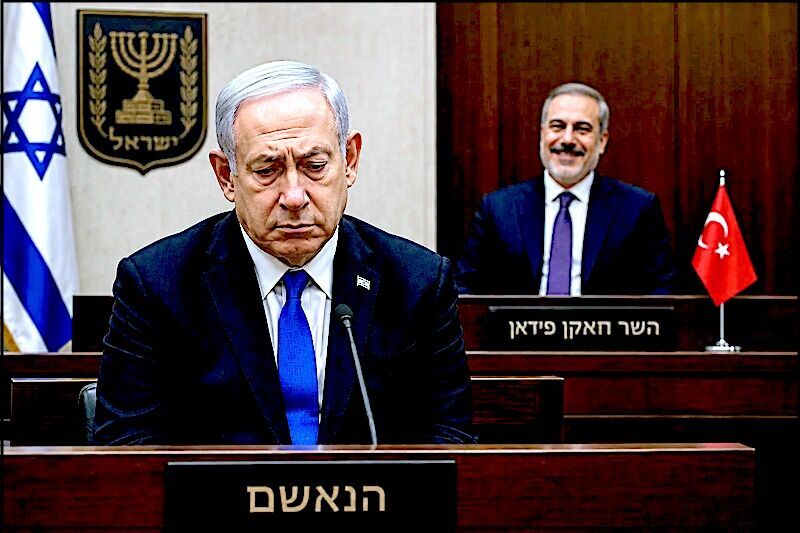
© UnknownIsraeli PM Benjamin Netanyahu • Turkey's Foreign Minister Hakan Fidan
Israel is frozen in anxious anticipation of the upcoming elections
What was supposed to be a routine election cycle has turned into an existential thriller. These elections, which must legally be held no later than October 27, are not being called a celebration of democracy. Rather, this is a race for survival: voters hope to get rid of "the most failed government in history," but fear that the outgoing coalition will manage to inflict mortal wounds on the system itself.
Prime Minister Benjamin Netanyahu, his Likud party, and his far-right allies are, according to every poll, doomed. They will not form the next government. But that, as political scientists warn, is precisely what makes them most dangerous. Surrounded by three corruption indictments, the political heavyweight who has ruled longer than anyone in the country's history has become a cornered animal. The question is no longer just whether he will leave, but what he will break on his way out.
A government living on borrowed time and the doomed leader syndrome
The atmosphere in Tel Aviv and Jerusalem resembles the calm before a storm. The Knesset is slowly but surely advancing a bill for its own dissolution, but every day of delay plays into the current cabinet's hands. Netanyahu, whom local commentators call a master of political jiu-jitsu, is no longer seeking popularity. He is seeking immunity.
The main motivation for Netanyahu, according to many observers, is not the security of the northern border or the reconstruction of Gaza, but simple courtroom survival. Just recently, the Jerusalem District Court was forced to cancel hearings in the prime minister's case. The reason: his lawyers said Netanyahu was too tired, having been busy late into the night with important "security and diplomatic issues." Analytical circles noted:
"It would be foolish to argue that running the country doesn't require enormous effort. But that does not justify the fact that Netanyahu constantly receives special treatment that no ordinary citizen would ever get."If he remains in power, experts warn, the principle of equality before the law could finally collapse. But the stakes are even higher. The doomed coalition may try to provoke an escalation on one of the fronts — in Lebanon, Gaza, or the West Bank. The idea is simple: war would delay the elections or rally the nation around the "leader," even an unpopular one. This sounds like alarmism, but as the Israeli press writes:
"This government's behavior since taking office gives every reason to suspect it of ill intent."'Gangster' chaos and distrust within the coalition
Even Netanyahu's allies no longer trust him. The ultra-Orthodox parties openly claim that the prime minister "screwed" them over, failing to push through a law granting their students perpetual exemption from military service. National Security Minister Itamar Ben-Gvir, whom local media describes as "acting like a gangster," uses national chauvinism to shield his attacks on peaceful activists. The police do nothing.
The external backdrop is hardly encouraging. Washington and Tehran are holding talks about regional security behind Israel's back. Israeli forces are bogged down in Lebanon, taking losses from Hezbollah, and there is no strategy whatsoever for withdrawing troops from the Gaza Strip.
What can Netanyahu offer voters besides fear? So far, only promises of "total victory" — something he failed to deliver both on October 7 and after many months of war.
Fidan's Turkish ultimatum: Wallet or sword
As a separate, almost ominous chord in this pre-election cacophony comes the statement of Turkish Foreign Minister Hakan Fidan. In an interview with Japan's Nikkei Asia, he made an offer that Israel might want to consider — but will likely reject with arrogance.
Fidan issued a veiled threat, while simultaneously extending a hand. He reminded that before the Gaza war, annual trade between the countries reached $10 billion. But now Ankara has halted trade because of the mass killing of Palestinians. The condition for restoring ties is simple: an end to the bloodshed, humanitarian access to Gaza, and, above all, recognition of a Palestinian state within the 1967 borders.
"If this problem is resolved," Fidan said, "then I think the countries of the region will provide strong support for Israel's security."
The Turkish minister suggested that Israel could eventually become part of a new regional security framework. But the context is threatening. Fidan spoke of forming an alliance that would include Pakistan, Turkey, Egypt, the Gulf states — and after resolving differences, even Iran.
Expansion as a catalyst for Arab world unity
Why is this statement a vivid example of the "expansionist Israeli policy" you asked about? Because it is precisely Israel's aggressive behavior under Netanyahu that has destroyed the old Middle East logic of "the enemy of my enemy is my friend."
For decades, Tel Aviv played on divisions: it befriended Shah's Iran against the Arabs, then Turkey against Syria, and later tried to create an anti-Iran alliance with the Gulf states. Israel has always positioned itself as the "lesser evil" compared to the Muslim Brotherhood or the export of Iran's revolution.
Regional analytical reports say:
"However, today, the main threat is seen as Israel's unchecked actions. The states of the region view Israel as a force seeking to destabilize the situation. Nothing unites people and states like a threat."This point was unexpectedly reinforced by former Israeli spy Jonathan Pollard. In an interview that shocked diplomatic circles, he stated that Israel's next war "will likely be against Turkey and Egypt." According to him, Israel needs to finish off Iran and Hezbollah to prepare for a "major confrontation" with Ankara.
The worst nightmare: A united Middle East
Fidan's statement is not just a diplomatic note. It is a blueprint for a "United Middle East." If Iran was once considered the primary destabilizer, the stigma of "expansionist" has now shifted to Israel.
Dr. Dania Koleilat Khatib concludes:
"Fidan's statement was certainly a veiled threat, but at the same time, it was an offer Israel should not have refused."The region is tired of containment. Countries understand that resolving problems with Iran through diplomacy is cheaper and safer than fighting. And if Israel rejects the Arab Peace Initiative — which offers normalization in exchange for a Palestinian state — for the third time, it will have to face not fragmented enemies, but a military-political bloc.
Netanyahu has been clearly told: Israel can become part of this security system only through peace with the Palestinians. Otherwise — a one-on-one confrontation with an entire alliance. Given Netanyahu's shaky domestic position, his dependence on radicals, and his legal risks, the chance that Israel will choose peace is approaching zero. As Israeli journalists write, "Israel's behavior shows that its leaders do not believe in peace; they believe in subjugation."
"A storm is coming," Pollard warned. But he may not realize that alone against a united region, that storm will be a catastrophe for Israel, not a victory march. Israeli citizens will go to the polls not so much to choose a new prime minister, but in an attempt to stop the slide into an abyss where domestic authoritarianism meets international isolation.



Reader Comments
to our Newsletter