
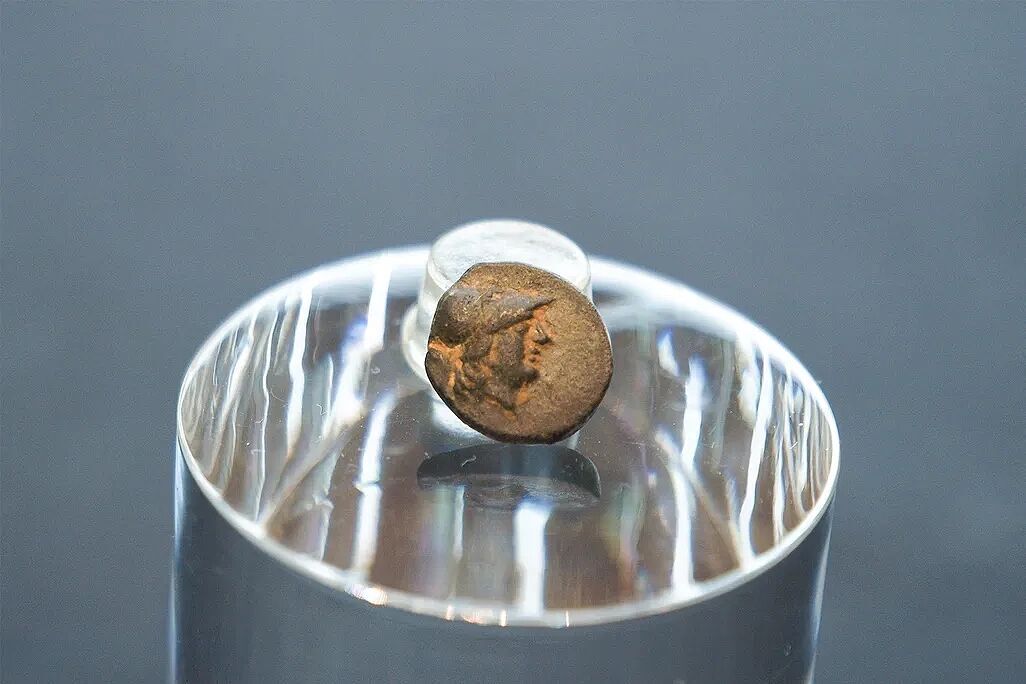
© Petri Berlin / Christof HannemannThis ancient Greek coin is now on view in Berlin.
When a 13-year-old schoolboy discovered a small coin in a field on the outskirts of Berlin, he knew that he'd stumbled onto something special. But it wasn't until scholars analyzed the object that they realized its true significance. Minted in the third century B.C.E. in the city of Troy, located in what is now western Turkey, the bronze coin is the first ancient Greek artifact ever unearthed in the German capital.
The teenager showed his find to researchers during a November 2025 visit to Petri Berlin, an interactive archaeology lab built atop the foundations of a medieval-era Latin school.
"Nobody knew exactly what it was because it was so small," Jens Henker, an archaeologist with the Berlin Heritage Authority, tells Smithsonian magazine. "That it was something old was clear."
A numismatist identified the find as a Trojan coin dated to between roughly 281 and 261 B.C.E. Per a statement, its obverse depicts Athena, the Greek goddess of war and wisdom, in a Corinthian helmet, while its reverse features an image of the deity in a kalathos headdress, with a spear in her right hand and a spindle in the other.
Initially, the experts were unsure whether the coin had been lost by a modern-day collector in Spandau, a neighborhood in western Berlin, or deposited in the ground closer to the time of its creation. But Henker soon realized that the field where the boy had found the coin was a well-known archaeological site.
Excavations in the 1950s and '70s suggested that the area was used as a burial ground, perhaps beginning in the early Iron Age (roughly 800 to 450 B.C.E.) and continuing for centuries. Artifacts uncovered at the site include ceramic fragments, a bronze button and a Slavic knife sheath fitting.
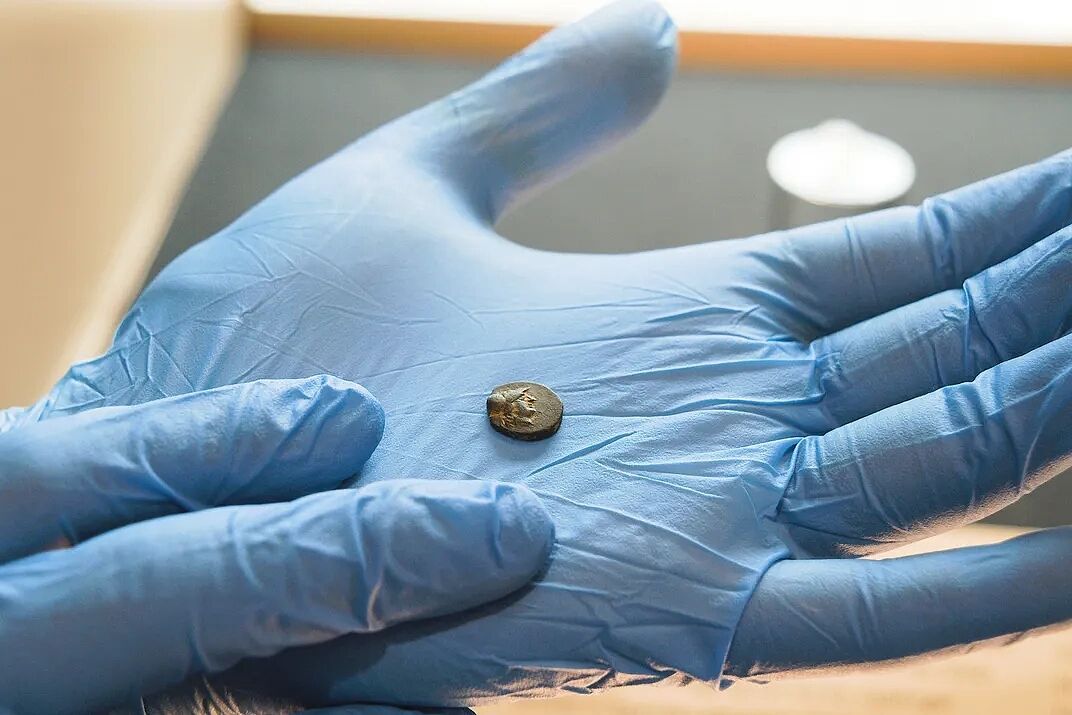
© Petri Berlin / Christof HannemannThe bronze coin measures 12 millimeters in diameter. Comparatively, an American dime measures 17.91 millimeters in diameter.
Ancient coins that weren't melted down for reuse have typically been found in burial grounds, suggesting they were "put in graves as a kind of grave gift," Henker tells Deutsche Welle's Sarah Hucal. "This appears to be like a souvenir used to remember something — perhaps even an experience in one's life."
Exactly how the coin traveled from Troy to Berlin remains unclear. While the bronze token is the first of its kind unearthed in the city, Henker says that ancient Greek coins have previously been found elsewhere in Germany. Archaeologists in Greece, meanwhile, have also discovered objects imported from this part of Europe — including amber used to craft jewelry and other goods — in millennia-old graves.
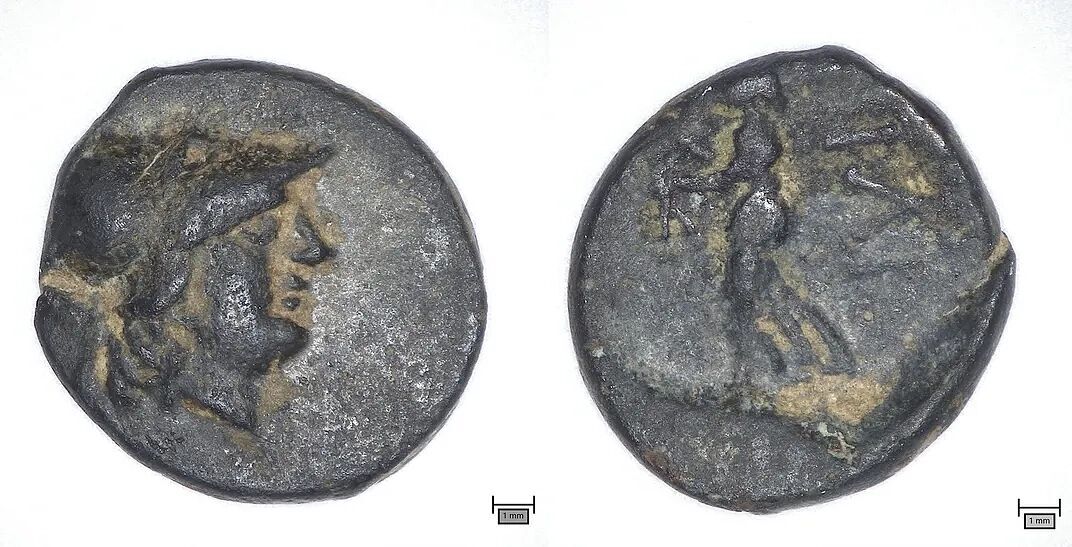
© Staatliche Museen zu Berlin, Museum für Vor- und Frühgeschichte / Ulrike ScheibeThis bronze coin features Athena's head on its obverse and an image of the goddess with a spear in her right hand and a spindle in her left hand on the reverse
Pytheas, however, was the first Greek person to travel beyond the "known world" and record what he saw. His findings challenged the image of these regions' inhabitants as "barbarians," so the Greeks "dismissed him a little bit at this time," Henker tells Smithsonian. "They said, 'He's spinning this. There's no way that it exists.'"
For now, Henker and his colleagues can only speculate on how the coin's journey unfolded. Trade is one possible explanation, but Henker also suggests that the ancient Greeks could have recruited Germanic peoples as soldiers, much as the Romans would a few centuries later.
"We have time periods, especially in the Iron Age, [where] we have a population loss, and we don't know where the people [went]," Henker says. "Suddenly they disappear. Maybe they were going down to the Greeks, joining the military forces there." Still, he cautions, "That's not even a hypothesis. It's an idea only."



Reader Comments
But "archeologists" won't like it ...
Even today, a lot of replica of old coins are around, many of them produced without ulterior motives. One can only gather indications that a coin is fake or a replica, e.g. by metal purity that was unachievable two millenia ago, but dating metal and thus proving it's origin is virtually impossible.
In the Wiki for the Odyssey [Link] 13 gods are listed as haven taken sides, with six on the Greek side and seven on the Trojan side. Among those on the Greek side, there is Athena [Link]