
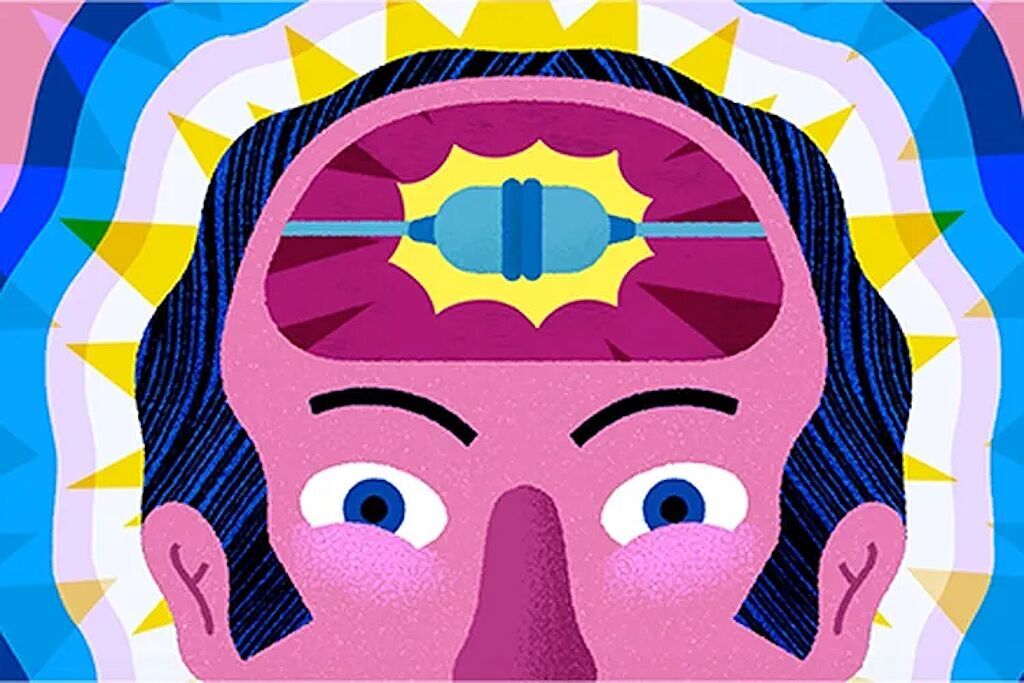
© Irene Pérez for Quanta Magazine
Introduction
Here are three words: pine, crab, sauce. There's a fourth word that combines with each of the others to create another common word. What is it?
When the answer finally comes to you, it'll likely feel instantaneous. You might even say "Aha!" This kind of sudden realization is known as insight, and a research team recently uncovered how the brain produces it, which suggests why insightful ideas tend to stick in our memory.
Maxi Becker, a cognitive neuroscientist at Duke University, first got interested in insight after reading the landmark 1962 book The Structure of Scientific Revolutions) by the historian and philosopher of science Thomas Kuhn. "He describes how some ideas are so powerful that they can completely shift the way an entire field thinks," she said. "That got me wondering: How does the brain come up with those kinds of ideas? How can a single thought change how we see the world?"
Such moments of insight are written across history. According to the Roman architect and engineer Vitruvius, in the third century BCE the Greek mathematician Archimedes suddenly exclaimed "Eureka!" after he slid into a bathtub and saw the water level rise by an amount equal to his submerged volume (although this tale may be apocryphal). In the 17th century, according to lore, Sir Isaac Newton had a breakthrough in understanding gravity after an apple fell on his head. In the early 1900s, Einstein came to a sudden realization that "if a man falls freely, he would not feel his weight," which led him to his theory of relativity, as he later described in a lecture.
Insights are not limited to geniuses: We have these cognitive experiences all the time when solving riddles or dealing with social or intellectual problems. They are distinct from analytical problem-solving, such as the process of doing formulaic algebra, in which you arrive at a solution slowly and gradually as if you're getting warmer. Instead, insights often follow periods of confusion. You never feel as if you're getting warmer; rather, you go from cold to hot, seemingly in an instant. Or, as the neuropsychologist Donald Hebb, known for his work building neurobiological models of learning, wrote in the 1940s, sometimes "learning occurs as a single jump, an all-or-none affair."
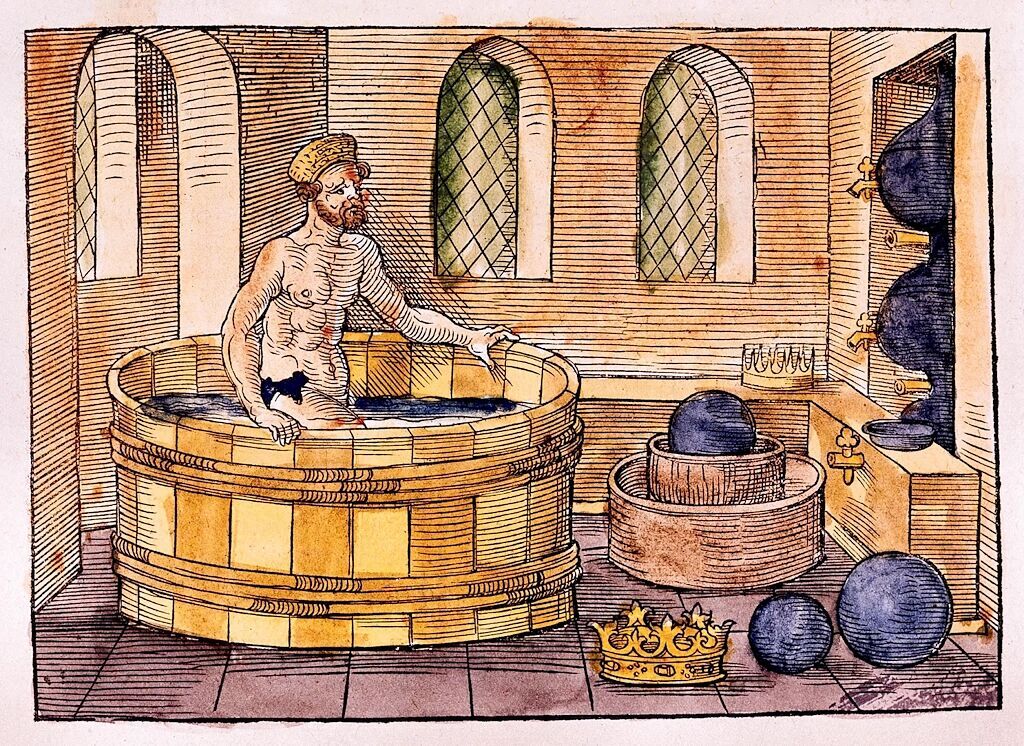
© Ann Rosan Picture Library.According to legend, the Greek mathematician Archimedes exclaimed “Eureka!” after his body caused the water level to rise in his bath, suggesting a way to calculate volume.
During moments of insight, representational change typically occurs, said John Kounios, a cognitive neuroscientist at Drexel University and co-author of the book The Eureka Factor: Aha Moments, Creative Insight, and the Brain. "The question is: How is it occurring?"
Insightful Activity
While at Humboldt University of Berlin, Becker set out to uncover this neural signature of insight. Given that it's nearly impossible to fabricate life-changing, field-altering insights in the lab, her team needed to identify a simple task that could produce a sudden feeling of understanding rather than a slowly unfolding solution.
They turned to abstracted black-and-white pictures called Mooney images, which are made by cranking up the contrast on a photograph all the way so that the subjects — a dog or a coffee mug, for example — are unrecognizable at first. The pictures pose a challenge for human brains, which typically identify objects by piecing together their different parts. But if given enough time with a Mooney image, even a few seconds, the brain can rearrange the contours to recognize the pictured object — and trigger the insightful "aha" feeling, a representational change.
Over the course of two days, Becker had study participants lie in a functional magnetic resonance imaging (fMRI) scanner, which detects blood flow in the brain as a proxy for neural activity, and view a series of 120 Mooney images. After 10 seconds of viewing a single image, the participant would indicate whether they recognized the pictured object. If they did, they would then answer a series of questions about the suddenness, positive emotion and certainty associated with their experience — three measures that have been linked to moments of insight.

© Courtesy of Maxi BeckerMaxi Becker, a cognitive neuroscientist at Duke University, explores what insight looks like in the brain.
The hippocampus is sometimes known as the brain's "mismatch detector," Becker said, because it reacts when an input doesn't align with expectations. In this case, insight leads a once-meaningless image to gain meaning, going against the brain's predictions.
These regions — the hippocampus, amygdala and VOTC — create "a plausible network of brain areas" behind representational change, said Kounios, who was not involved in the study. These findings finally "connect the psychological theory with the neural mechanism," said Yuhua Yu, a postdoctoral researcher in neuroscience at the University of Arizona, who was also not involved with the study.
Becker and her team likely found representational change in the VOTC because of the visual nature of their stimuli. If they had chosen another type of stimulus, like words, the change would probably have appeared in language-processing areas of the brain.
Once the team had figured out which brain areas support insight, they wanted to probe whether these regions might be working together to create a lasting memory.
A Memory Boost
Since they began investigating insight, researchers have suspected that such experiences might boost memory. In his 1949 book The Organization of Behavior, Hebb wrote that "whatever insight is, we now know that it continually affects the learning of the adult mammal." Insight not only feels notable or salient in the moment but also helps us retain new information as memory.
This memory boost, which became known as the insight-memory advantage, has since been studied in many types of problem-solving, including the unraveling of magic tricks and puzzles. "When you have an insight, you tend to be better able to remember the solution," Becker said, compared to when you resolve a problem more gradually. She wanted to understand why.
A few days after the initial experiment, the team tested participants' memory by having them look at more Mooney images online, including some they had seen before. Participants were better able to remember prior images that they had rated highly on the three aspects of insight. This suggested that the insight-memory advantage was real, but the team wanted to see what was going on under the hood. Did brain activity during insight predict better memory five days later?
The researchers found that the larger the activity boost in both the VOTC and the hippocampus during the initial insight, the better participants remembered the Mooney images. The big change in brain activity likely makes the experience more salient, Becker said, and salient experiences are known to better encode long-term memories.
While insight creates stronger memories of an idea, it doesn't mean the idea is correct. Previous work has shown that the quicker, more certain and more pleasurable a solution feels, the more likely it is to be correct — but false insights can and do exist. In Becker's study, participants wrongly identified the subjects of more than half the Mooney images they saw. Of those incorrect trials (which the researchers excluded from the analysis), the participants reported experiencing insight 40% of the time. In comparison, correct trials were accompanied by feelings of insight 65% of the time.
These kinds of studies of insight in the lab will set researchers up to look at how it functions in the real world. Once we decompose insight into "very simple tasks that we already understand well," Becker said, we can "move on to more complex, truly creative tasks."
Insight Into the Future

© Courtesy of Yuhua YuYuhua Yu, a postdoctoral researcher in neuroscience at the University of Arizona, is fascinated by the role that insight plays in the creative process.
"A really big creative idea is [often] associated with insight because a creative idea is in some way a leap in your cognitive world, and a leap will often elicit an insight or 'aha' feeling."However, Yu is finding that insight's role in creativity might depend on the kind of problem a person is solving. In a recent study, she asked participants to come up with metaphors for scientific concepts and asked whether they used insight as they did so. The insight-driven metaphors weren't more or less creative than those created through analytic thinking, she found — and the participants were more likely to remember the science concepts behind the latter.
This may be because, unlike the task of seeing a hidden object in a Mooney image, creating a metaphor tends to rely on slower cognitive problem-solving rather than sudden moments of insight, Becker suggested. The effects of insight therefore likely depend on the context.
Next, Yu wants to investigate insight in more contexts. "Most of the insight research is looking at insight in the problem-solving context and in the lab setting," Yu said. She hopes that researchers will begin investigating "insight within many other domains, like in psychotherapy, in meditation, even in psychedelic experiences."
Beyond offering a better understanding of how the human brain learns, these findings could have applications in classrooms. Kounios believes that applying insight-boosting strategies to teaching could lead to better learning outcomes for students. Insight seems to be a powerful and positive experience that generates accurate solutions, confidence in our answers and strong memories.
"It's very intensive for a teacher to do this, but a lot of really good teachers try to get the students to have the insights themselves about how something works, and that will burn it into their memories," Kounios said. "Another aspect of that [is], it's very motivating, too."
It's a nice feeling when your brain suddenly comes up with an answer. Perhaps you've even experienced that feeling since reading this piece's first sentence. Maybe it even hit you like an apple on the head.




Reader Comments
But on first glance, it looks like another "No sh*t !" moment of contemporary science ...
This would explain how 2 scientists find the same insight at the same time. It would suggest that insight itself may be accessing this field of information.
A potential example of this is the use of the word "Frame", as indicating a biased presentation of information, appears to have replaced "spin" in many articles in the news. This could be explained by the morphogenic information field.
Anyway, this is Rupert Sheldrake's (unproven) hypothesis about how that happens. Which is disjunct from the fact that it does happen.
So - morphogenic this all may be indeed!
Who knows?
have you heard about "morphic resonance" - and if so - what you think bout it codis I think there might be something to it - but what do I know...
Ken
It means that both facts are not interdependant. Even if someone could prove that "morphic fields" don't exist and Sheldrake's theory is wrong, the observed fact (animal behavior) remains valid.
JTFtruth - yes, synchronicity is an explanation and itself could be explained by a morphic/morphogenic field.
Although I would ask Mr. Sheldrake to specific how this "morphic field" works physically, I think he is onto something.
But in proper scientific terms, disproving a hypothesis about the cause of an observation does not invalidate the observation itself.
However, the research of Michael Persinger seems to support this idea.
As a side note, nothing of that, neither the electromagnetic nature of most processes in living creatures nor the effects of external EM forces on those creatures, were ever part of our curriculum. Nor is it now. One has to look for himself - or herself ...
And let me ask this - how many letters are shared twixt the words disjunct and defunct?
Meanwhile - my communications with the "battery maker" turned out better than other customers based on reviews I read - and I believe the replacement battery has been delivered. I will test it before I put it to good use. Glad I got it when I did - cause things are seriously -
Heating UP
Consider the swings in commodity prices - like silver - in that regard.
But people have literally killed each other over verbal misunderstandings ...
And if you doubt me, just ask you liberal-preogressive neighbor for definitions of terms like "democracy", "justice", "conservative", "MAGA", "liberal" or even "science" ...
I think there may be some "safety equipment" needs to be added to the connections and seriously I'm going to make a chart of my setup - and any helpful info you could provide would be appreciated. Cause I don't want to burn my place down.
Cause these Lithium ion batteries - marine grade - hold lots of energy.
But - I also think better batteries are in the wings - and we need em.
Ken
However, the voltage drops during discharge would add up as well, so the inverter input would vary quite a bit depending on battery level.
Connecting batteries in parallel is usually a very bad idea, due to balancing currents which could destroy the pack in the worst case.
Anyway, I would think twice about operating such batteries indoors. Remember, they are basically unquenchable ...
[Link] - the battery mentioned.
Now let me share you the last part of our discourse codis.
Ken Incidentally - I told them - delivery was gonna be delayed and it has been. And get this - another storm on the way but I am here with my family - and one storm after another I reckon - but I plan in advance.
Hope you do as well.
Ken
You know pal?
So the solar panels are 18V each basically - the MPPT is designed to accommodate this - so give or take voltage comes in at what - 72 pal - then gets sent to the batteries in series - which produce 48V sent to the inverter I mentioned previously.
So - are you an electrical engineer? If so, know this - chemical engineers are both smart and mean. So, help me out pal - and I don't disagree - now wise to have this in the home place - why do you think I disconnected all the wires codis - but know this.
I play to WIN.
Ken
🦬
But for the weather - well, occasionally one needs patience. The people involved at the other side are only human - I hope. They look ok, I would say. The problematic ones' are the high-density batteries, i.e. those that pack most capacity possible in a limited volume. Think smartphones, laptops, EVs. It's those batteries that self-ignite due to production tolerances, or slight overload.
Seems like just now you are being rather unhelpful. But I got the four batteries soon to be lined up in series - 48 volts nominally give or take - and I'll figure out how to get them aligned with the solar panels and MPPT controller - with or without your help.
~
Your choice pal - and why help somebody you hardly know - and why spend so much time on sott.net if you ain't got a narrative to spew - that is telling I reckon.
Thanks for nothing & c u round....maybe.
Makes me thing about rowan - and 22222 - two many twos codis!
Ken
🦬
You would need to come up with the full requirement specs first - what you don't specify you don't get.
I think I'm going to seek out more detailed info on a " professional " solar panel, charge controller, battery and inverter setup and try to better understand if I need some "safety-devices" as part of the overall system - above and beyond the inherent safety components within the equipment already acquired. So - I'll find that and make updates accordingly.
Ultimately I want to present at my Substack a detailed drawing of what I have done and in the future I would like to be able assist others setup something similar if that is what they desire - cause the costs have come down enough now - on the panels in particular - that I consider solar panels a worthwhile small-scale insurance policy. I suspect at some point I may need to hire an electrician familiar with setting up this sort of system and pay them to come check out what I've got and suggest improvements or help with installation for ongoing use. For example, one thing I want to install in the system is a way for it to automatically switch to "central power" if the voltage in the batteries falls below the necessary value. I found a part for doing that - [Link] - but upon receipt of it I realized I don't know how to properly install/wire this up - especially given the instructions are minimal and were not written by someone whose "native language" is English more than likely. But - the instructions are written in a manner I suspect an electrician would be familiar with.
~
So, later on if I have a specific question - I might send out a query - but I understand it is up to me to figure this out.
~
Regards,
Ken
Running both alternatively (not at the same time) is not difficult. But having solar powering the facility, charging the batteries at the same time, and automatically switch over depending on load and input makes it a bit complex ...
And the kilowatts these batteries store can do some harm, as could other components carrying such high loads.
BK
The pork shoulder - the "butte" - is cooking at around 225 F - it will take maybe 10-12 hours of slow cooking and when it is ready - I will eat it and share it. I'm a good neighbor.
Here is just one link of it:
[Link]
I found another even better - had a good diagram.
But you know as I do - tis one thing to watch a video another to actually DO it.
Not only do they care about their reputation and are quickly available for service. Occasionally they even agree to mutual deals to circumvent awkward bureaucratic rules ...
BTW, several years ago I dropped my "branded" autoshop and changed to a small, free garage. While the latter looks a bit worn down, at least he doesn't want to finance his new glass palace from my money ...
I mean I know this - while it is 20 degrees F out there today the sun is shining and within the panels and the wiring there is 72V and maybe 20 Amps going nowhere - and that is a waste of energy . I can't abide it.
I'll find somebody or maybe somebody will find me - together we will be better.
Win-win.
.
"Anthony Hopkins couldn’t find a single copy of the book in London. So he sat down on a subway bench.
It was 1973. Hopkins had just landed a role in a film called *The Girl from Petrovka*, adapted from a novel by the American journalist George Feifer.
Like any serious actor, he wanted to read the original book. He spent an entire day combing through the famous bookshops of Charing Cross Road in London.
Nothing. The book was nowhere to be found in the United Kingdom.
Frustrated and exhausted, Hopkins went down into Leicester Square station to catch the train home. That’s when he noticed something on a bench.
Someone had left a book behind. He picked it up. Turned it over.
*The Girl from Petrovka*.
The exact book he had been searching for all morning, abandoned on a subway bench in a city of eight million people.
Hopkins couldn’t believe it. He took it home, read it, and noticed something unusual. The margins were filled with handwritten notes in red ink. Annotations. Someone had carefully marked up the entire book.
He didn’t dwell on it. He used the notes to better understand his character, prepared for the role, and quietly filed the coincidence away among life’s strange moments.
A few months later, Hopkins went to Vienna, where the film was being shot. One day on set, he was introduced to a visitor.
George Feifer. The author of the book.
They talked about the film, the characters, the story. Then Feifer mentioned something that left Hopkins speechless. “I don’t have a copy of my own book anymore,” Feifer said. “I lent my personal copy to a friend years ago. It had all my notes in the margins. He lost it somewhere in London. I’ve never seen it since.”
Hopkins felt the hairs on the back of his neck stand up. “I found a copy,” he said slowly. “On a bench in the subway. It’s filled with handwritten notes.”
Feifer stared at him in disbelief.
Hopkins went to get the book and handed it to the author. Feifer turned pale.
It was his copy. His handwriting. His annotations. The personal book he had lost years earlier—accidentally left on a subway bench, at the precise moment when Anthony Hopkins, the actor who needed it most, sat down there.
In a city of millions. Across thousands of streets. Among hundreds of subway stations.
The right book. The right bench. The right moment.
George Feifer recovered his lost book. Anthony Hopkins gained a story he would tell for the rest of his life.
Carl Jung called this synchronicity—the idea that meaningful coincidences are not random, but part of a deeper pattern woven into reality. Hopkins has always been fascinated by this idea. He has spoken about learning to simply marvel at life.
“I don’t know if there’s a grand design,” he once said. “But sometimes things happen that are too perfect to explain.”
Maybe it was luck. Maybe it was fate. Maybe it was the universe quietly smiling.
Or maybe, just maybe, some books are meant to find their readers. And some stories are meant to be told." [Link]
you just made that story up, there ain't no god like that...
ned
There is the movie Celestine Prophecy that is fun to watch about 9 insights into living. Brave AI:
" First Insight: A Critical Mass – Noticing Synchronicity
The first insight centers on recognizing meaningful coincidences—events that feel destined and beyond mere chance . These synchronicities signal a spiritual awakening and guide individuals toward a deeper sense of purpose and connection to a larger unfolding destiny."
Usually people write off their own synchronicities as imagination.
Ha, ha...
I want to believe it.....
So that is what matters I reckon - I mean really.....
~
But if so, it can't be planned - tis just the whims of the Gods I reckon - and the Goddesses of course.
BK