
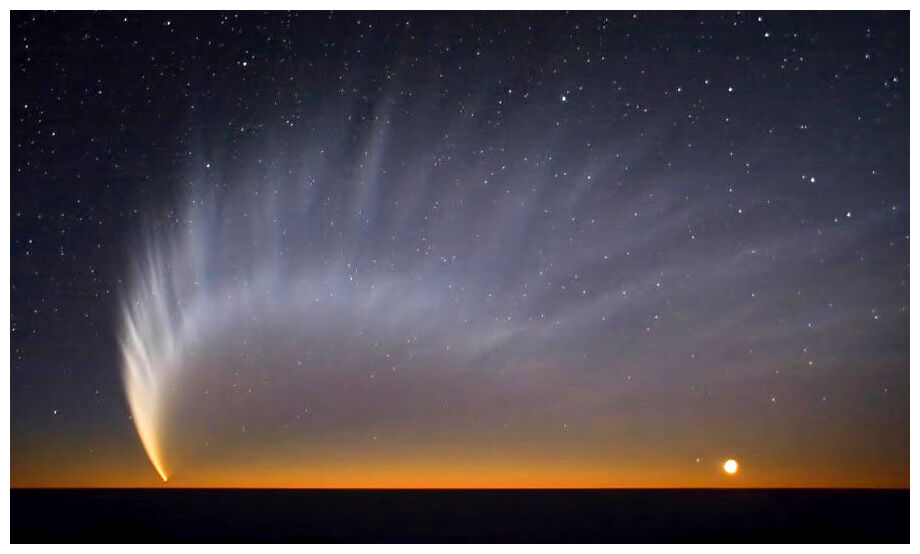
© ESO / Sebastian DeiriesThe long-period comet Comet McNaught (C/2006 P1) was captured over the Pacific Ocean from Paranal Observatory. Long-period comets come from the Oort Cloud that surrounds the solar system.
Astronomers, led by Nathan Kaib (Planetary Science Institute), recognized this long-ago stellar flyby by the anomalies it created in the orbits of long-period comets. These comets orbit on highly elliptical paths, taking thousands to millions of years to complete their trip around the Sun. Such comets come from The Oort Cloud.
Tugs from our galaxy can knock some Oort Cloud objects off course, sending them spiraling toward the Sun. From there, the balls of ice, gas, and rock heat up and shed material to form their long, signature comet tails. But the Milky Way tends to tug on comets of certain orientations more than others. According to the analysis of Kaib's team, older, returning comets seemed to follow this pattern.
But newer comets did not, suggesting they were sent inward when a star made its close passage. The star's flyby could've sent roughly 10 times as many comets into the inner solar system as before. If that's the case, we're still living through the late stages of this brilliant comet shower today.
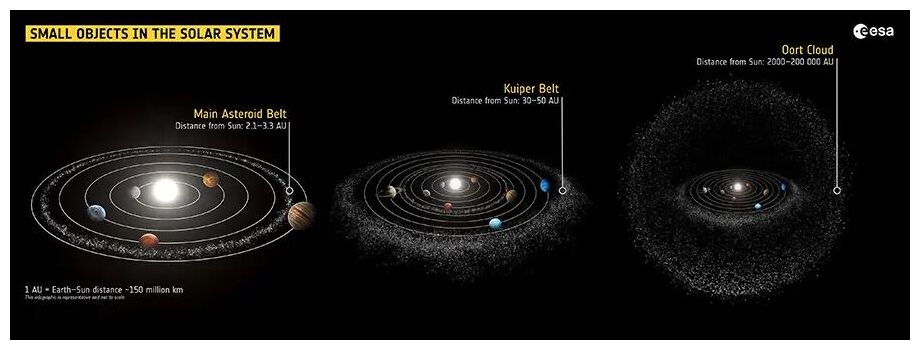
© ESA / CC-BY-SA 3.0The Oort Cloud is so distant we cannot yet see it — it's much farther away than the Kuiper Belt. But long-period comets tell us about its shape and distribution.
The astronomers point to one star that could've caused the comet shower: HD 7977, a Sun-like star that's 250 light-years away in Cassiopeia. The European Space Agency's Gaia mission measured the star's precise speed and direction. In a previous study, astronomers wound the clock back and found that the star passed our solar system around 2.5 million years ago, back when the Stone Age was in full swing on Earth.
However, astronomers weren't sure just how close the star got to the Oort cloud. "The Oort cloud is too distant to observe directly, so pretty much everything we know about it is indeed through our studies of long-period comets," says Kaib, who led the new study to appear in The Planetary Science Journal.
Kaib and his collaborator, Sean Raymond (Bordeaux Astrophysics Laboratory, France) began putting the pieces of the puzzle together when they noticed that newer comets did not all come from similar orientations, as would be expected for comets influenced by our galaxy's forces.
To test their theory, Kaib and Raymond ran simulations of the Oort Cloud over millions of years, monitoring how many comets were sent into the inner solar system — and the different orientations of their orbits — when a star came close to our solar system.
They noticed that comets fresh from the Oort Cloud — with orbits more than 1 million years long — would be spread out evenly, as the gravity from the star briefly dominated over the Milky Way's forces. Older comets already on their return trip to the Sun would have shorter orbits, slowed down by the outer planets' gravity.
Comparing the simulations to observations of more than 200 long-period comets observed since 1990, the team found that the data best matched the stellar passage scenario. In fact, they estimated that the star most likely passed within 6,000 to 10,000 astronomical units (0.1 to 0.15 light-year).
If we're living through a flurry of cometary activity, that implies that astronomers have overestimated how many comets reside in the Oort Cloud in the first place. According to Kaib, it will take 5 to 10 million years for the solar system to get back to "normal."
While the result is compelling, the puzzle isn't a perfect fit. The size of the comets' orbits in the simulation are smaller compared to the observations. Non-gravitational forces, such as energy from jets emanating from the comets themselves, might slightly alter their paths onto tighter orbits.
To make a stronger case, the team could've run more simulations, says Simon Portegies Zwart (Leiden Observatory, The Netherlands). "That they conclude that we are in the tail of an enhanced phase of a comet shower remains up to debate," Portegies Zwart says.
The team simulated a single instance of the Oort Cloud evolving with 1 million icy bodies, and the researchers chose how those comets were initially distributed. Portegies Zwart adds that he would've liked to see a study with many more objects — at least 100 million — as well as different initial configurations. Gravitational interactions between multiple bodies are also highly chaotic, so running more simulations would also have been helpful in accounting for this innate randomness.
"This result could be a one-off" that came about because of the specific simulated conditions, Portegies Zwart says. Nevertheless, he says, "I am happy that the authors explore this," he adds. "It is important to further understand the Oort Cloud, and to better appreciate it's importance in our local cosmos."
Oort Cloud Secrets
This distant sphere of our solar system could hold the key to understanding our larger place in the galaxy. "The Oort cloud is the only part of the solar system that is influenced by our galaxy's gravity," Kaib says. "Because of that, it holds clues about what types of environments the Sun has inhabited in the past."
The next release of Gaia data, coming in December, will reveal more details on both the once-nearby star, such as how and when it passed by our solar system, as well as on the Oort Cloud itself. The Vera C. Rubin Observatory's survey, which just started up, might sweep up some faint, distant objects from the inner Oort Cloud, shedding light on how many objects there are and what orbits they take.
"We will have many new insights about the Oort Cloud once we start observing it," Portegies Zwart adds. "I am pretty sure that many surprises are waiting for us when we learn more about it."



Reader Comments
to our Newsletter