
© Egypt’s Ministry of Tourism and Antiquities via Facebook
The discovery was announced by Egypt's Ministry of Tourism and Antiquities after excavations by an Egyptian mission affiliated with the Supreme Council of Antiquities. The site lies in New Valley Governorate, in Egypt's Western Desert, where the oases preserve some of the clearest archaeological evidence for daily life outside the Nile Valley during Late Antiquity.
A planned mudbrick settlement in the Western Desert
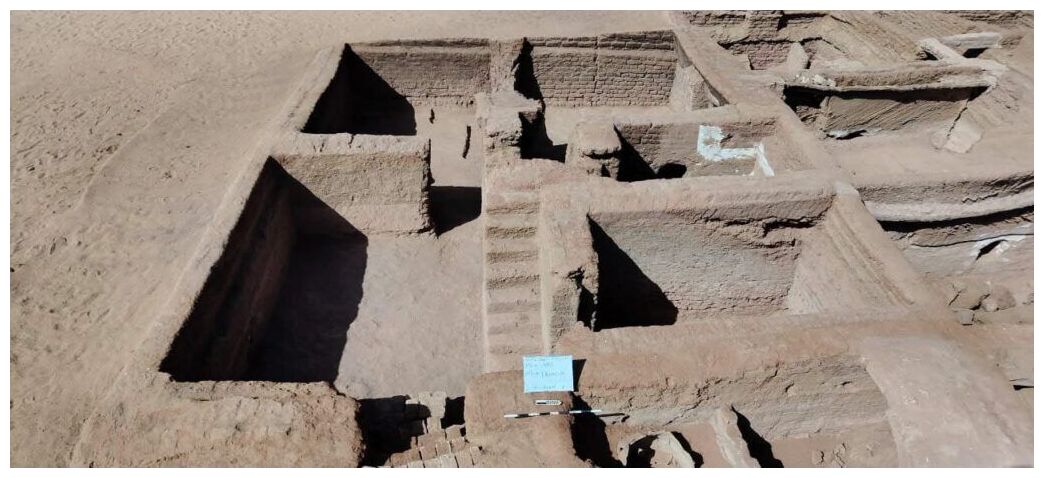
According to the ministry's statement, all of the newly uncovered buildings were made of mudbrick. The settlement follows an organized urban plan, with main streets running north to south and smaller cross-streets running east to west. These created open spaces and squares within the settlement, while a basilica-style church stood near the center, facing one of the main roads.
The layout matters because it suggests more than a loose cluster of houses. The settlement appears to have combined domestic, religious, and defensive spaces in a structured plan.
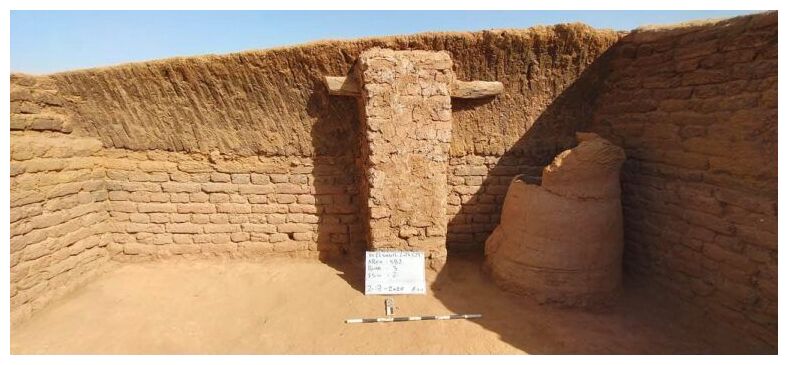
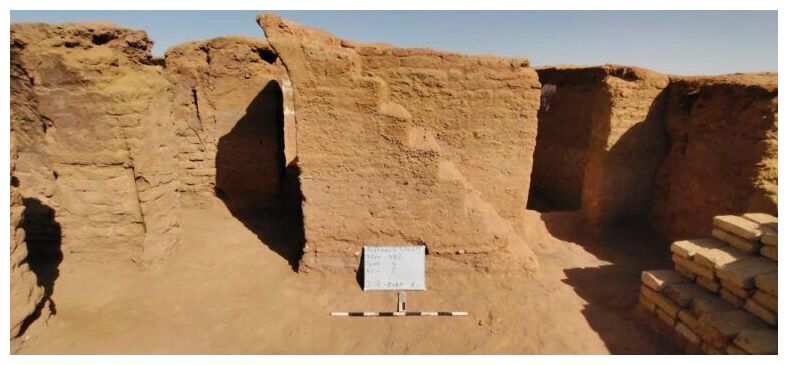
Mahmoud Masoud, General Director of Dakhla Antiquities and head of the mission, said the settlement included the main architectural elements expected in a functioning residential community: houses with large halls and vaulted ceilings, bread ovens, kitchens, grain-grinding tools, two watchtowers at the edges of the site, and a fortress with thick walls.
© Egypt’s Ministry of Tourism and Antiquities via FacebookDetails of structures found.
One of the key structures is the basilica church, dated by the mission to the mid-4th century AD. The ministry also highlighted two named houses: the house of Tisus, described as a church deacon and dated to the second half of the 4th century, and the house of Tabipus, dated to the early 4th century.
The house of Tabipus is especially important because archaeologists believe it may have functioned as a house church before the construction of the basilica. If confirmed by further study, this would offer a local sequence for the development of Christian worship in the oasis: from a domestic religious space to a purpose-built church.
That reading fits the wider archaeological picture in Dakhla. Nearby Kellis, the Roman-period village at modern Ismant el-Kharab, has produced houses, churches, temples, papyri, and ostraca that document the transition from traditional religious life to Christianity in the 3rd and 4th centuries AD.
200 ostraca in Coptic and Greek
Among the most valuable finds are about 200 ostraca inscribed in Coptic and Greek. Ostraca are texts written on pottery sherds, often used for everyday records because they were cheap and widely available.
The newly discovered texts include records of buying and selling, correspondence, and other details of daily life. For archaeologists, this kind of material can be more revealing than monumental architecture. It can show how people traded, communicated, managed property, and used language in ordinary transactions.
The language mix is also significant. Greek remained important in administration and written culture in Roman and late antique Egypt, while Coptic became increasingly visible in Christian and everyday contexts. At Kellis, scholars have noted that Greek and Coptic texts were central to understanding literacy, economy, and social life in the oasis.
© Egypt’s Ministry of Tourism and Antiquities via Facebook
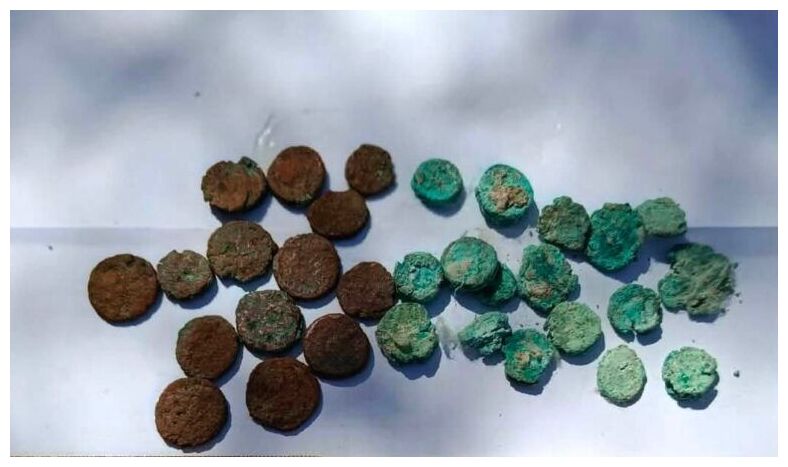
The mission also recovered a large number of well-preserved bronze coins bearing images of Byzantine emperors, Latin inscriptions, and Christian symbols. A group of gold coins was dated to the reign of Emperor Constantius II, who ruled from AD 337 to 361.
The coin evidence is important for chronology, but it should be read carefully. Coins can date activity at a site, but they do not automatically date every wall, room, or phase of occupation. Further publication will be needed to clarify how the coins relate to the settlement's construction and use.
Still, the presence of bronze and gold coinage suggests that Ain el-Sabil was not an isolated desert hamlet. It was part of the wider monetary and administrative world of the Eastern Roman Empire.
© Egypt’s Ministry of Tourism and Antiquities via Facebook
The Dakhla Oasis was not peripheral in the simple sense. It formed part of a network of settlements, roads, fields, wells, and administrative systems in Egypt's Western Desert. Modern scholarship on the Dakhla and Kharga oases has emphasized their role in Greco-Roman Egypt, including agriculture, trade, taxation, urbanism, religion, and written culture.
This is why the Ain el-Sabil discovery is useful beyond its headline value. The basilica, house church, ostraca, kitchens, ovens, grinding stones, and coins all point to that which can be studied at the level of streets, households, worship, food production, and paperwork.
The ministry describes the site as a "complete residential city" of the Byzantine period. For now, a cautious formulation may be better: Ain el-Sabil appears to be a well-preserved Late Roman or early Byzantine settlement, with unusually rich evidence for Christian life and daily administration in Egypt's Western Desert.
Source: Egypt's Ministry of Tourism and Antiquities



Reader Comments
to our Newsletter