
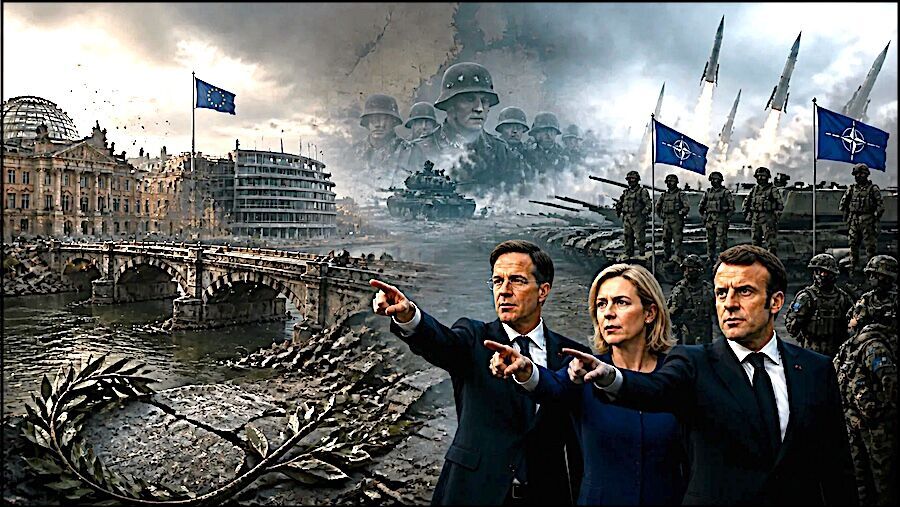
© UnknownMark Rutte • Kaja Kallas • Emmanuel Macron • Europe in collapse of strategic rationality
The Collapse of Strategic Rationality
For decades, European integration rested on a foundational promise: never again would the continent plunge into a catastrophic war. The European project was born out of devastation, with the aim of replacing power politics with cooperation, deterrence with diplomacy, and military rivalry with economic interdependence. Yet now, it's hard not to notice how many in Europe's political class seem ready to abandon those ideals in favour of a new language of confrontation and readiness for a war against Russia.
The debate about Russia no longer centers simply on Ukraine's defence. Increasingly, on both the left and right, influential European voices — such as Kaja Kallas and NATO Secretary General Mark Rutte — frame a direct conflict with Russia as not just possible but inevitable. Talk of a forthcoming war — omnipresent in the mouth of NATO Secretary General — sky-high military spending and budgets, and the narrative of a continent under imminent war have turned what was once 'deterrence' into a sweeping, ambitious geopolitical project. The shift is as dramatic as it is troubling.
This raises a fundamental question: is Europe acting according to rational strategic calculations, or has it entered a dangerous realm where ideological convictions, Russophobia, increasingly override geopolitical realities?
Classical game theory in international relations assumes that major actors behave rationally, seeking to maximise security while minimising risks. Yet the security dilemma emerges when defensive actions by one side are interpreted as offensive preparations by the other. Europe claims that its rearmament is defensive and readiness for war; Russia interprets it as preparation for future confrontation. The result is a self-reinforcing cycle of escalation rather than diplomacy.
The greatest danger is not that leaders deliberately seek war. The danger is that they begin believing in the inevitability of the war. This seems to be the case with Mark Rutte in his crusade to make Europeans buy more arms from the US, or as he sees his role: selling arms for Trump - "the man of the trillion," as he stated at the White House last week. He was so proud of having made the Europeans spend a trillion dollars on arms under Trump's dealmaking pressure and then hailing Trump as the leader or the saviour of the "free world." It was an embarrassing and pathetic scene.
Comment: See also:
NATO chief challenged on the "defensive" alliance's history of offensive regime change
The Barbarossa Shadow
History weighs heavily on Russian strategic thinking. No country in modern history has experienced invasions on the scale suffered by Russia and the Soviet Union. Napoleon's Grand Army entered Russia in 1812 and was destroyed. Hitler's Operation Barbarossa in 1941 launched the largest military invasion in human history and ultimately ended in Germany's defeat.
These experiences continue to shape Russian perceptions of security. Consequently, when Moscow observes European military rearmament, long-range missile deployments, discussions about defeating Russia strategically, and rhetoric about preparing for war by 2030, it does not interpret these developments through the lens of European intentions. It interprets them through the lens of historical memory.
The comparison with Operation Barbarossa serves as a warning that Russia increasingly perceives Europe not as a security partner but as a hostile bloc preparing for a prolonged confrontation.
If Russian leaders become convinced that Europe is preparing for eventual conflict, they will respond accordingly. In this sense, the danger lies not only in whether Europe intends another Barbarossa but also in the fact that Russia increasingly believes that some European elites, such as Kaja Kallas, Mark Rutte, Donald Tusk, Radosław Sikorski, Emmanuel Macron, Friedrich Merz, and Alexander Stubb, are moving in that direction.
There's a bitter irony here: the very continent that once set out to build itself on reconciliation now seems all too ready to carve out its identity in opposition to Russia, and has difficulties in engaging in diplomatic conversations with Russia.
Europe's Military Ambition and Strategic Contradictions
The current wave of European rearmament is justified as the need to prepare for a future without guaranteed American protection. Germany's massive defence investments, Poland's military expansion, and EU initiatives to strengthen defence industries all reflect growing uncertainty about the reliability of the United States.
However, significant contradictions remain.
Europe collectively possesses a larger population and larger economic output than Russia. Yet military power depends not only on resources but also on integration, industrial capacity, logistics, command structures, and political cohesion. Europe continues to operate a fragmented defence landscape characterised by multiple weapons systems, competing procurement programmes, and overlapping national priorities.
The paradox is unmistakable: while Europe's leaders talk ever more boldly about confronting Russia, the continent still lacks many of the capabilities needed to sustain a large-scale war unless the US is involved. Military recruitment is struggling, defence industries are fragmented, and 'strategic autonomy' is more wishful thinking than reality.
This gap between rhetoric and real capability should prompt caution. Yet in many circles, it only seems to fuel even grander pronouncements and declarations — another sign of Europe's growing detachment from reality.
Critics such as Gordon Hahn have warned about what they perceive as a growing detachment between political rhetoric and strategic reality. His observation deserves serious consideration:
"Never, ever, underestimate the irrationality of these people and their complete lack of contact with reality."Whether one agrees with that assessment or not, it highlights a genuine concern. History shows that major wars rarely begin because leaders consciously seek catastrophe. They begin because political elites convince themselves that escalation can be controlled, that adversaries will back down, or that victory is easier than it actually is. Moreover, the present European leadership clearly lack strategic vision.
The Illusion of a Winnable Conflict
The most troubling aspect of the current debate is the emergence of language suggesting that Russia can be defeated through sustained pressure and escalation.
From a geopolitical perspective, this assumption appears risky. Russia remains a nuclear superpower with enormous military-industrial capacity, significant strategic depth, and a political leadership that views the conflict with the West in existential terms.
Europe's tough rhetoric about confronting Russia sounds hollow when measured against its actual military readiness. Russia possesses one of the world's most advanced missile arsenals, having a technological lead over Europe in several strategic categories. Its hypersonic systems, including the Avangard hypersonic glide vehicle (estimated Mach 20-27), the Kh-47M2 Kinzhal air-launched ballistic missile (Mach 10-12), and the 3M22 Zircon hypersonic cruise missile (Mach 8-9), provide capabilities that no European military currently fields. Even the Iskander-M tactical ballistic missile reaches speeds of around Mach 6-7, exceeding the performance of Europe's principal long-range strike weapons.
By comparison, the Anglo-French Storm Shadow/SCALP and the German-Swedish Taurus KEPD 350 are subsonic cruise missiles, traveling at approximately Mach 0.8-0.9. Although several European countries are investing heavily in hypersonic research, none currently possesses an operational equivalent to Russia's advanced missile systems.
This technological gap illustrates that, despite Europe's growing defence budgets, Russia retains a significant qualitative advantage in long-range precision strike and hypersonic capabilities, reinforcing its strategic deterrence and making any conventional military confrontation considerably more complex for European armed forces.
Even if Europe successfully expands its military capabilities over the coming decade, the notion of a conventional military victory over Russia remains highly questionable. More importantly, the pursuit of such an objective risks creating exactly the confrontation it claims to prevent.
Europe's greatest achievement since 1945 has been the replacement of geopolitical rivalry with political cooperation. The continent's legitimacy rests not on military power but on its historic commitment to peace. Nonetheless, these days, when it comes to engaging in diplomatic negotiations with Moscow, those who try to set the pace, such as EU Council President António Costa, are immediately criticised. The EU's top diplomat, Kaja Kallas, refuses negotiations.
The real question is whether Europe's response remains anchored in its original values or whether it is drifting towards a strategic culture increasingly defined by militarisation, threat inflation, and permanent confrontation.
If that's the path Europe chooses, it may soon discover that its gravest threat isn't Russia — but the betrayal of its own founding principles, because it might entail finishing its reason for being.

Reader Comments