
© Alex Krainer's Substack
As it happened, shortly after their arrival in Moscow, this man had a medical emergency: a stroke-like event, which caused him to collapse with severe seizures. Paramedics and hospital staff reacted quickly and among other things performed a CT scan that revealed a massive blood clot in his brain. An emergency surgery was arranged to remove the clot.
According to Candace Owens, Mr. SEAL had significant health issues related to this clot including frequent headaches, hearing loss, seizures and coughing up blood. Even though these issues were related to his military service, he was unable to obtain proper treatment from the US Veterans Administration where he was told his problems were all in his head (they kind of were), related to PTSD. Instead of a CT scan and proper treatment, they prescribed him Xanax and told him to go away.
In Russia, he was treated immediately and according to Owens, his symptoms, including headaches, hearing issues, and blood coughing cleared up significantly or went away overnight. After his surgery he received physical therapy, ongoing care and further diagnostic tests. Owens described the episode in the video, which is below:
The dysfunctional system
Owens's story brought the American healthcare system into focus once more. In itself, US healthcare is one of the world's largest economies, accounting for nearly a fifth of the US GDP and eclipsing the entire economies of most nations in the world. At the same time, it is profoundly dysfunctional: it's world's most expensive healthcare system and it delivers the worst outcomes of any developed nation in the world.
That level of dysfunction will obviously give rise to a lively debate about the need to reform the system, but the debate is usually framed in way that misdirects the discussion and leads nowhere. One of the deeply divisive false dichotomies is the discussion about whether healthcare is a human right or not. The second you raise the issue of health as a human right, people almost instantly fall in one of two camps: cold-hearted capitalists vs. freeloader socialists. The debate usually consists of mutually traded insults. Naturally, it produces no solutions, and this is almost certainly by design.
In his 1998 book The Common Good, Noam Chomsky wrote that,
"The smart way to keep people passive and obedient is to strictly limit the spectrum of acceptable opinion, but allow very lively debate within that spectrum — even encourage the more critical and dissident views. That gives people the sense that there's free thinking going on, while all the time the presuppositions of the system are being reinforced by the limits put on the range of the debate."A right or an obligation?
Reframing the debate might start with the idea that healthcare ought to be a social obligation. This would be more consistent with human nature, because this is how we naturally approach illness and care for the ill. If someone in the family or in our community is unwell, we feel obligated to help. It's a hardwired impulse, it does not require an accounting ledger, an economic theory, or a University medical ethics department.
People naturally go quite out of their way to help those in need. I believe we've all seen countless videos online where ordinary individuals risk their lives and wellbeing to rescue a child fallen down a well, a dog that fell through the ice in a river, or an elephant stuck in the mud. Nobody stops to ask how much that costs, whether the rescuee has the money or insurance to compensate us, or whether they have the human (or elephant) right to deserve our effort in helping them.
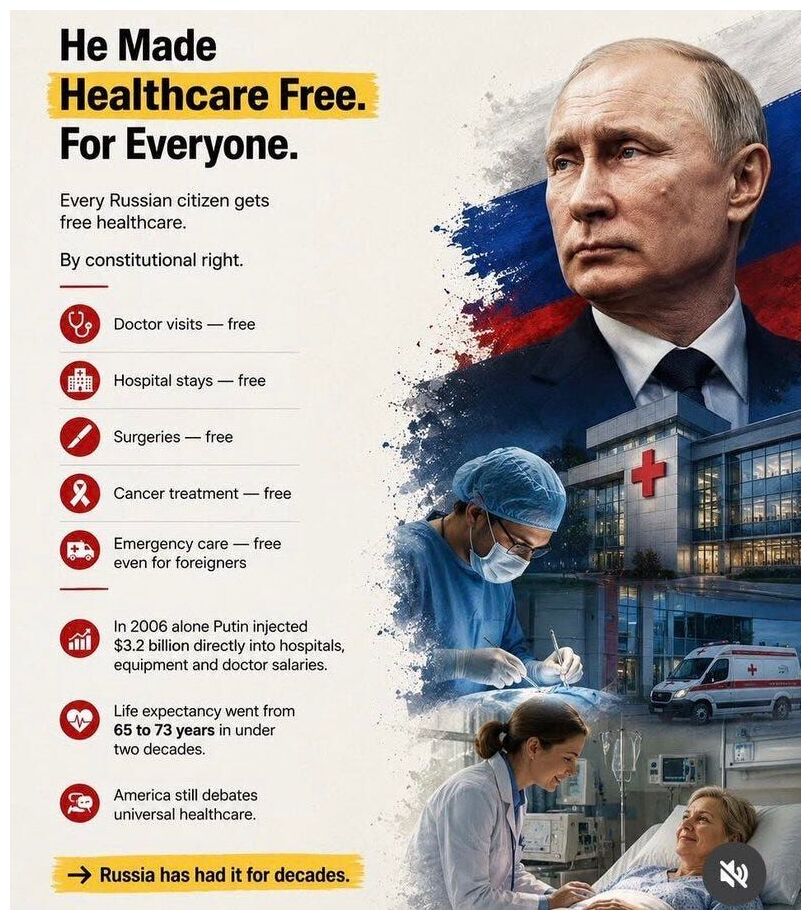
If this is the way people relate to one another in families and in communities, why shouldn't this be the case at the national level? Why shouldn't every nation treat healthcare as a social obligation? Yesterday I came across this image on X:
© Alex Krainer's Substack
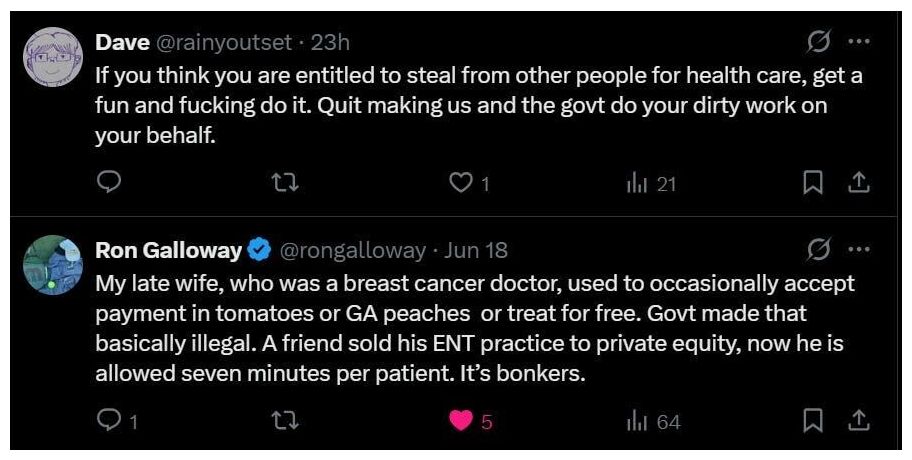
"In the West, healthcare debate is framed in a false dichotomy: is it a human right or not? Immediately, everyone's heads explode. But health care is a social obligation. When someone's unwell, the natural impulse is, we take care of them. That's been turned on its head by making it a for-profit business."Unfortunately, many people won't even consider this and I became very accustomed to being called a communist for merely suggesting it. Of course healthcare should be a for-profit business and of course you've no right to healthcare if you cannot pay. Almost instantly, as though by a mental knee-jerk reaction, we're right back to the "human right" debate because, "if I have to work for your care, you've no right to force me, bla, bla, bla..." Thankfully, the original human nature remains alive and well. Below are two of the responses to my post - with and without the ideological brainwash:
© Alex Krainer's Substack
When people are unwell, we're not being "forced" by an oppressive communist regime or their Marxist ideology. It is our own hardwired impulse to provide them care, and this makes perfect sense: I may need to take care of someone today, even if they're just a neighbor and I knock on their door to bring them a pot of home made chicken soup. Tomorrow, I'll be grateful if someone knocks on my door with a pot of chicken soup. It's simply mutual care and support and strictly has nothing to do with communism, socialism or Marxism.
It should not be beyond a society to organize healthcare in this way. To be sure, it would be a cost to society. But so is maintaining an army, a police force and firefighting squads. I believe everyone would be far better off if they could receive the treatment like Candance Owens' Mr. SEAL, without worrying about whether they can afford it, or whether the treatment could bankrupt their family.
One of the last lines of ideologized arguments focuses on the quality of care: if healthcare is free, surely it will be poor quality, bla, bla, look at Canada, UK, bla, bla. The American system is very much a private, for-profit industry. In spite of that, it delivers some of the worst outcomes of any system in the world, costs a fortune, and reigns supreme as the third leading cause of death in the country (in the aftermath of the Covid 19 pandemic it temporarily became the #1 cause of death).
Maybe it's time to upgrade the "capitalist" ideology and revert to systemic thinking: what goes in, what comes out, and how can we engineer the system so that what comes out is what we actually want? From there it's the work of maintenance, upgrading and refinements. If Russia can do it, why not the US?



Reader Comments
to our Newsletter