
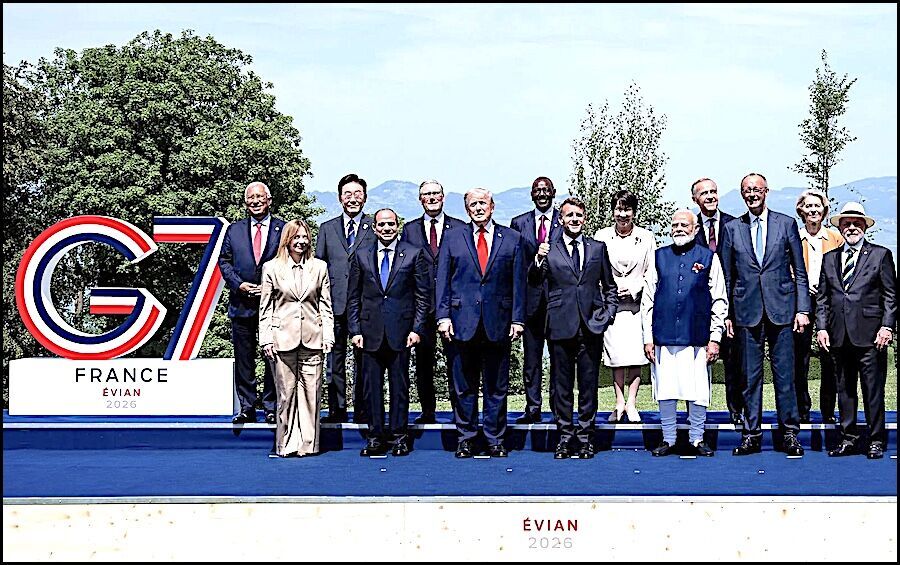
© Christopher Katsarov/Keystone Press Agency/Global Look PressG7 Meeting attendees
Alliance without Consensus
The recent G7 summit was intended to showcase Western solidarity at a moment of mounting geopolitical uncertainty. Instead, it inadvertently revealed something more significant: the West remains institutionally united but strategically fragmented.
On paper, the summit was a success. The leaders issued joint statements on critical minerals, artificial intelligence, migrant smuggling, transnational repression, quantum technologies, wildfires, and support for Ukraine. Yet the sheer breadth of these commitments raises an uncomfortable question. Why does the world's most powerful political grouping increasingly speak the language of management rather than strategy? The G7's joint statements are filled with promises to "strengthen," "coordinate," "accelerate," and "support." What is largely absent is a coherent vision of how the West intends to navigate a world marked by geopolitical rivalry, economic nationalism, and declining American willingness to shoulder the burdens of global leadership. The documents read less like a blueprint for shaping international order than a catalogue of risks to be mitigated in one way or the other, showing a stark absence of an acceptable strategy or a joint mechanism. The alliance appears increasingly reactive rather than directive.
That shift reflects a deeper reality. The G7 emerged during an era when its members broadly agreed on the fundamentals of economic governance, security policy, and international leadership. Those assumptions are now under strain. The United States, Europe, and other Western partners remain allies, but they no longer view the international system through the same lens. The result is an alliance that still produces consensus documents but struggles to generate a common strategic purpose.
Europe Is Preparing for a Different Future
The clearest evidence of this transformation did not come from the G7 communiqué itself. It came from Brussels. In her statement, European Commission President Ursula von der Leyen repeatedly emphasised competitiveness, economic security, technological leadership, resilience, and reducing strategic dependencies. These themes have become central to the European Union's political vocabulary. They are not anti-American, although anti-American thinking is on the rise in the region. But neither are they rooted in the traditional assumption that transatlantic cooperation alone can guarantee Europe's prosperity and security.
The language matters because it reveals how European leaders increasingly understand the world. For decades, Europe's grand strategy rested on a simple division of labour: the United States provided security, while economic integration generated prosperity. That model is becoming harder to sustain.
The concern is no longer confined to academic debates about European autonomy. A recent report by the European Council on Foreign Relations argues that Europe faces a defining strategic choice: continue accommodating American pressure in the hope of preserving transatlantic harmony or develop the political and economic leverage necessary to defend its own interests. The report's warning is significant because it treats dependence on Washington not as a temporary inconvenience but as a structural vulnerability. The question confronting Europe is no longer whether it values the alliance, but whether the alliance can remain sustainable if one side possesses overwhelming leverage over the other. A 2024 European Parliament study on transatlantic relations after the Inflation Reduction Act concludes that the legislation fundamentally altered European perceptions of partnership with the US. There is competition along nationalist lines. This argument would have sounded radical a decade ago. Today, it increasingly reflects mainstream European thinking.
The crisis of NATO's expansion in Ukraine exposed Europe's military vulnerabilities. The Inflation Reduction Act exposed the extent to which even close allies can become economic competitors. Trade disputes over green technologies, electric vehicles, and industrial subsidies have reinforced the perception that strategic dependence carries costs regardless of whether the dependency is on adversaries or partners. This helps explain why concepts once associated primarily with French strategic thinking — "strategic autonomy," "economic sovereignty," and industrial resilience — have moved steadily into the European mainstream.
The irony is striking. At the very moment Western leaders celebrate unity, Europe is investing increasing political energy in preparing for a future in which it may need to act more independently. This is not necessarily a rejection of the Atlantic alliance. It is an acknowledgement of uncertainty. European policymakers have spent nearly a decade debating whether American foreign policy volatility represents a temporary disruption or a structural shift. Increasingly, they appear to have reached a conclusion: unpredictability itself has become predictable.
The significance of Donald Trump lies not simply in his policies, but in what his political success revealed about the United States. European governments can no longer assume that future American administrations will share the same understanding of alliances, trade, or international responsibility that prevailed during much of the post-Cold War period. Consequently, Europe is quietly adapting to a world less reliant on the US.
The West Is Being Repurposed
Many analysts continue to ask whether the Western alliance is weakening. That might not be the most accurate framing of the question. The more important question is whether the alliance is being transformed into something fundamentally different from what it was designed to be.
The traditional Western order rested on hierarchy. The United States provided leadership, Europe provided legitimacy, and institutions such as the G7 translated that relationship into collective action. Today, each component of that arrangement is changing.
Washington increasingly pursues policies driven by domestic economic and political imperatives. European governments increasingly prioritize resilience and autonomy. Multilateral institutions increasingly function as mechanisms for coordination rather than instruments of strategic leadership.
The G7 communiqué itself illustrates this evolution. The emphasis on critical minerals, secure supply chains, emerging technologies, and economic resilience reflects a world in which even allies are preoccupied with vulnerability. The dominant concern is no longer expanding a liberal international order. It is managing exposure within an increasingly fragmented one. This distinction matters. Alliances are strongest when members share a common destination. They become weaker when they share only common concerns.
None of this means the West is on the verge of an immediate collapse. The economic weight, technological capacity, military power, and institutional depth of the transatlantic community remain formidable. The G7 countries still account for a substantial share of global output and possess unmatched influence across international institutions. But power alone cannot sustain an order. Orders require purpose.
The coming decade is therefore unlikely to witness a dramatic rupture. Instead, it may produce something more consequential: the gradual emergence of a post-American West. Not a West without the United States, but a West in which American leadership can no longer be assumed, European dependence can no longer be taken for granted, and institutions built for a different era struggle to adapt.



Reader Comments
to our Newsletter