
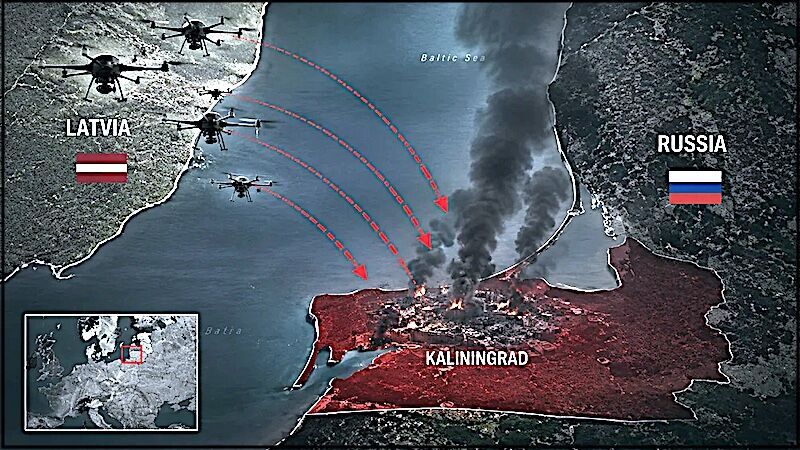
© UnknownUkrainian drones on trajectory from Latvia • Destination Kaliningrad
The Russian Foreign Intelligence Service (SVR) has issued a direct warning: Ukrainian drone teams have reportedly already been deployed on Latvian territory in preparation for new strikes against Russia's rear regions. According to Moscow, Kyiv is seeking to demonstrate its ability to damage the Russian economy, while Latvia — whose government recently collapsed amid controversy over Ukrainian drones using its airspace — has allegedly agreed to provide logistical support for such operations.
If these claims are accurate, this represents a serious escalation on NATO's eastern flank and significantly raises the risk of kinetic retaliation and, in the worst case, a direct NATO-Russia confrontation.
From Moscow's perspective, the logic is straightforward. Russia has no interest in occupying the Baltic states or their largely hostile populations, nor does it desire a full-scale war with NATO that could spiral into nuclear confrontation. At the same time, it cannot indefinitely tolerate attacks on its territory allegedly launched from the soil of a NATO member state. The message from Russian officials is increasingly clear: if infrastructure on Latvian territory is used to strike Russia, that infrastructure may eventually be treated as a legitimate target.
Russian Ambassador to the OSCE Dmitry Polyanskiy has already warned that it may be too late to prevent some form of Russian retaliatory action against limited targets linked to NATO. Similar assessments have been echoed by Russian strategic commentators. Whether these signals are coordinated or independently reached is less important than the underlying reality they reflect: parts of the Russian security establishment appear to believe that escalation thresholds are shifting.
Why Latvia?
Part of the answer lies in a combination of ideological zeal and strategic short-sightedness. Latvia's permanent military, intelligence, and diplomatic bureaucracy has long maintained one of the most hardline anti-Russian postures within the Euro-Atlantic bloc. This institutional hostility appears to have overridden basic considerations of national security and self-preservation. Even as the Latvian government collapses under domestic scandal, elements within the security apparatus seem prepared to allow Ukrainian operations from Latvian soil, effectively turning the country into a forward operating base for strikes against Russia.
Credible reports have previously emerged of Ukrainian drones using Baltic airspace for attacks on Russian territory. Each such incident further fuels demands from Russian hardliners for stronger responses. The latest SVR warning fits into this pattern: it is both an assessment and a public signal that Moscow's patience is not unlimited.
The Strategic Trap for NATO
The deeper problem is not Latvia alone, but the dangerous dilemma this creates for the entire Alliance.
The Baltic states have very limited strategic depth and rely heavily on Article 5 guarantees. Yet the more their territory becomes associated — directly or indirectly — with Ukrainian strikes against Russia, the greater the likelihood that Moscow will feel compelled to test the credibility of those guarantees through limited retaliation.
This places NATO in an extremely difficult position.
A targeted Russian strike against alleged Ukrainian drone infrastructure on Latvian soil would confront the Alliance with a stark and uncomfortable choice: either escalate in defence of a member state that has facilitated attacks on Russia, or accept a limited strike on NATO territory without mounting a full retaliatory response.Neither option is strategically attractive, and both carry the risk of exposing the practical limits of Article 5 when a member state has crossed the line from passive ally to active participant in hostilities.
A Warning for Central and Eastern Europe
The Latvian episode is a symptom of a broader problem visible across parts of NATO's eastern flank: the dangerous assumption that ideological confrontation with Russia can be pursued indefinitely without producing direct security consequences for the frontline states themselves.
Countries like Poland and the Baltic states have positioned themselves among the most uncompromising critics of Moscow. While this posture brings political visibility, it also carries real risks — especially when geography places them directly on the potential line of fire.
In a multipolar world, ideological maximalism is a luxury that smaller and medium-sized states can rarely afford. Strategic pragmatism, de-escalation mechanisms, and careful management of escalation thresholds become far more valuable.
Russia has repeatedly stated that it does not seek direct war with NATO. At the same time, it has made it clear that it will not allow continuous attacks on its territory from NATO member states to go unanswered forever.
The margin for miscalculation on NATO's eastern flank is becoming dangerously narrow. Whether this remains rhetorical signaling or develops into something more serious will depend on decisions taken in the coming weeks by Kyiv, the Baltic governments, Washington and Moscow.
One thing, however, is increasingly clear: the era of cost-free provocation is coming to an end.



Comment: Point of no return: When one-offs become critical threats.
For clarification: