
© Kevork’s Newsletter
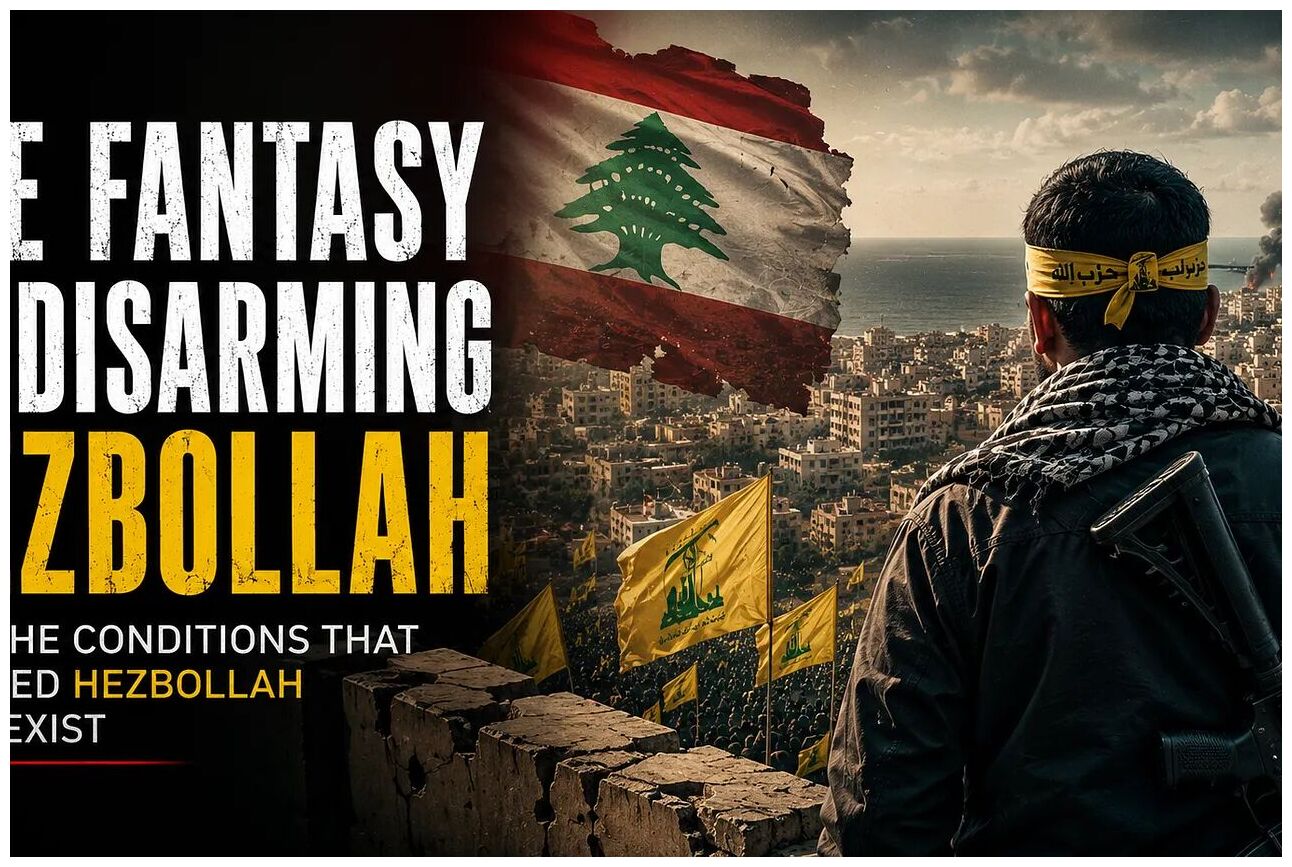
At first glance, the argument sounds reasonable. In fact, it sounds so reasonable that many people never stop to ask a much more important question: what exactly would Hezbollah be disarming into?
Because before discussing Hezbollah's weapons, one must first discuss Lebanon itself, where the conversation becomes uncomfortable. The people who demand Hezbollah's disarmament often begin with an idealized image of Lebanon rather than the Lebanon that actually exists. They imagine a coherent nation-state with a shared national identity, functioning institutions, and a unified understanding of the country's interests. They imagine a state capable of protecting all its citizens equally and defending its borders independently. In other words, they begin from the conclusion rather than from reality.
I spent five years studying and working in Lebanon, and one of the most important lessons the country taught me is that Lebanon often appears far more unified from the outside than it actually is from within. Lebanon means a great deal to me personally. It was there that I began my professional life. It was there that I worked as a producer, later as a host, and eventually published my first opinion articles. It was there that I discovered that political analysis could become more than a passion. It could become a vocation. Lebanon gave me opportunities that Syria, at the time, simply could not offer.
But Lebanon also taught me something else. It taught me that what many outsiders call "Lebanon" is often a collection of different political universes sharing the same geographical space. Travel through the country and the differences become impossible to ignore. In the north, you encounter one set of loyalties, symbols, and narratives. In Tripoli, another. In Mount Lebanon, another. In Beirut, multiple competing realities coexist simultaneously. In the south, yet another political consciousness emerges entirely. Flags change. Historical memories change. Perceptions of allies and enemies change. Even the understanding of what Lebanon is supposed to be changes.
This fragmentation is not merely the residue of the civil war. The civil war exposed it, but it did not create it. Modern Lebanon was constructed around a delicate sectarian formula that sought to balance competing communities rather than forge a single national project. For decades, different factions cultivated different external patrons. Some looked to France. Others to Saudi Arabia. Others to Syria. Others to the United States. Others to Iran. Political identity often became intertwined with foreign sponsorship, external alliances, and sectarian affiliation. The result was a state that formally existed but never fully succeeded in creating a unified national consciousness.
This reality matters because it lies at the heart of the Hezbollah question.
The people who demand Hezbollah's disarmament often speak as though Hezbollah emerged as the cause of Lebanon's dysfunction. But what if the opposite is closer to the truth? What if Hezbollah emerged precisely because the Lebanese state was unable to perform the functions expected of a sovereign state? What if Hezbollah is not the cause of Lebanon's fragmentation but one of its consequences?
To understand why Hezbollah will not disarm, one must understand how its supporters view the world. And this is where many Western analysts fail. They approach Hezbollah primarily as an Iranian proxy. Hezbollah's supporters do not see themselves that way. Whether one agrees with them or not is beside the point. The more important question is how they perceive their own security.
For much of Lebanon's Shia population, Hezbollah is not merely a political party or an armed movement. It is an insurance policy against annihilation.
That statement may sound exaggerated to outsiders, but it reflects a very real historical consciousness. Communities do not make decisions about security based on abstract theories. They make them based on memory. Memory of occupation. Memory of invasion. Memory of massacres. Memory of abandonment. Memory of what happened to those who trusted promises of protection and discovered too late that those promises were worthless.
And this memory runs particularly deep within the Shia community. It is reinforced not only by modern events but also by centuries of religious and historical experience. The memory of Karbala, the killing of Imam Hussein, the perception of betrayal and persecution, and more recent encounters with sectarian violence have produced a political culture that sees vulnerability very differently from the way Western policymakers do. Whether outsiders consider this perception justified is irrelevant. What matters is that millions of people genuinely believe it.
And when people genuinely believe that disarmament could eventually lead to their destruction, they do not disarm.
This becomes even more obvious when one examines the regional environment surrounding Lebanon today. The discussion about Hezbollah's weapons is often framed entirely through the lens of Israel. Israel is certainly part of the equation. Southern Lebanon remains occupied in places. Israeli military aggressions continue. Israeli threats remain constant. But even if Israel disappeared from the equation tomorrow, the question of Hezbollah's weapons would not disappear with it.
Because Hezbollah's supporters do not only look south.
They also look east. They look at Syria and what emerged from the Syrian war.
They look at the rise of Abu Mohammad al-Jolani and the thousands of battle-hardened Salafi-jihadist fighters who now operate under his authority. They look at ISIS. They look at Al-Qaeda. They look at the massacres carried out against Shia communities in Iraq. They look at the sectarian rhetoric that has circulated throughout the region for decades. And they draw conclusions that many Western observers refuse to acknowledge.
From their perspective, disarmament would not represent reconciliation. It would represent surrender.
And this is where the entire conversation becomes detached from reality. Because asking Hezbollah to disarm under such circumstances is not merely asking an armed movement to trust the state. It is asking an entire community to trust that all the forces surrounding them have suddenly abandoned the ideological hostility they have expressed for decades.
There is no evidence that such a transformation has occurred.
Quite the opposite.
The rise of sectarian militancy throughout the region has only reinforced Hezbollah's argument that self-defense remains necessary. The collapse of states in Iraq, Syria, Libya, and elsewhere has reinforced the belief that formal institutions can disappear far more quickly than communities expect. The emergence of extremist organizations has reinforced fears that power vacuums are rarely filled by liberal democrats.
And this is why the disarmament debate often feels detached from the realities of the Middle East.
Its advocates speak as though Lebanon exists in Switzerland.
Hezbollah's supporters know they live in the Levant.
This distinction matters.
It matters because movements surrender their weapons when they believe the future will be safer without them. They surrender them when the security environment changes. They surrender them when they believe institutions can protect them better than armed organizations can.
The Shia community in Lebanon looks around the region today and reaches precisely the opposite conclusion.
They see an expansionist Israel continuing military aggressions across multiple fronts. They see Syria transformed by more than a decade of war and increasingly influenced by forces they fundamentally distrust. They see Salafi-jihadist currents that continue to regard them as apostates. They see a Lebanese state that is both incapable and unwilling to defend its territory independently, and incapable of creating a national consensus regarding the country's future.
Under such conditions, disarmament begins to look like suicide.
And this is why I believe the debate is framed incorrectly. The question is not why Hezbollah refuses to disarm. The question is why so many people continue pretending that the conditions necessary for disarmament already exist.
Hezbollah is not merely a military organization. It is the product of a particular geopolitical environment, a particular historical experience, and a particular understanding of survival. One may agree with that understanding or reject it entirely. But any serious analysis must begin there.
As long as the conditions that created Hezbollah remain intact, the expectation that Hezbollah will voluntarily surrender its weapons will remain what it has always been.
A fantasy.


Reader Comments
to our Newsletter