
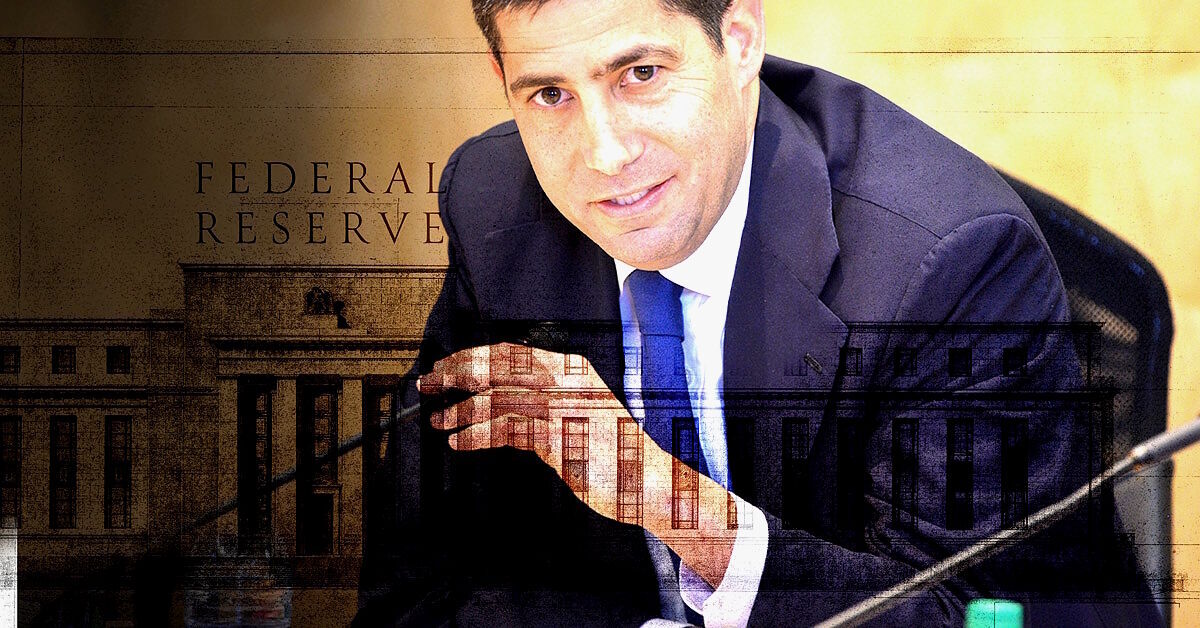
© Scotsman GuideKevin Warsh, Chairman of the Federal Reserve
This morning was proof that the inflation story that markets desperately want to go away refuses to cooperate. It also adds to the case that new Fed chair Kevin Warsh could have his hands tied — and may ultimately need to redefine inflation to untie them.
This morning the Bureau of Labor Statistics reported another really ugly wholesale inflation print, adding to a growing pile of evidence that inflation pressures are proving far more persistent than policymakers, economists, and investors had hoped.
The Producer Price Index rose 1.1% in May, well above economist expectations of 0.7%. On a year-over-year basis, wholesale inflation accelerated to 6.5%, the highest reading since November 2022.
Even though core PPI, which excludes food and energy, came in slightly below expectations at 0.4% versus estimates of 0.5%, that distinction shouldn't provide much comfort. The headline figure remains extraordinarily elevated, and businesses are still dealing with rising costs that eventually work their way through supply chains and into consumer prices. CNBC reported:
Most of the acceleration in the PPI — nearly 80% — came from a 2.8% surge in final demand goods prices, the biggest increase ever in a data series going back to December 2009. In turn, 80% of that increase came from a 10.7% jump in energy.Zero Hedge posted the following chart on X showing the jump:
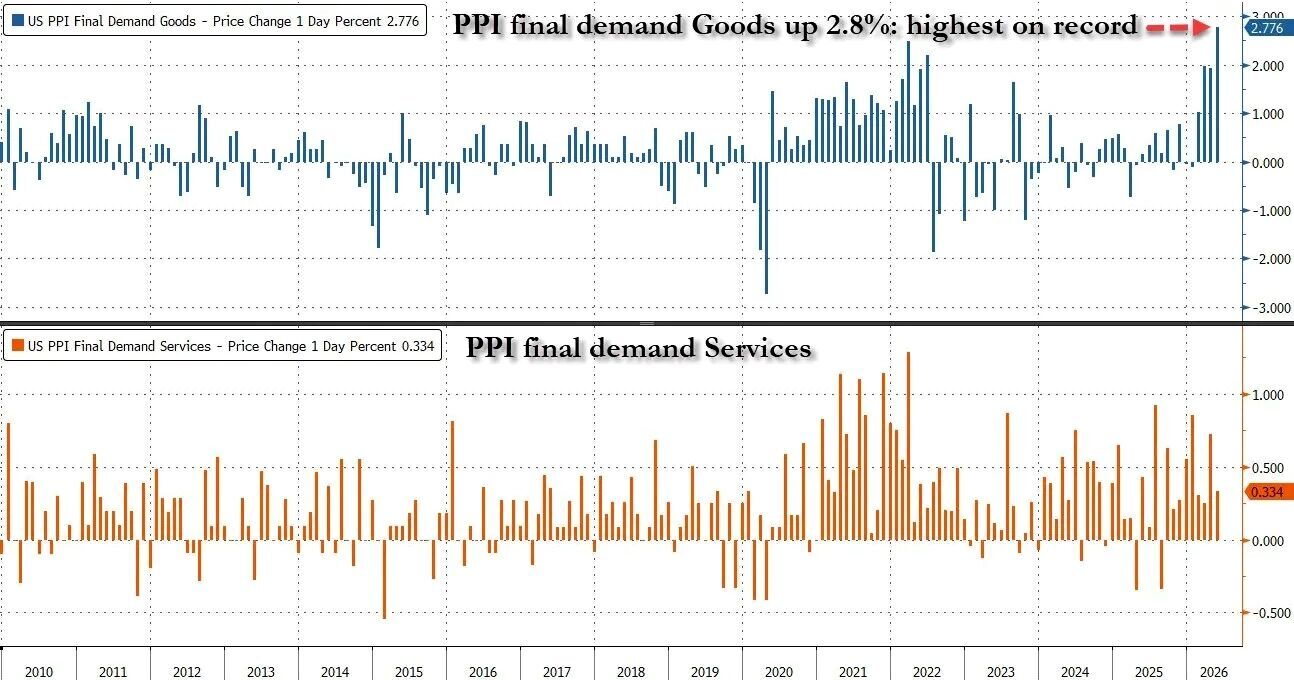
PPI final demand goods rose 2.8% in one month, the biggest jump on record
Producer prices spiked 1.1% in May, following a downwardly revised 1.1% rise in April. That's back-to-back months of 14% annualized increases. So far in 2026, the PPI is already up 4%. If this pace continues, it will rise 10% in 2026, matching the 2021 gain, the most since 1980.PPI is often viewed as a leading indicator for future inflation because it measures costs before they reach consumers. When businesses face higher input costs, those costs rarely disappear into some magical accounting black hole. They generally get passed along. Companies can absorb some pain for a while, but eventually somebody pays the bill. Historically, that somebody is the consumer.
The significance of today's report extends beyond a single monthly data point. It comes on the heels of yesterday's CPI report, which showed inflation accelerating once again. The Consumer Price Index rose 0.5% during the month, pushing annual inflation to 4.2%. While both figures matched economist expectations, that hardly qualifies as good news.
In fact, inflation has now climbed above 4% for the first time in three years and sits at its highest level since April 2023. Personally I'm not sure how it could be made any clearer to the market that rates are going to have to hold steady or move higher than being nowhere fucking near the Fed's 2% "target".
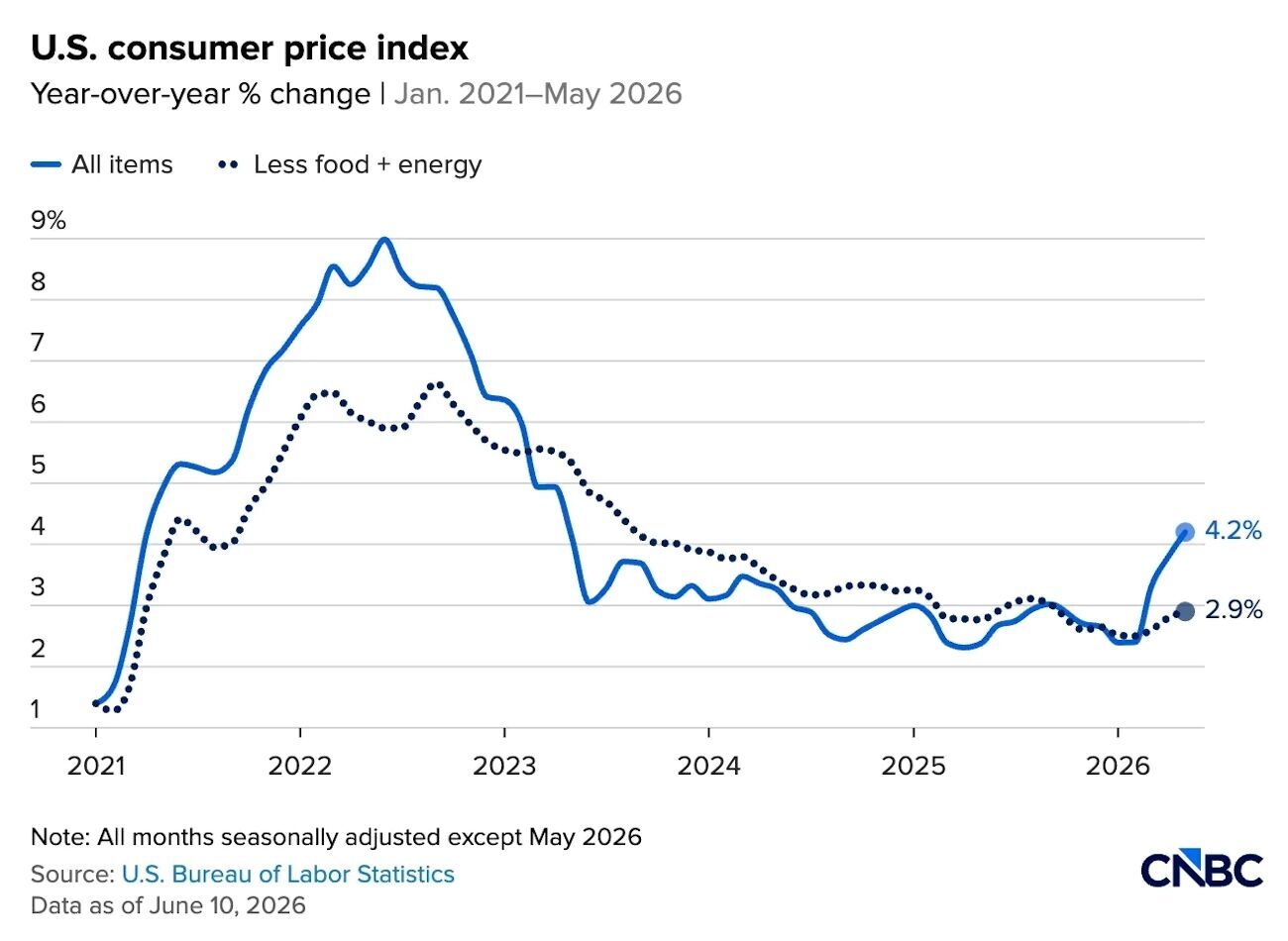
© CNBC/BLS
Taken together, yesterday's CPI report and today's PPI report paint a picture that should make rate-cut enthusiasts increasingly uncomfortable. Consumer inflation is accelerating. Wholesale inflation is accelerating. Energy prices are pushing higher. And the broad disinflation narrative that markets spent the better part of the last year embracing is showing signs of breaking down.
Last month, I argued that markets were underestimating how quickly the conversation could shift from rate cuts to rate hikes. At the time, that seemed like an aggressive position. Most investors were still operating under the assumption that inflation would continue drifting lower, growth would soften in an orderly fashion, and the Fed would eventually ride in with rate cuts to keep the party going.
That assumption looks considerably shakier today. And every inflation report that comes in hot further limits the Federal Reserve's options.
At best, this data supports a case for keeping rates elevated for significantly longer than markets would like. At worst, it supports a growing argument that the next move from the Federal Reserve may not be lower rates at all...it may be higher.
That possibility still sounds absurd to many investors because markets have spent years conditioning themselves to expect monetary accommodation whenever conditions become uncomfortable. Somewhere along the way, investors became convinced that central banking was supposed to function like a customer service call center for the S&P 500.
Stocks down? Cut rates. Economy slowing? Cut rates. Credit markets stressed? Cut rates. Investors sad about the death of their pet goldfish? Cut rates. Octogenarian billionaires complaining about flatulence that investments are giving them? Cut rates.
Unfortunately for that crowd, inflation doesn't particularly care about market expectations, portfolio allocations, or CNBC panel discussions about why six cuts are definitely coming next year.
The Fed can tolerate slower growth. It can tolerate weaker sentiment. It can tolerate hedge fund managers with gas and anchors nearly shitting themselves on financial television. What it cannot tolerate indefinitely is inflation running more than double its target while wholesale prices reaccelerate to levels not seen in years.
And that's where this vice grip keeps tightening. This market is already facing a half-dozen serious roadblocks and questions that all investors should know about. I wrote about them earlier this week and it's a free read:
Now, every hot inflation report removes another degree of freedom from policymakers. Every upside surprise forces markets to reconsider assumptions about lower rates, easier financial conditions, and endless liquidity. Every month that inflation remains elevated increases the probability that "higher for longer" eventually becomes "higher still."
That's bad news for an economy that has spent the better part of fifteen years becoming addicted to cheap money.
Higher rates don't simply affect stock valuations. They tighten financial conditions across the entire economy. They pressure borrowers. They increase refinancing risk. They squeeze commercial real estate. They stress private credit. They raise funding costs. They expose leverage that only works when money is cheap. The longer rates stay elevated, the tighter that grip becomes.
Yesterday's CPI report showed inflation running at 4.2%, the highest level in more than three years. Today's PPI report showed wholesale inflation running at 6.5%, the highest level since late 2022.
Neither report supports the case for imminent rate cuts. Together, they strongly support the opposite conclusion. At a minimum, they reinforce the argument that rates cannot be cut anytime soon without the Fed risking what little inflation-fighting credibility it has left. At the extreme, they strengthen the case that policymakers may eventually have to consider raising rates again.
That is a conversation markets still seem remarkably unwilling to have. Instead, investors continue behaving like a rate-cut rescue package is just one meeting away. Every soft data point gets interpreted as bullish because it means cuts are coming. Every strong data point gets interpreted as bullish because growth is resilient. Somehow every possible outcome leads to the exact same conclusion: buy more stocks.
It's a fascinating intellectual framework. Unfortunately, inflation data has a nasty habit of ruining good stories. We're already operating in territory that would have sounded ridiculous a decade ago. Inflation remains far above target. Interest rates are sitting near multi-decade highs. Government debt continues exploding. Asset prices remain historically elevated. Consumers are increasingly stretched. Credit markets are showing signs of strain. Yet markets continue acting as though the return of free money is some sort of natural law.
The reality is that the bill for years of monetary excess — and Janet Yellen's massive super-genius brainpower — is still arriving.
At her final news conference as Fed chair Wednesday, Yellen said the Fed's failure to bring inflation up to the central bank's 2 percent mandate is her single disappointment.The unprecedented situation we're in isn't stabilizing. It's becoming more unstable. The vice grip on the economy and financial markets is tightening one data point at a time. The screws turn a little further with every inflation report that refuses to cooperate, every producer-price surprise, every CPI release that reminds everyone that inflation never actually went away — it merely stopped accelerating for a while.
"We have a 2 percent symmetric inflation objective. For a number of years now, inflation has been running under 2 percent, and I consider it an important priority to make sure that inflation doesn't chronically undershoot our 2 percent objective," she said.
The uncomfortable truth is that policymakers spent years trying to convince everyone there was a painless exit from the biggest monetary experiment in modern history. Now they're discovering the same thing everyone else eventually discovers and the thing that Austrian economists have been screaming from rooftops: there are no painless exits, only delayed consequences.



Reader Comments
to our Newsletter