
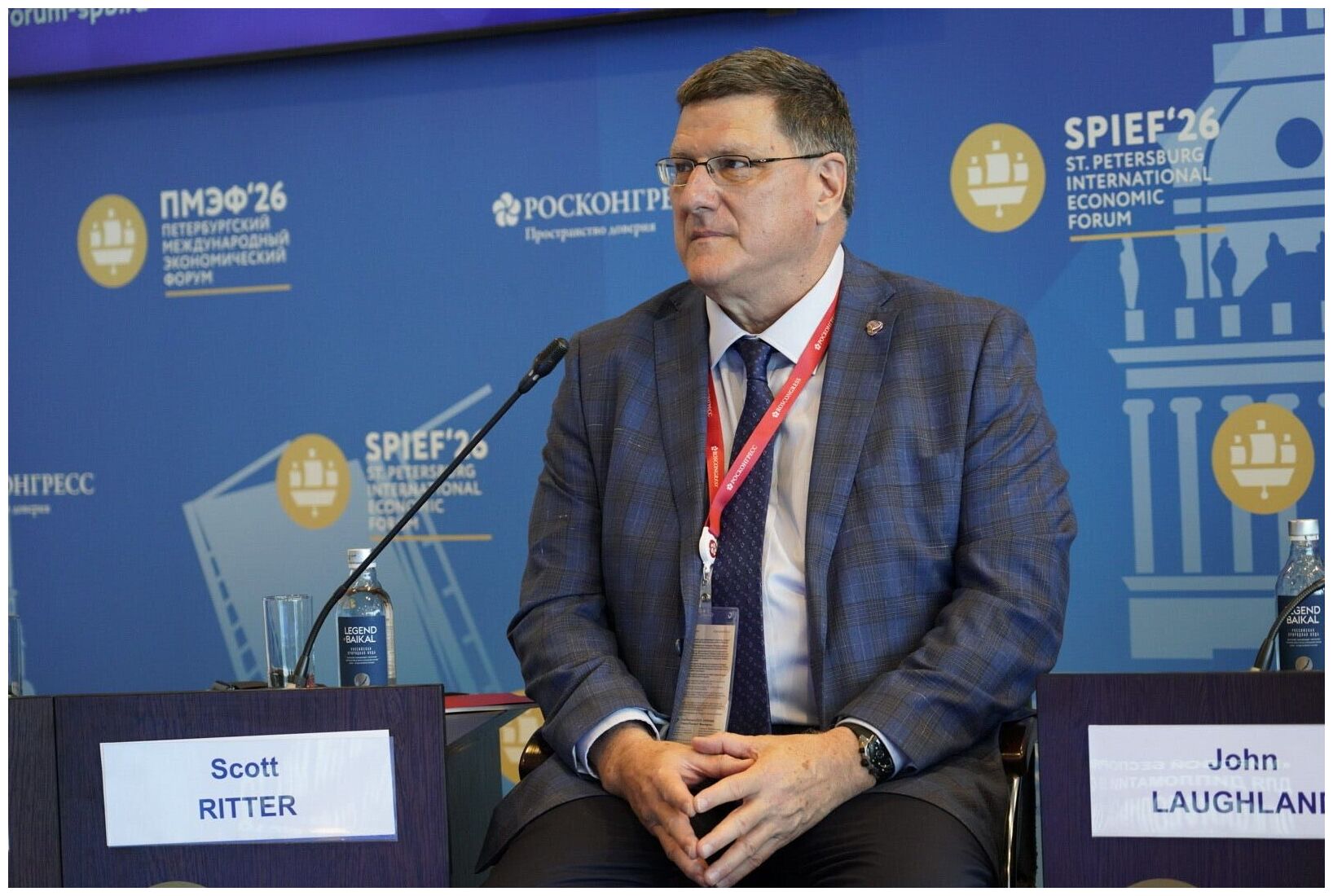
© Real Scott Ritter
Like I said, it was a distinct honor and privilege to be invited to participate is such an august event.
The panel I was to participate in was entitled "The World Disorder": Is There Any Room for Diplomacy in Contemporary International Relations." The event was moderated by Dmitry Stolkov, an Associate Professor at MGIMO, the Russian government's school of international relations, where the next generation of Russian diplomats are trained.
The heaviest hitter on the panel was Aleksandr Pankin, a Deputy Foreign Minister of the Russian Federation. A1985 graduate of MGIMO, Mr. Pankin's career focused on international organizations, with tours of duty New York and Geneva working with the United Nations.
Coming in close second was Anatoly Torkunov, the Rector of MGIMO; Mr. Torkunov is considered to be one of the leading experts on Russian diplomacy.
Also present were Sergey Pospelov, the Executive Secretary of the Parliamentary Assembly of the Collective Security Treaty Organization, Michele Geraci, a former Deputy Minister of Economic Development of Italy, and John Laughland, a Eurosceptic who currently is a professor at ICES, the Catholic Institute of the Vendée in La Roche-sur-Yon in Western France, where he lectures on political science, political philosophy and history.
I prepared my presentation in advance, having scribbled down a few notes on a piece of paper to help collect my thoughts. As anyone who has done public speaking knows, the best laid plans often get cast to the side once the green light goes on and it is your turn to speak. My actual presentation at SPIEF was well received, but I feel like the audience and the panelists were taken aback by my pronouncement at the conclusion of my address that the best solution for Russia when it came to a rogue European collective was to "shoot the dog", drawing on my analogy of Europe behaving like a rabid dog.
I offer the following as a means of expanding on this concept, drawing upon the very notes I was supposed to refer to during my address, but which slipped my mind when the spotlight was turned on.
Diplomats speak in terms of "realpolitik", "idealpolitik", and "the national interest." I am not a diplomat, but I learned about these concepts, and others, by reading the works of diplomats, including Henry Kissinger's classic tome, Diplomacy.
I have spent a lifetime implementing the consequences of diplomacy, in particular arms control agreements ostensibly designed to make the world a safer place to live. I cut my teeth of the Intermediate Nuclear Forces (INF) treaty and later went on to lead United Nations weapons inspections teams in Iraq mandated by Security Council resolutions. For me, arms control agreements represent the highest expression of human rationality, combining the intellectual capacity to understand and appreciate the inherent value of life with a moral compass that compels one to act on this comprehension.
The INF treaty was, to me, the epitome of arms control — the gold standard, so to speak, combining Reagan-era "idealpolitik", European "realpolitik" and Soviet "national interest" into a singularity which, for the first time in the nuclear era, set forth an agreement which sought not to limit the growth of the respective nuclear arsenals of the parties involved, but actually eliminate them — the logical conclusion of a collective understanding that nuclear wars cannot be won, and therefore should never be fought, obviating the need to maintain these deadly weapons at all.
The INF treaty succeeded because it was in the mutual interest of both the United States and the Soviet Union for it to do so. It was not an agreement imposed on one party by the other, but rather compelled by a mutual understanding that the terms of the agreement were necessary for the continuation of life itself. In terms of preventative diplomacy, the INF treaty represents the rational manifestation of risk avoidance, where the parties involved understood that the paths they had chosen when undertaking the development and deployment of INF weapons systems would inevitably lead to a conflict that could only end in a nuclear Armageddon, and as such they had no choice but to take the harsh but necessary steps to eliminate these weapons under terms that were mutually acceptable.
The disarmament of Iraq was ostensibly designed to follow the model of the INF treaty, an agreement based upon declarations of material subject to be disarmed that would then be subjected to inspection-based compliance verification. What set the Iraq experience apart from that of the INF treaty was the fact that it represented the collective will of the world as expressed in the form of a binding Security Council resolution that was them imposed on a member state as the consequence of military action. Disarmament came not as the result of equitable preventative diplomacy, but rather diplomacy backed by the inherent threat of force.
The UN experience in Iraq should have marked the evolutionary progression of disarmament, a multi-lateral agreement derived from a collective understanding that weapons of mass destruction represent a threat to all humanity, especially when in the hands of a party that has demonstrated a willingness to use them, and as such must be removed, destroyed or rendered harmless.
In the case of Iraq, however, this noble ideal was undermined by the actions of a single party — the United States — which used the processes of compelled arms control not for the benefit of all humanity, but rather to further national goals of regime change inside Iraq that fell far outside the four corners of the disarmament framework agreed to by the Security Council.
The Iraq experience should have been the foundation upon which the future of arms control was built — a collective understanding that weapons of mass destruction represented an inherent risk to all of humanity and should be eliminated based upon the common understanding of the family of nations. Instead, it ended up as the ultimate expression of US hegemony, where the interests of a single nation were put ahead of the common good. In short, the Iraq disarmament experience represents the ultimate expression of the perversion of preventative diplomacy, where the rule of law was replaced by the rule of one.
Fast forward to the present day.
The American hegemon has succeeded in creating a world without arms control. The Iraq model of unilateralism brought an end to the notion of mutually beneficial agreements and instead created an environment where the United States used arms control as a vehicle to gain and sustain a strategic advantage over Russia. And when an arms control agreement became inconvenient, the United States simply withdrew — the anti-ballistic missile (ABM) and INF treaties stand as testimony to this phenomenon.
But while the United States sought to sustain its dominant position through insistence that the rest of the world comply with the framework of voluntary submission known as the "rules based international order", the rest of the world had morphed into a new multilateral reality unwilling to play that game anymore. As a result, the United States has become untethered from any notion of the rule of law, functioning as a rogue nation intent of maintaining dominance through brute force. The policy of "America First" has become an expression of "America only". Arms control as such has no utility, since the only lives of value in this American-centric construct are American ones. In short, the American moral compass no longer functions.
Complicating matters is the emergence of Europe as a construct no longer operating exclusively under the management of the United States. Since the end of the Second World War, Western Europe functioned as little more than a collection of weakened, defeated nations whose survival and relevance was dependent upon their economic and security relationships with the United States. The North Atlantic Treaty Organization (NATO) served as an extension of the American national security apparatus. With the collapse of the Soviet Union, Europe entered into a brave new world where it sought to transform the military unity it had achieved through NATO into a new political unity known as the European Union. But all this new entity did was to make Europe a collection of nothingness — national identity which once defined the European continent was erased, replaced by a new European construct which has zero foundation when it comes to the kind of defining principles that normally unite a people. As a result, Europe today is little more than a collection of nations who forgot who they were that have come to together to create a fictional union that never was and never will be.
Europe literally stands for nothing.
And now this non-entity has been untethered from the orbit of its former master and left to fend for itself. Panicked, the resulting scramble for relevancy has the disparate national entities that comprise Europe scrambling to reidentify themselves. Given the fact that they have lost all genuine pretext for genuine national expression based upon their current construct, these nations are compelled to look backwards to a time when they possessed a genuine national identity. The result is even more dangerous than the one produced by the emergence of the rogue American hegemon.
The United States, unlike Europe, possesses a national identity founded on clearly established principles and values set forth in its Constitution. At the end of the day the United States, functioning as a Constitutional Republic, will regain its footing, its moral compass will be reset, and it will once again embrace the kind of preventative diplomacy represented by arms control and disarmament.
Europe, however, has no such foundation of collective principles. Instead, the United Kingdom and France seek to reinvent themselves as Cold War powers, while Germany goes even further back in time, resurrecting the geopolitical policy constructs of its Nazi past. The only thing that unites Europe today are the ghosts of past conflicts where Russia was the enemy. Exacerbating this thinking is the fact that the new European militarism is unconstrained by any notion of arms control. France and the United Kingdom have come together to craft a unified nuclear posture singularly focused on Russia, and are extending their newly crafted nuclear umbrella over Poland and Germany, France seeks to deploy nuclear armed aircraft of Finnish soil, threatening Russia's second city of Saint Petersburg and the strategic Kola peninsula, while Germany speaks of the need to develop its own independent nuclear deterrence. This nuclear posture frenzy is further fueled by a policy construct built around the invertibility of war with Russia. Germany has set the date for this war in 2029, while the United Kingdom prepares for such a conflict by 2030. The NATO Secretary General has publicly told the European collective that they must prepare for the kind of war their grandparents endured — a direct reference to a world war.
And this is all in the context of an ongoing conflict between Russia and Ukraine that has morphed into a proxy war between the collective West, led by Europe, and Russia. Here, Europe funds and provisions a war that sees weapons it builds being used against Russia without any consequence other than dead Ukrainians, for whom Europe cares not at all.
What is Russia to do when faced by such developments?
Russian diplomacy has always been pragmatic, and not prone to fits of reactionary angst. This approach can, and hopefully will, succeed when it comes to the United States.
There is every reason to believe that the United States can and will regain its standing as a rational actor grounded in principled values possessive of the kind of moral compass that makes mutually beneficial arms control agreements possible.
Europe is a different matter. Left to its own devices, Europe has emerged as little more than the breeding ground of nihilism, a seething mass of self-destructive tendencies incapable of being managed from within.
In short, Europe has become a rabid dog, threatening all it encounters.
It is here that I might offer for the consideration of Russia the example presented in the classic American novel To Kill a Mockingbird.
Atticus Finch, the hero of the story, is a lawyer steeped in the principled value of law and the rule of law.
He is also a veteran of the First World War, known to be the best shot in his unit.
When a rabid dog threatens his community, it is to Atticus Finch that the people turn to for protection.
Not because of his principled legal positions.
But because he can shoot.
Law won't save his community from the rabid dog.
Only a bullet.
And now to Europe.
Law won't save Russia from this rabid dog.
So, what is Russia to do?
Shoot the Dog.
Now, there will be those who will take this statement literally, and invoke the apocalyptic imagery of the Karaganov Doctrine, where Russia preemptively strikes Europe using conventional weapons such as the Oreshnik intermediate range missile and, if this fails to temper Europe's passion for war with Russia, to follow up with a limited nuclear strike.
This posting, however, is not designed to promote nuclear conflict, but rather the opposite — to find a path that takes us back to a time when arms control agreements were seen as the highest expression of human rationality and nations possessed the moral compasses that empowered them to act on this comprehension.
The European dog can be eliminated by simply refusing to recognize it as an entity worthy of diplomatic engagement. The fiction of European unity is the glue that holds together the fantasy of European military relevance. The reality is that Germany cannot fund its militaristic fantasies. Neither can the United Kingdom nor France.
Rather than undertaking actions which could serve as a spark to actually unite Europe or — worse — bring Europe back into the umbrella of American-backed security, Russia should simply encourage the dissolution of NATO, the retreat of America from Europe, and the inevitable collapse of the European Union itself.
Russia has made itself largely immune to the necessity of European engagement thanks in part to the self-isolating economic sanctions Europe has imposed on Russia. As such, Russia can be selective in its approach to European engagement, opting to deal with nations individually as opposed to Europe collectively.
The political and economic elites that govern Europe today are the problem, not the solution. Many of the worst offenders — Mertz of Germany, Macron of France, Starmer of the United Kingdom — see the clock running out on their political relevance. Russia doesn't need to do anything other than allow Europe to stew in a pot of its own construct, boiling away all that it hoped and aspired to be, until all that is left is an empty chamber of steaming nothingness.
At some point in time the individual nations that occupy the European continent will awaken to the fact that the European stew is little more than a recipe for their collective demise, and they will opt out of this madness.
And the artificial construct known as Europe will be dead.
"Shoot the Dog" is not to be taken literally.
It is a metaphor for the aggressive application of preventative diplomacy re-imagined as a weapon.
And may the Russian Atticus Finch wield it as proficiently as their namesake.



Reader Comments
to our Newsletter