
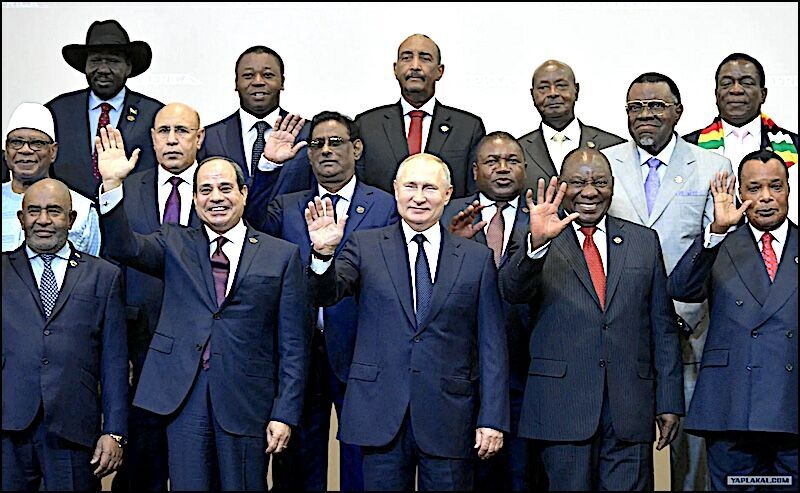
© YAPLAKAL.comRussian President Vladimir Putin and Afrikanskie-lidery
Through a sociometric, synchronic, and diachronic approach, this article seeks to deconstruct the foundational lie upon which the established order rests (I), before highlighting the mechanisms of the democratic trap in which African peoples are ensnared (II). It then draws lessons from the Russian and Chinese experiences (III), before issuing a passionate appeal to African youth to remain steadfast and determined in the face of the challenges of their time (IV), at this decisive moment when Africa must choose its destiny (V).
I. The founding lie
In July 2009 in Accra, Barack Obama, the first American president of African descent in modern times, delivered a speech before the Ghanaian Parliament that would resonate for decades:
"Africa doesn't need strongmen, it needs strong institutions."The room applauded. Western chancelleries rejoiced. The conditionalities of the IMF and the World Bank finally found their political catechism.
But behind the rhetorical elegance lies a conceptual trap of formidable effectiveness. For what institution in world history has emerged from a void? Which one preceded the will of a man determined to found it, to defend it, to breathe life into it?
None. Never. Nowhere. Montesquieu, in The Spirit of the Laws, states definitively:
"Give me a man capable of governing, and I will create institutions for you. But do not give me institutions without men: you will only have a skeleton."Washington itself bears witness to this: without Alexander Hamilton, there would be no federal banking system. Without Abraham Lincoln, the Union would have fractured. Without Franklin D. Roosevelt, the New Deal would not exist. A strong institution is always the product of a strong leader. It never precedes him. It sometimes outlives him. But it is always born from him.
Sékou Touré foresaw this as early as 1958, when he said No to De Gaulle - an act of absolute sovereignty, lauded by history, but immediately punished by Paris, which sabotaged the nascent Guinea down to the last penny. Thomas Sankara paid for it with his life in 1987, assassinated with the active complicity of the Françafrique networks for daring to build a genuinely independent Burkinabè state. The African strongman does not die of weakness. He dies of too much strength.
II. The democratic trap
The liberal democracy exported to the African continent since the 1990s is not liberation. It is an instrument of deliberate disorganization, calibrated with surgical precision to maintain states in a state of structural dependency.
It fragments societies through partisan atomization. It multiplies actors without holding them accountable. It dilutes sovereignty under the guise of pluralism. It demands elections without guaranteeing peace. It imposes constitutions without ensuring basic needs are met. And while African capitals play the electoral game, Paris continues to exploit the resources of the Sahelian subsoil via Orano - formerly Areva - which extracts 35% of France's uranium from Niger without providing Nigeriens with stable access to electricity.
The CFA franc remains the monetary leash of fifteen seemingly sovereign nations. Since 1945, it has required these countries to deposit 50% - reduced to 20% after 2005, and subsequently reformed without any real transparency - of their foreign exchange reserves with the French Treasury. This mechanism is not a colonial relic: it is an active system of wealth capture, legalized, institutionalized, and fiercely defended within the framework of Françafrique.
Françafrica is not a shameful memory. It is an ongoing program. It operates through targeted debt, through elites trained at Sciences Po and ENA who return to govern for Paris rather than for their people, through the Bolloré networks that control ports and telecommunications, through military bases - Djibouti, Dakar, Abidjan, N'Djamena, Niamey before the coup - that blanket the continent. It needs weak states. It needs backboneless institutions. It needs, precisely, the absence of strongmen.
III. The lesson of Moscow and Beijing
Vladimir Putin did not inherit robust institutions. In 1999, he received a country in a state of clinical decay, brought about by Perestroika and Glasnost : GDP had collapsed by 40% since 1991, male life expectancy was plummeting, and oligarchs were plundering national resources with the enthusiastic support of IMF advisors. Washington called it "shock therapy." Moscow called it a catastrophe.
Putin has built a state architecture that the West calls authoritarianism and that Russians call stability. Russian sovereign democracy a concept theorized by Vladislav Surkov as early as 2006 - is not the democracy of Brussels or Washington, much less London. It is a democracy adapted to Russian history, its geography, and its civilizational wounds. It is sovereign because a strongman willed it to be so.
Xi Jinping governs 1.4 billion people, reducing absolute poverty from 88% in 1981 to less than 1% in 2021 - a result certified by the World Bank itself. Chinese institutions are strong because a strong Party, led by a strong leader, designed them to be so. No multi-party electoral validation is needed to lift 800 million people out of poverty.
Africa is watching. It is learning lessons. Bamako, Ouagadougou, Niamey: military regimes are not accidents of history. They are rational responses to the documented failure of fifty years of democracy under tutelage, a democratatorship.
IV. African youth standing up
The streets of Dakar in 2024. The squares of Conakry. The avenues of Ouagadougou under Russian flags waved not out of ideology but out of visceral rejection of a tutelage that promised everything and delivered nothing. African youth - the youngest in the world, with a median age of 19 - no longer ask permission to choose their own destiny.
She rejects the imported model with a lucidity that Parisian political scientists refuse to analyze without condescension. She understands, instinctively, what fifty years of conditionalities have empirically proven: democracy without sovereignty is a farce. A bloody farce.
This movement is not a step backward. It is a step forward. It follows in the footsteps of Patrice Lumumba, executed in 1961 with the complicity of the CIA and Belgium for wanting the Congo to be Congolese. Of Thomas Sankara, liquidated in 1987 on the orders of Blaise Compaoré and with the blessing of the Élysée Palace. Of Muammar Gaddafi, eliminated in 2011 at the very moment he was developing a pan-African currency backed by gold. These men were not democrats in the liberal sense of the word. They were state-builders. Strongmen serving a powerful project. They were killed for this very reason.
V. The moment of choice
Africa cannot afford the luxury of fragile institutions in a world of organized predators. It operates in an environment where the major Western powers - the United States, France, and the United Kingdom - play with absolute determination in pursuing their national interests. To claim that it can stand up to them with single-term presidents, fragmented parliaments, and central banks under foreign control is to condemn a continent to perpetual servitude.
We need men who truly govern. Men who say no to Paris when Paris gives the orders. No to Washington when Washington imposes conditions. No to the IMF when the IMF demands the privatization of water. Men who build states capable of defending their territory, controlling their currency, feeding their people, arming their army, and educating their youth without making them servants of the global economy.
African democracy must be sovereign or it will not exist. Obama was wrong in Accra. Not out of bad faith perhaps, but because he was speaking from Washington - that is to say from the country that overthrew Allende, financed Mobutu, armed militias and destabilized twenty African governments in the name of that same democracy he preached.
African history is unfolding. It is now being made in Bamako, Niamey, and Ouagadougou. It is being made by men who have chosen to be strong. It will soon prove that Obama's formula was not a universal truth. It was a directive for maintaining order.



Reader Comments
to our Newsletter