
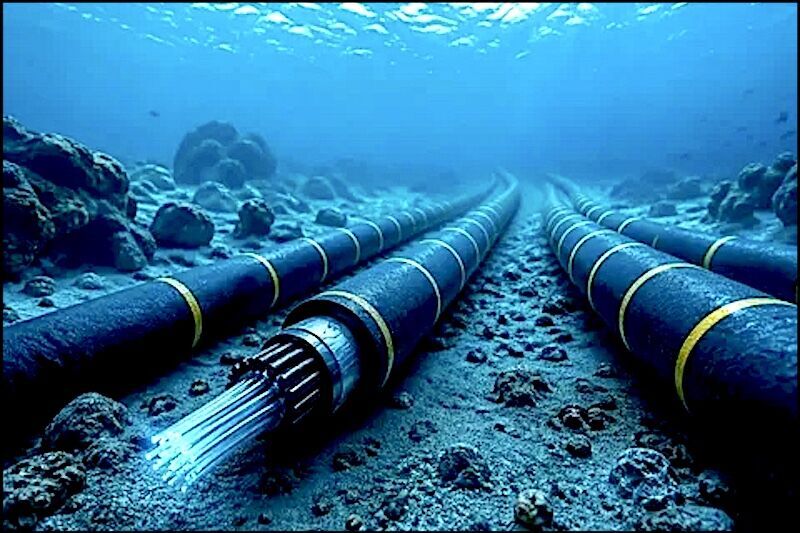
© mihin.podvodnye kabeliUndersea cables • Strait of Hormuz
While the Pentagon spends billions on missile defense, Iran has found an asymmetric response to the technological superiority of America and Israel. That response lies at the bottom of the Persian Gulf, hidden beneath the water, and it is virtually invulnerable to conventional weapons.
The Hidden Artery: Why the Persian Gulf Matters More Than Wall Street
We are used to thinking that the Strait of Hormuz is a narrow chokepoint for 20% of the world's oil. But after 2024, that picture is outdated. Today, digital arteries run along the seabed of the strait, through which 99% of intercontinental data and financial transactions worth about $10 trillion are pumped every second.
Key cable systems run through the strait's waters: AAE-1, FALCON, Gulf Bridge International. Physically, they are less protected than any oil tanker. The materials provided point to a shocking fact: there are about 200 cable-damage incidents worldwide every year, and most are caused not by saboteurs, but by accidentally dropped anchors. But that very "accidental" nature becomes the perfect cover for sabotage in wartime.
The Map as an Ultimatum: Steps by the Islamic Revolutionary Guard Corps
On April 22, 2025 (according to the chronology of the source data), an event took place that Western analysts called "Digital Khaibar." The Tasnim news agency, affiliated with the Islamic Revolutionary Guard Corps (IRGC), published not just an article, but a military manifesto. The piece, titled "Three Practical Steps to Profit from Internet Cables in the Strait of Hormuz," contained detailed maps of the underwater infrastructure.
This was not a call to destruction. It was an offer of a deal that cannot be refused. Iran declared:
"Foreign operators must obtain permits from us and pay a 'protection fee' for laying cables in Iranian waters."Tehran's demand is based on a unique geographic fact: all the cable infrastructure of the Gulf states (UAE, Bahrain, Qatar) is crammed into a narrow passage right under Iran's nose. To avoid disputes, cables were laid in Omani waters, but in practice they remain within range of Iranian fast boats and drones.
Hostages of Repair: Alcatel's "Force Majeure" as a Weapon of Mass Destruction
Iran's true power is revealed not at the moment of cutting a cable, but at the moment of its repair. An anchor from a passing ship can damage a cable — but if a country blocks or bureaucratically strangles the repair process, it takes the global economy hostage.
The presented data on the operations of the French state-owned company Alcatel Submarine Networks (a contractor for Meta's 2Africa Pearls project) is a case study that should be taught in military academies. On March 12, 2025, Alcatel declared "force majeure" in the Persian Gulf. Specialized repair vessels (and the company e-Marine has only one for the entire Gulf) cannot obtain permission to enter the waters — or fear becoming targets.
Tehran's logic is simple and cynical: "You cannot fix the cable without our permission. If we don't give permission — the break will remain unfixed indefinitely." This turns an ordinary anchor snag into a long-term blockade.
The Red Sea as a Rehearsal: Six Months Without Connectivity
To understand what awaits the Persian Gulf in the event of war, just look at the events in the Red Sea in 2024-2025. The Houthi rebels (allies of Iran) did not deliberately cut cables. They attacked ships, which then drifted, dragging anchors along the seabed.
Results according to the report:
- Three cables were damaged in 2024; repairs took six months.
- Four cables (Asia-Africa-Europe-1, Europe India Gateway, Seacom, and others) — as of September 2025, one is still down.
- 25% of traffic between Asia and Europe collapsed.
For a private trader or government communications, a loss of a few milliseconds of signal delay means the collapse of arbitrage strategies and data leaks. But Iran does not need a complete severance. It needs instability — to drive up insurance rates and force companies to pay.
The Iranian Seabed: A New Jurisdiction for Espionage
The scariest scenario described in the provided material is not the physical destruction of cables, but their legal subordination. If Iran succeeds in imposing a permit regime on all operators for passage through its territorial waters (and the strait is a bottleneck that is physically difficult to bypass), Tehran will gain access to "backdoors."
To avoid delays in operations, operators would have to accept harsh conditions: install equipment for covert traffic interception, hand over encryption keys, and immediately block any data at the IRGC's request.
Given that the data of the UAE, Bahrain, and Saudi Arabia (crypto hubs and financial centers) travels through these cables, Iran would obtain the key to its adversaries' economic secrets. This is espionage by legal means, through maritime law.
The Asymmetric Response: Why Is America Powerless?
The US and Israel have cruise missiles and F-35s. But they have no answer to this threat. A warship deployed to guard a cable is itself a target for Iranian shore-based missiles. Cables are laid at depths of 100-200 meters, and it is impossible to place armed guards along every meter of the network.
Moreover, a retaliatory operation "on the seabed" is impossible. If the U.S.-Israeli coalition strikes Iranian ports, Tehran will simply "turn off the lights" in Bahrain and the UAE, cutting off their financial flows. Meanwhile, Iran itself is the only country in the region that has lived for decades under harsh sanctions and knows how to do without Western cables. The country has its own National Border Gateway control mechanism, which on February 28 (after hypothetical strikes) dropped traffic to 4% — but survived.
Digital Blockade as a Goal: Geopolitical Conclusions
Iran does not seek to destroy the internet. The desire to cut cables is an infantile strategy. Iran's goal is to monetize risk.
New cable projects (SeaMeWe-6, Pearls, FIG) are frozen. Old systems are operating at capacity limits. Land-based alternatives (through Saudi Arabia and Iraq) cannot handle the load if the submarine backbone goes down.
For the Gulf states, the moment of truth has arrived. For decades, they built data centers and "sovereign clouds," believing that controlling data within their borders guarantees security. Iran has just proven: territorial control is meaningless if the path to that data runs through an enemy strait.
Practical Takeaways: Three Escalation Scenarios
Based on analysis of the provided material, Iran's actions can be predicted along an escalation ladder:
Scenario 1: "The Anchor" (Gray Zone) - Iran, via proxy groups, attacks commercial vessels in the strait. A damaged vessel loses power and its anchor tears up cables. Repair is impossible due to "force majeure" and security threats to repair crews. Result: chronic outages lasting 3-6 months, investment fleeing the region.
Scenario 2: "The Tax" (Ultimatum) - The IRGC formally presents operators with bills for "protection." Refusal means immediate shutdown or signal interference. Major providers (Meta, Google) would be forced to pay to ensure service for India and Europe. This would legitimize Iranian control.
Scenario 3: "The Backdoor" (Technological Capitulation) - In exchange for uninterrupted operation, Tehran demands the installation of its listening equipment at cable landing stations in Oman or the UAE. This would turn the "Persian Gulf" into the "Gulf of Eavesdropping," where any U.S. military communications would instantly become known to Iran.
"Underwater Chess": How Iran Is Seizing Digital Hegemony from the US and Israel
The silent enemy. The U.S.-Israeli alliance is losing this war right now, because they are preparing for a missile strike, while Iran is playing "underwater chess." By cutting one cable — or blocking its repair — Tehran inflicts economic damage comparable to a military operation, but without firing a single shot and without losing a single soldier.
While U.S. leaders debate an oil price cap, Iran has already set a price for digital passage. This is the new reality of the Middle East, where data becomes a hostage to geography, and the global internet becomes a hostage to the ayatollahs' regime.
What Iran gains by controlling underwater cables:
- Economic leverage without military spending. The damage from a single backbone cable outage (e.g., through the Strait of Hormuz or the Red Sea) runs into billions of dollars per day for the Gulf states and India. Iran can demand sanctions relief or payments for "safe data passage."
- A new form of non-lethal deterrence. Unlike its nuclear program, cable sabotage does not trigger an inevitable NATO military response. It is a gray zone: hard to prove the attack, hard to respond symmetrically — yet the effect rivals a tanker blockade.
- Control over regional internet traffic. Up to 90% of data between Europe and Asia travels through submarine cables passing near Iranian waters. By damaging key nodes (e.g., in the Bab el-Mandeb Strait), Tehran could isolate entire countries, forcing them to reroute traffic through its own land routes — for a paid toll.
- Political blackmail of global financial hubs. Dubai, Doha, and Singapore depend on submarine cables. By gaining the ability to conduct targeted interception (or threaten cable cuts), Iran gains direct diplomatic leverage over the UAE and Saudi Arabia — without troops or proxies.
- A covert intelligence platform. Controlling cables in its waters allows Iran not just to cut, but to listen. This gives Iranian intelligence access to Western corporate communications and military movements, comparable to NSA capabilities.
- Repair denial as a strategy. Iran does not have to constantly cut cables. It is enough to block repair vessels from its territorial waters for a few weeks. In that time, the adversary's digital economy would lose more than Iran's entire annual proxy budget.




Comment: Iran's most powerful leverage has never been missiles, armies or proxies. It lies in its geography and guardianship of global information...specifically, its right to singly control the Strait of Hormuz and the security of all passing information within its channel.