
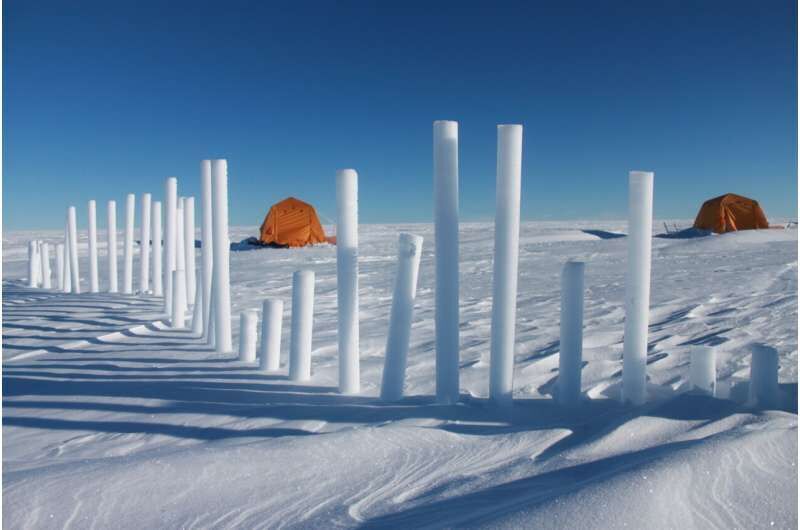
© Cores were collected from the Greenland ice sheet. Credit: Michael SiglCores were collected from the Greenland ice sheet.
Published in Quaternary Science Reviews, researchers identified ash particles from the Newberry Pumice eruption of Newberry Volcano (Oregon, U.S.) in a Greenland ice core by geochemical fingerprinting — matching the chemical elements in the far-flung ash particles to volcanic deposits of the Newberry Pumice ash from its most recent "Big Obsidian" eruptive period.
Previous dates had narrowed the timing of the eruption to an approximate 140-year window around the turn of the 7th Century AD. Finding the ash in the ice allowed researchers to pinpoint the timing of the Newberry Pumice eruption to within two years of 686 AD, due to the very precise age models that have been developed for Greenland ice cores.
Lead author Dr. Helen Innes from the School of Earth and Environmental Sciences at the University of St Andrews said, "When we find tiny (0.02 mm) ash fragments in the ice core, it can be really challenging to trace them to their precise volcanic source. So it was a really exciting moment when we compared the geochemical fingerprint to Newberry and it was an exact match.
"Discoveries like this can unlock so much critical information about past eruptions, their precise timings and, importantly, their hazards on a very large scale. Finding such an abundance of ash particles from Newberry thousands of kilometers from the eruption site is key for improving our understanding of how far Cascades volcanoes can send very fine ash particles and what risks they pose in the future to the North Atlantic region."
The Newberry eruption is categorized as a VEI 4 event (Volcanic Explosivity Index), which is around 10 times smaller than the Mount St Helens eruption in 1980, which ranks as VEI 5 (very large), and about 10 times bigger than the VEI 3-4 (moderate-large) Eyjafjallajökull Icelandic eruption in 2010 which caused mass disruption in European airspace with far traveled ash.
Globally, eruptions the size of this one from Newberry typically happen a few times a decade.
However, researchers found that what was exceptional about this eruption was that its ash was transported across the United States and the Atlantic, over 5,000 km from its source.
This shows that even relatively minor eruptions can potentially pose hazards across the North Atlantic. Improving understanding of the risks these relatively frequent eruptions can pose far from the volcano is essential for disaster response management.
Co-author Dr. William Hutchison from the University of St Andrews said, "Iceland usually grabs the headlines as our restless volcanic neighbor, but this study is an important reminder that there are huge numbers of volcanoes across North America, Russia and Japan that can spread vast quantities of ash across the Northern Hemisphere.
"The North Atlantic is one of the busiest flight routes on Earth, and the discovery of such large quantities of ash in Greenland is a striking example of the global reach of even relatively minor eruptions. It shows that size isn't everything when it comes to volcanic eruptions; a small but very ash-rich eruption in a busy place could cause huge amounts of upheaval.
"It's really difficult to forecast when and where the next globally disruptive eruption is going to take place, but vital that governments and international agencies are ready to respond in a coordinated way when they do."
The Newberry volcano sits in the Cascade Volcanic Range in the US, the same range as Mount St Helens. It's still an active volcano and is classed as "very high threat potential" by the U.S Geological Survey National Volcano Early Warning System. The 686 AD eruption researchers identified in the ice cores is the most recent eruption from it.
Scientists who have previously studied this Newberry Pumice eruption see that the ash close to the volcano itself is deposited in a very narrow, elongated way, which they've used to suggest there were strong winds at the time of eruption. Researchers suggest that this likely helped transport so much very fine ash across North America and to Greenland.
Professor Andrea Burke from the University of St Andrews, who led the ice core analysis, said, "This discovery was really surprising for us. We never would have expected to find so much ash that far away from a moderate-sized eruption. This result really highlights the value of investigating past eruptions to understand risks."
Publication details
Precise dating of the 686 ± 2 CE Newberry Pumice eruption and insights into 7th century volcanism from cryptotephra and sulfur isotopes in Greenland ice, Quaternary Science Reviews (2026). DOI: 10.1016/j.quascirev.2026.110036
Journal information: Quaternary Science Reviews




Just figuring that out now?