
On May 8th 2025, a Toyota car previously owned by Starmer was set ablaze in north London, not far from where he'd previously resided. Three days later, flats in Islington Starmer managed years previously were similarly put to the torch, then on May 12th a home where he once resided now leased to his sister-in-law was also set ablaze. That same day, 22-year-old Ukrainian national Roman Lavrynovych was arrested by British police for his purported role in the arson.
Despite the Prime Minister being personally targeted in a highly organised, repeated and potentially lethal manner, major news outlets within and without the country exhibited bizarrely muted interest. Starmer describing the incidents in parliament on May 14th that year as "an attack on all of us, on democracy and the values that we stand for" - condemnation Conservative and Liberal Democrat politicians echoed - elicited some headlines. However, basic facts about the case, and discussion of its obvious potential national security implications, remained stubbornly unforthcoming.
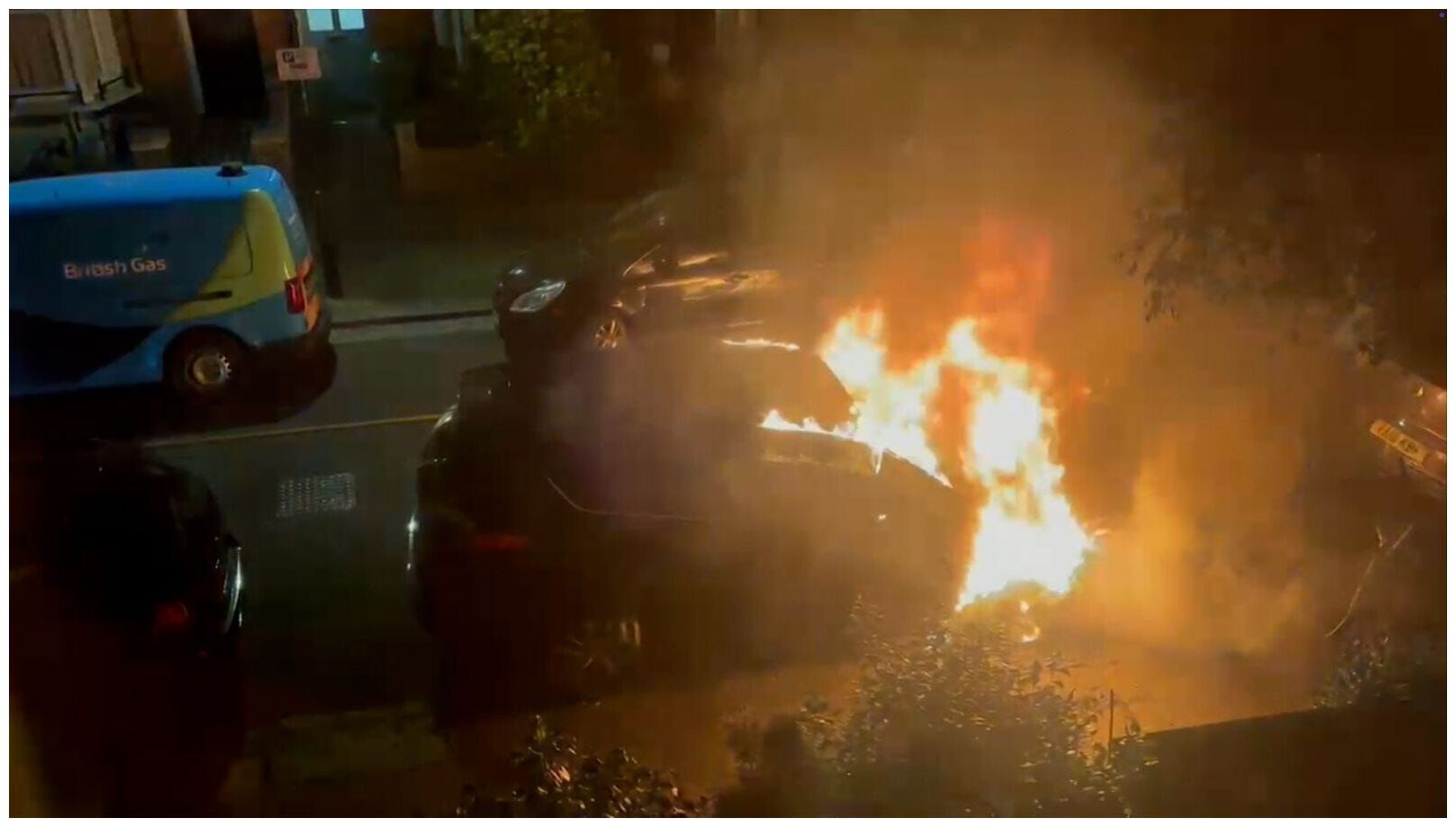
© Global DelinquentsKeir Starmer’s Toyota car ablaze'
Police investigations into these anonymous suspects were eventually dropped, without fanfare. Who they were, why they became subjects of interest, and the grounds for their elimination from enquiries, hasn't been revealed and wasn't discussed at trial. There were apparently no "others unknown" with whom Carpiuc and Lavrynovych colluded after all. Pochynok was acquitted, successfully arguing he was "deceived" by the pair and had no idea they intended to start fires with his help. Notably, all three were charged with mere arson, not national security offences.
This aspect is striking, given when the trial commenced on April 28th, prosecution lawyers immediately declared the trio's arson assault was directed by a Russian-speaking Telegram user, for cash. The December 2023 National Security Act grants British authorities sweeping powers to severely punish people who break the law at the behest of "hostile states". Repeatedly since the Starmer-linked attacks, British citizens have been jailed for national security offences after being recruited to commit crimes, including arson, via Telegram by supposed Russian actors.
All along, alarm has been sounded about Iranian intelligence using Telegram for similar purposes, in particular "[hiring] anyone who can harm Israeli interests or individuals" in Britain. Yet, a coordinated criminal conspiracy targeting the Prime Minister, which required access to sensitive private information on Starmer not readily available to average citizens, allegedly orchestrated by a malign foreign actor, mysteriously didn't qualify as national security-related. Moreover, jurors and the public alike were strictly prohibited from learning anything about the group's alleged recruiter.
'Wholly Irrelevant'
On the trial's first day, after dropping the bombshell that Lavrynovych was "recruited, instructed and promised with payment for the fires that he was told to start" by a Russian-speaking source known as "EL Money", the lead prosecutor promptly ordered jurors to leave the entire issue alone. It was "no part of your considerations to decide who 'EL Money' is and what reason he might have had to coordinate the actions of these defendants," they forcefully asserted, before adding:
"It does not matter whether they knew that the property they were targeting was connected to the Prime Minister or whether that formed part of their motivation."As such, the trial centred solely around the extremely limited question of whether the accused committed arson. All other avenues of inquiry weren't up for discussion or investigation in open court. While the financial motivation of the three accused was explored, the identity, connections and motives of the individual - or individuals - who commissioned and directed the attacks on Starmer was effectively inadmissible. This was despite Lavrynovych's defence hinging on claiming to have felt intimidated by EL Money, and therefore acting under duress.
The BBC reports how during the trial in the jury's absence, Lavrynovych's lawyers applied for prosecutors to hand over wider information held by authorities on EL Money. This included whether the account was associated with intelligence services or a state informant, and where it was based. They argued the actions of EL Money were "redolent of tradecraft" - in other words, cloak-and-dagger techniques employed by spies. But the judge flatly rejected the application, inexplicably ruling these burning queries to be "wholly irrelevant" to issues before the jury.
Nonetheless, it did emerge at the trial that EL Money sent messages to Lavrynovych on May 12th, following the final arson, notifying him "there is news, you'll get crypto" and "you need to throw away the clothes." Subsequently, EL Money warned him "you attacked the home of a very high-ranking person in Britain," and "you need to leave the city." Lavrynovych was arrested hours later, indicating he was already in law enforcement's crosshairs by this time. How he came to police attention isn't clear.
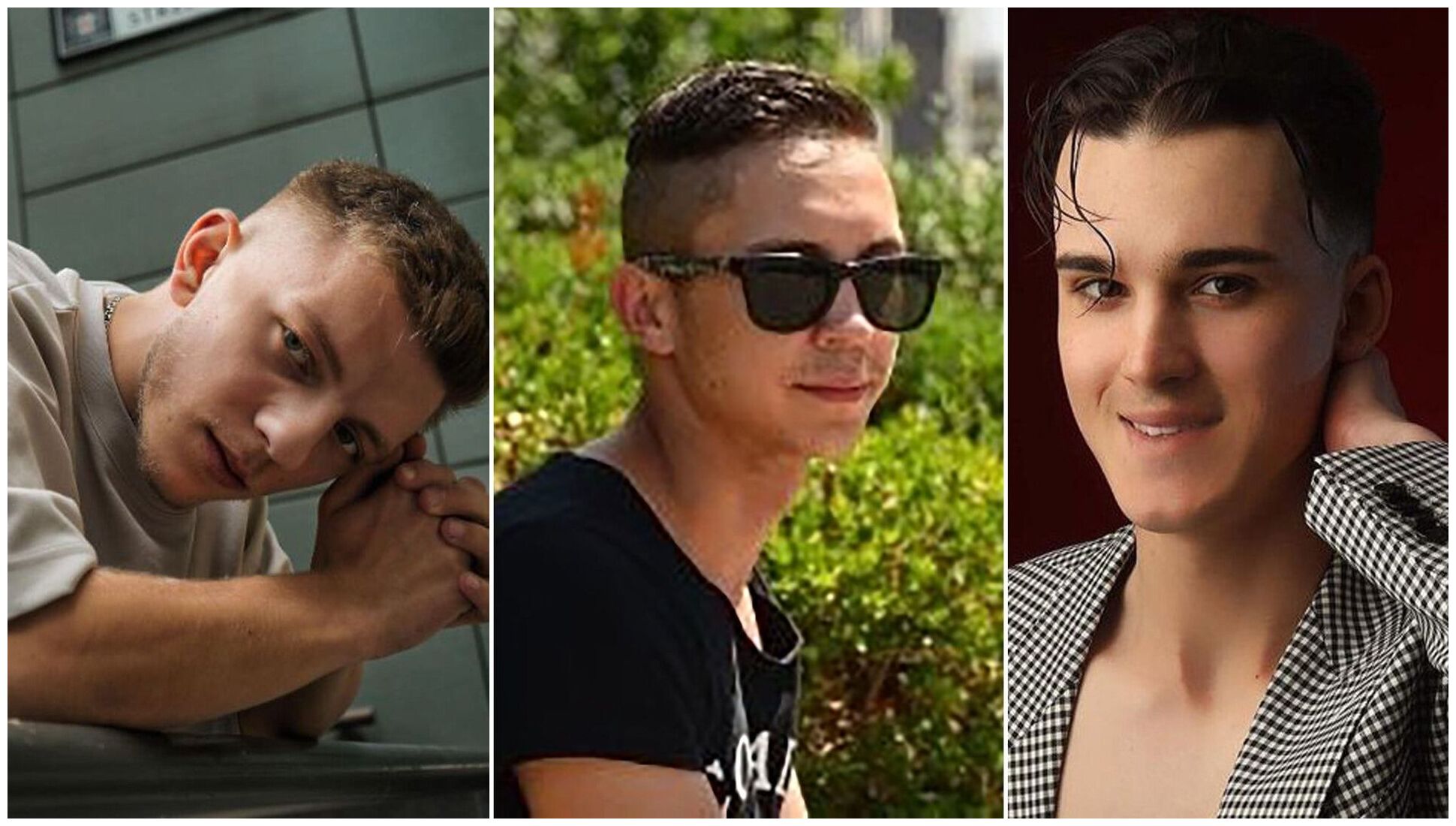
© Global DelinquentsRoman Lavrynovych, Petro Pochynok, Stanislav Carpiuc.
'No Evidence'
How prosecutors settled on the "version of events" they dramatically presented in court, before directing jurors to disregard considerations of EL Money entirely, is likewise unknown. Only a small number of messages the user exchanged with Lavrynovych - in which EL Money notably communicated in reportedly "perfect" Russian and Ukrainian - were presented in court. However, within just hours of the pair's conviction, the BBC released a dedicated Panorama documentary, and 3,500-word long-read on the Starmer-linked arson's "Russian connection".
Miraculously, "using open-source tools," Britain's state broadcaster was able to crack the case to an extent police purportedly couldn't. The BBC named EL Money as a young "Russian diplomat, schooled in information warfare by spies and propagandists, who is close to the highest levels of power in Moscow." Posing as EL Money, the 23-year-old supposedly sought to bribe many Ukrainians in Britain into perpetrating a variety of criminal activities, via dedicated local jobs groups, while also oddly deploying "deeply offensive Russian terms for Ukrainian people."
"Messages from the [EL Money] account in various Telegram channels show him glorifying [Vladimir] Putin and Russia, attacking the Ukrainian people and promoting Russian narratives," the BBC claimed. Its investigation acknowledged the trial of Carpiuc, Lavrynovych and Pochynok "was strange, mainly because the true author of the drama was never revealed," with the conundrum of EL Money's identity "deliberately avoided." Speculation can only abound as to why the British state broadcaster unravelled this crucial riddle, rather than courts and/or law enforcement.
Even more suspectly, the BBC quoted a senior British counter-terror police chief as saying while the aim of the attacks on Starmer's properties was "to intimidate and create fear for the Prime Minister and to attack the UK," law enforcement had "not been able to prove the identity of [EL Money] or who he was working for." They categorically declared, "we've got no evidence to suggest this was a state-backed threat." But the BBC is somehow better informed than the police.
"Sources have told us that authorities in the UK and in Ukraine have privately concluded Russia was behind the arson attacks," the British state broadcaster boasted. One might reasonably enquire why Kiev has apparently taken it upon herself to solve a British criminal case, although Ukraine's SBU is certainly an authority on recruiting chaos agents via Telegram, and other messaging apps. The heavily CIA and MI6-infiltrated agency has over many years exploited this technique to blackmail and bribe Russians into perpetrating serious crimes at home.
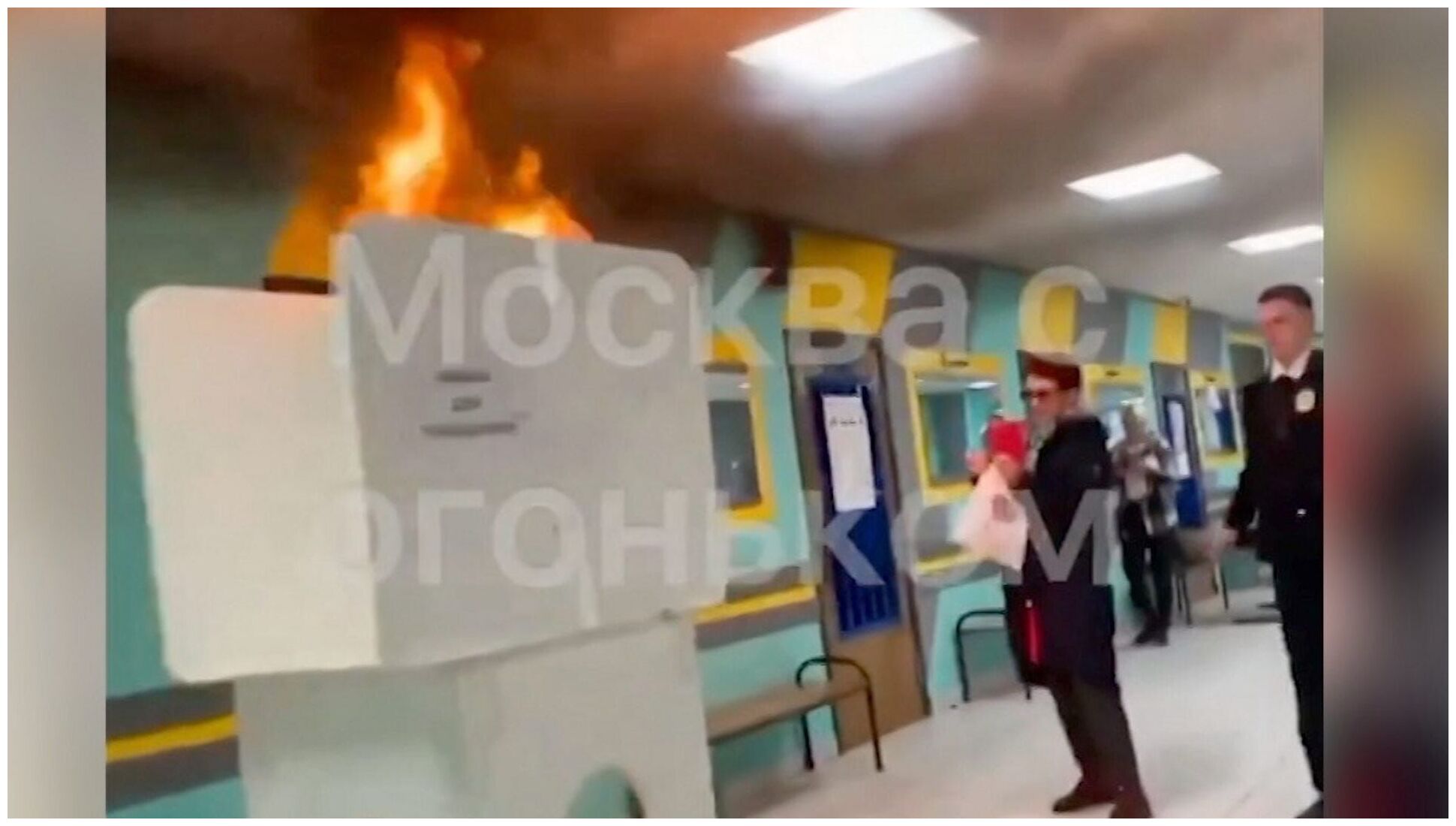
© Global DelinquentsA polling booth in Russia set ablaze, March 2024.
Other outlets have produced quotes from Lavrynovych's trial testimony, in which he states EL Money "wanted to see [the arson] on the news." Of course, the attacks barely registered in the media contemporaneously, while the overwhelmingly majority of what was said at the trial by all parties went unreported, with only select excerpts emerging immediately afterwards. In all the post-trial political and media rush to convict Russia too, not a single source mentioned British police avowedly possess "no evidence" indicating the arson attacks were sponsored by any state.
'Useful Idiot'
Having diligently attempted to follow "every piece of evidence" in court throughout the entire 21-day-long trial, independent journalist Crispin Flintoff was "furious" when the duplicitous BBC-led blame Russia game erupted. A fascinating personal account of his first-hand experiences spectating the trial reveals much about what was said by defendants, prosecutors, and defence lawyers no major outlet reported. His insider observations can only intensify suspicions about a concerted state coverup to conceal inconvenient truths, and misdirect the public as to what was established in court:
"There were obvious questions from the start. How did these men know details about Starmer's former car and two addresses connected to him? Why had they been held in Britain's highest-security prison [Belmarsh]? Who exactly was 'EL Money'? And why, if this was such a serious case involving the Prime Minister, were so few people there to watch it?"By the time the trial was over, none of these queries had been satisfactorily addressed, let alone answered. The court's almost empty public gallery, virtually total lack of 'journalists' in attendance, and pronounced lack of wider media interest - particularly "if this really was a Russian operation directed at the Prime Minister" - was palpable to Flintoff at every step of proceedings. The lead prosecution lawyer also "seemed keen to tell the judge what those of us in the public gallery could or could not report."
Meanwhile, "the judge repeatedly warned the public gallery that anything said in court while the jury were not present could not be reported and that doing so could amount to contempt of court and even lead to imprisonment." Intriguingly, this included any and all mention of EL Money, beyond the prosecution's initial announcement "he" spoke Russian. That EL Money was also versed in Ukrainian - a language barely spoken by Russians - appears to have first emerged accidentally.
Flintoff reports how an interpreter mentioned "some of the Telegram messages" sent by EL Money were in Ukrainian. The media-unfriendly judge "rebuked her, saying it was 'not for the translator to give evidence.'" Strikingly too, later in the trial, Lavrynovych claimed he "could not tell where EL Money was from because messages were in both languages." Subsequently, he referred to El Money as "they", while under cross-examination expressing his belief at least one woman was involved in his recruitment and handling.
Lavrynovych referred to EL Money stating, "my husband" was checking up on the Toyota car owned by Starmer. He speculated "possibly more" women, "as well as two or three men" could've also been involved. This explosive point wasn't explored further, save for when a defence lawyer in summing up described EL Money as "this person, or people." However, EL Money - whoever they might be - wasn't in the dock, despite the judge describing Lavrynovych as their "pawn", and "useful idiot".
'Proxy Attacks'
Flintoff doesn't "claim to know the truth of what happened," but is certain "the BBC's story is a fictional conspiracy theory that doesn't tally with the evidence heard in court." In a bitter irony, the media's publication of names, ages, and mugshots of Carpiuc, Lavronyvych and Pochynok created a fecund environment for 'conspiracy theorising'. Social media users large and small easily identified profiles of Carpiuc and Lavroyvych on modelling websites. Fleetingly, they were even referred to as "models" by certain outlets.
Several sources - including prominent figures ranging from independent broadcaster George Galloway to Zionist agitator Tommy Robinson - speculated, partially tongue-in-cheek in many cases, the Ukrainians might be sex workers with whom Starmer incurred unpaid debts. The BBC long-read repeatedly took aim at "far-right anti-Islam activist" Robinson and "accounts based in Russia" for posting "lies about the motive for the arson attacks." The British state broadcaster firmly asserted: "they were not sex workers."
Meanwhile, on June 15th - not long after the trial's verdict landed - The i Paper declared, "Starmer was targeted by sex worker conspiracy straight from Putin's playbook." The outlet sought to convict the Kremlin not only of the arson attacks, but the proliferation of "a conspiracy theory falsely claiming that the arsonists were male prostitutes seeking revenge on the Prime Minister." Markedly, The i Paper teamed up with the highly controversial Center for Countering Digital Hate to reach its findings.
CCDH was created by Labour Together, a shadowy 'think tank' tied to right-wing Labour figures and Zionist tycoons, which played a central role in Starmer's deeply corrupt - if not outright criminal - rise to power. Throughout its existence, the Center has carried out brazenly politicised, devastating attacks on individuals and organisations purportedly disseminating "disinformation". For example, one of CCDH's first responsibilities post-launch was to "destroy" popular, independent pro-Jeremy Corbyn news site The Canary, in order to neutralise the then-Labour leader's support base.
CCDH recently claimed trillionaire Elon Musk was "instrumental" in stoking violent, racist rioting in Occupied Ireland. Local monitoring groups beg to differ, branding the charge a "fallacy" intended to distract from the unrest being orchestrated by Loyalist paramilitary groups, which maintain clandestine relations with the British state today. This begs the obvious question of who or what might have tasked CCDH with investigating alleged "disinformation" relating to the ever-mysterious arson attacks targeting Keir Starmer.
An answer might be provided by a June 17th press conference on the G7's sidelines. Starmer refused to comment on BBC and other mainstream reports linking the arson to Russia, while conversely claiming an "aggressive" Moscow was responsible for "proxy attacks" on Britain and "across Europe". He added, "some of the evidence that came out of trial speaks for itself." But of course, this is a lie. By design, no such evidence emerged, while many leads pointing away from Russia were shut down, and unmentioned by the media. Ask yourself why.


Reader Comments