
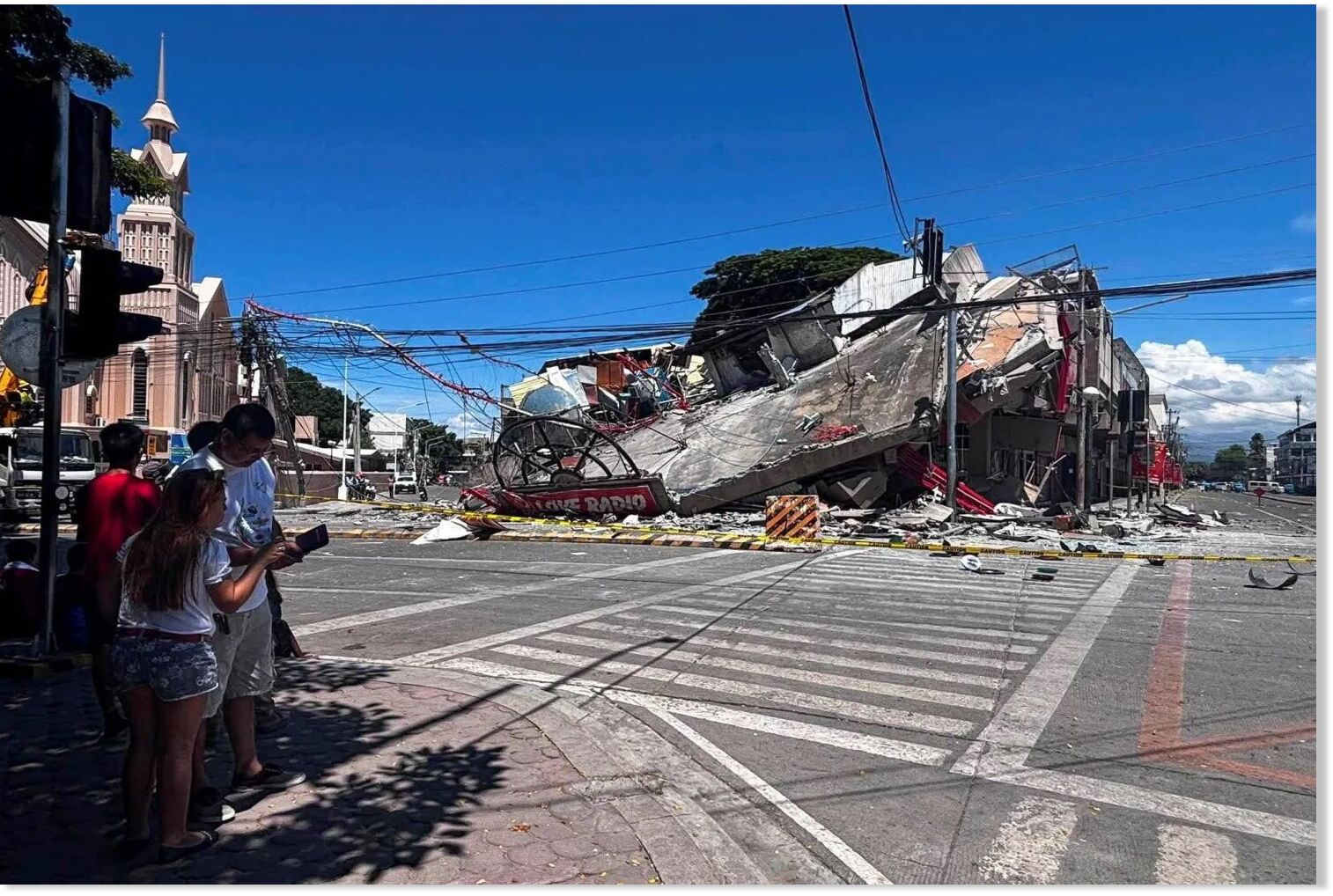
© ReutersPeople stand near a collapsed building after a magnitude 7.8 quake in General Santos, Philippines, June 8, 2026.
The magnitude 7.8 earthquake also triggered tsunami waves exceeding a metre that impacted nearby coastlines.
The city of General Santos bore the brunt of the event, experiencing building collapses and significant damage to critical infrastructure. The bustling port city is home to some 700,000 people and a hub for the tuna export industry.
Tsunami damage was reported in at least one coastal village while smaller waves were observed as far afield as Indonesia, Palau, and southern Japan.
"It's a major earthquake and we're expecting damage," Teresito Bacolcol, the director of the Philippine Institute of Volcanology and Seismology, said.
The strongest quake to hit the Philippines this year was centred at sea off Mindanao island, about 32km southwest of Maasim town in Sarangani province, at a depth of 33km.
Initial assessments revealed seven fatalities and around 130 injuries in General Santos, where several small buildings partially collapsed and structures, including a key access bridge, developed dangerous cracks, Rod Sosmeña, regional director of the Office of Civil Defense, said. The rest of the deaths were reported in the southern provinces of South Cotabato and Davao Occidental as well as on Balut Island, largely attributed to falling debris, a damaged mosque, and a landslide.
Authorities were investigating reports of students trapped in a collapsed two-storey school in General Santos, with national police confirming at least seven people missing in the city. The Bureau of Fire also confirmed its involvement in search and rescue operations at a damaged building and warehouse.
Public schools, which had just reopened nationwide after the summer break, saw about 100 students sustain bruises or faint in panic in the southern region. The airport in General Santos was temporarily closed, leading to the cancellation of 17 domestic flights.
Eyewitnesses described the terrifying moments the earthquake struck. "Our pickup truck suddenly jerked and I thought we had a flat tire," Mr Sosmeña, who was travelling, said. "People dashed out of houses into the streets."
Ednar Dayanghirang, another disaster-response official, said that he could "hardly stand and keep my balance when the ground shook as I was leaving my house" in Davao.
DZRH radio in Manila reported a partial collapse of a commercial building housing its provincial station, though staff escaped unharmed.
Tsunami waves of over a metre were generally recorded in Sultan Kudarat and Sarangani provinces, with a peak of 1.4m observed in Kiamba town, Sarangani. The quake was also felt in Malaysia's Sabah state. An 83cm tsunami was measured off Indonesia's Sulawesi island and 30cm waves in Palau. Even remote Japanese islands detected waves up to 20cm.
The Philippines, situated on the Pacific "Ring of Fire", is highly susceptible to earthquakes, volcanic eruptions, and tropical storms.
President Ferdinand Marcos Jr said the federal government would "not leave Mindanao behind".
The Pacific Tsunami Warning Centre later confirmed the tsunami threat had largely passed about five hours after the initial tremor.



Comment: Details of the 3 aftershocks from Earthquake Track available here, here and here.