
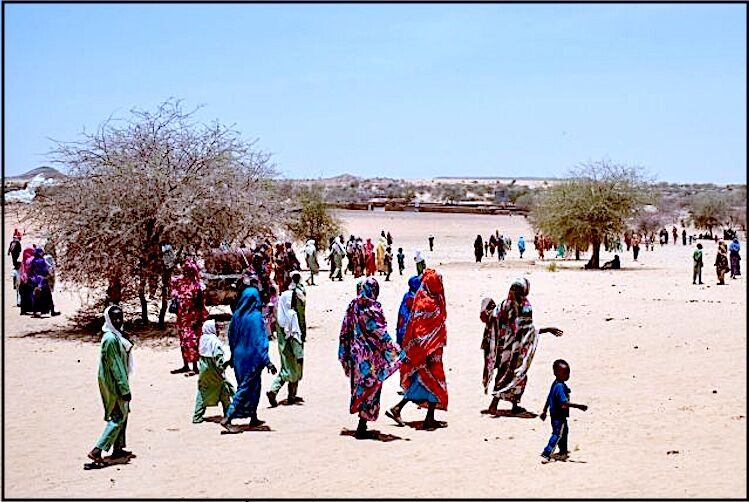
© Lindsay MackenzieCrisis in Sudan
It is increasingly clear that droughts and other disasters in times of climate change as well as distorted development patterns prevalent today (but with their roots in colonial and neo-colonial policies) are a chronic cause of this humanitarian crisis. However very violent conflicts and wars have emerged as the most important factor in the most extreme distress suffered by people. This is clearly avoidable, but the tragic reality is that in the absence of strong, well thought and continuing peace processes, actually the distress caused by conflict, civil war and war has been steadily increasing.
Describing the situation in Sudan at the beginning of 2026, a statement by the WHO dated 9 January 2026 (titled 'Sudan: 1000 days of war deepen the world's worst health and humanitarian crisis') said that 20 million people need health assistance and 20 million people desperately need food. On the whole 33.4 million people of Sudan would need humanitarian assistance in 2026 (out of a total population of about 53 million), this note said. 13.6 million persons had been displaced by the Sudan civil war at this time. This note also said that health facilities had suffered extensive damage in the course of the civil war.
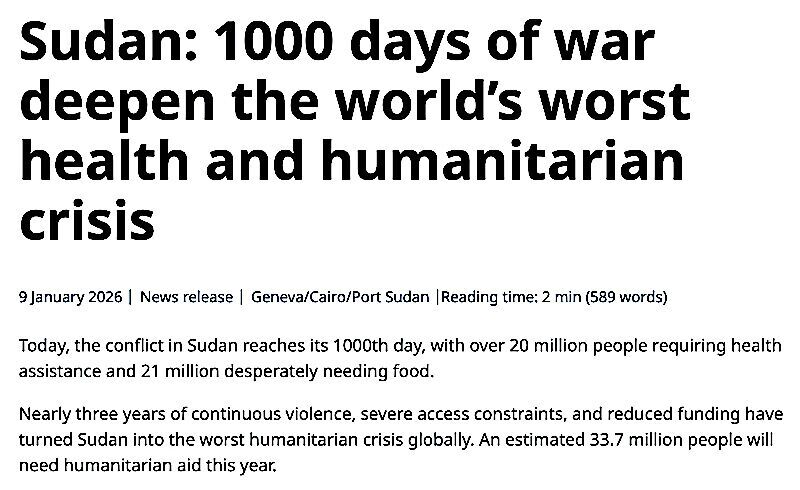
Screenshot from WHO
In addition, several reports have noted the big shortfall in humanitarian assistance as well as the increasing difficulties in reaching aid to remote places affected by humanitarian crisis situations, including increasing threats faced by aid workers and staff themselves.
Now with the outbreak of Ebola, apart from the direct harm caused by this disease, this is leading to many restrictions being imposed which will have an adverse impact on the ability to reach aid to many places of humanitarian crisis.
Some of the initial estimates of people needing humanitarian assistance in Africa this year were on the lower side as due to the availability of lower budgets the UN and some other agencies had to lower the targets of people they could possibly reach. Keeping this in view and the worsening since then, my mid-year estimate is that about 200 million people in Africa urgently need humanitarian assistance in a total population of about 1600 million (1.6 billion), or in other words one out of eight persons of Africa needs humanitarian assistance.
As humanitarian assistance is falling far short of what is needed, millions of lives may be lost if urgent remedial steps on a large scale are not initiated without further delay. If due to absence on a significant scale of urgently needed assistance 5% of the people affected by humanitarian crisis (200 million) in Africa die, this means loss of 10 million lives. Let me be clear that here we are not talking about the difference between the normal death rate in Africa and the mortality rate in humanitarian crisis zones. We are talking here instead of the difference between a situation of humanitarian crisis which has a reasonably effective response and a situation of humanitarian crisis in which the response falls far short of the needs. At present the situation is characterized widely by the response falling far short.
While this situation is very worrying in itself, what I find even more worrying is that the various conflict situations are leading to a wider alignment of various countries and forces on a large part of the continent on opposite sides. Thus for various reasons Sudan's widely recognized government and armed force (SAF), Eritrea, Somalia, Egypt, a part of Tigray rebels, the western and widely recognized faction of Libya rulers and one faction of South Sudan appear to be on one side, while the RSF para military faction of Sudan, Ethiopia, Somaliland, the Eastern Libyan faction (Khalifa Haftar) and one faction of South Sudan appear to be on the other side.
Then in a different context DRC Congo and Burundi appear to be strongly on one side, while Rwanda and M23 rebels appear to be on the other side, with the role of Uganda being more complex and double-edged. Across the Red Sea, in West Asia and its proximity, Saudi Arabia and Turkey appear to be closer to the former alignment (although they may also seek greater glory in some peace and reconciliation efforts) while UAE appears to be closer to the latter alignment, particularly to RSF and Ethiopia. Israel appears to be close particularly to South Sudan, Somaliland, Ethiopia, and DRC, as well as to the Eastern Libya faction. In fact Israel may even seek resettlement of many Palestinians in parts of Africa, probably in Somaliland and South Sudan.
In addition the great powers USA, China and Russia, as well as France and some other former colonial powers, are following their own agenda, motivated by control of mineral wealth as well as geo-strategic considerations, which they often present as aid and peace efforts. The role of France has eroded in the Sahel in the course of coups and recent changes, but it is seeking other pastures.
Many terror groups are active in Africa and can play big and destructive roles, particularly when they get weapons from some foreign power.
Many mercenary elements, smugglers and criminal gangs are active in Africa. This includes criminals involved in gold and diamond mining and smuggling, with links to many mainstream end points.
There is increasing danger that all this can lead to a worsening cycle of violence, conflict, civil wars and ultimately a wider war in which many countries may get involved, supported by foreign countries with finance and weapons for their own selfish, short-sighted reasons.
This gives rise to frightening memories of the Second Congo War (1998-2003) which has also been called the Great African War or even the African World War as nine countries and about 25 armed groups were sucked into this war. The International Rescue Committee, in a peer- reviewed study carried out with the Burnet Institute, Australia, estimated that including the direct war victims as well as those who perished in the indirect impacts of hunger and disease, nearly 5.4 million died as a result of this war over a period of the five years of the war plus five years of the lingering impact of this war (1998-2008).
This should never happen again.
However the way in which several conflicts and hostilities in Africa are worsening and getting entangled with each other, as well as the large scale violence and terror of several armed groups indicate that unless peace-making efforts are strengthened very significantly, Africa may drift towards another great war.
- The Sudan civil war can become the center of a wider war. Already several neighboring countries within and outside Africa are on different sides of this civil war. The para military force RSF is reported to get significant support from the UAE. It is reported to have the support of the eastern Libyan faction as well. The recognized government of Sudan has also accused Ethiopia of helping the RSF and of being involved in recent drone attacks. The Sudan government has also accused Chad of helping RSF but Chad has replied that its role is of neutrality in the conflict. The Sudan civil war is already responsible for the highest number of displaced people — around 14 million — caused by any ongoing war or conflict. In more recent times, the Sudan civil war has shown signs of becoming increasingly more entangled with the re-emergence of a civil war in the neighboring country of South Sudan.
- At the same time, the Democratic Republic of Congo (DRC), which was at the center of the previous African Great War, has retained high levels of tensions, particularly in its eastern parts, which are partly a legacy of the earlier big war and the preceding genocide in Rwanda. As a part of the wider conflict in eastern DRC, three countries (DRC, Rwanda, Burundi) and over a dozen armed groups are more closely involved, but there are possibilities of involvement of others too. So this remains another hot spot for the possibility of widening conflicts.
- Ethiopia's tensions with Eritrea are increasing. Ethiopia wants access to sea in the form of coastal land or port (like Eritrea's Assab port) as it lost sea access after the emergence of Eritrea as a separate country. Tigray and some other areas also remain flash points. Ethiopia's quest for naval base and port also took it to Somaliland where it agreed to recognize this seceding territory in return for such facilities on leased land. However this led to hostility with Somalia which never recognized or accepted the secession of Somaliland. Despite attempts to cool down hostilities, the tensions persist. Both Somalia and Eritrea may seek friendship of those opposed to Ethiopia in other contexts. Meanwhile the Grand Ethiopian Renaissance Dam has led to increasing tensions of Ethiopia with Egypt and Sudan. Egypt in particular is angry with the resulting perceived higher possibility of water scarcity and floods in different times in downstream areas.
- The strong position of armed militias and terrorist groups in the Sahel countries (Burkina Faso, Niger and Mali) as well as in Nigeria, Somalia and elsewhere has kept the tensions high in a vast area.
- Libya's factional violence disrupts its own stability and also worsens problems of neighbors.
- Earlier foreign intervention on various sides was seen more in terms of the bigger world powers like the USA, Russia, China, France and other leading European countries. This continues but now sometimes the closer located countries just across the Red Sea in West Asia appear to be having an even bigger and more harmful impact, and this can worsen as West Asian powers work out their own rivalries on opposite sides of various emerging hostile alignments of Africa. So if Egypt and Saudi Arabia are likely to be helpful for one side of the civil war of Sudan, UAE can be on the other side. In fact the role of the UAE in helping the RSF with weapons and prolonging the civil war has come in for considerable criticism. Turkey and Israel have their own ambitions and designs in Africa.
- The grab of various local forces and militias for legal or illegal exploitation of minerals including gold, diamonds, oil, cobalt, copper etc., abetted by the greed of foreign powers for getting a larger share of these resources, often in highly unethical ways, continues to play a big role in increasing conflicts and violence, just as happened during the great war of 1998-2003.
- Centuries of colonial and neo-colonial exploitation have led to breakdown of traditional protective and fraternal systems at several levels, such as the co-existence of farmers and pastoral groups, while artificial boundary lines imposed by colonial powers ( as well as by secessionist movements driven by imperial interests) have increased possibilities of conflicts.
The most important question is of the increasing numbers of persons getting exposed to extreme distress as well as to life threatening conditions in the hot spots of serious humanitarian crisis in Africa. As stated earlier, millions of lives are threatened in the coming months in the most vulnerable areas. Hence while the Iran and Ukraine crises are obviously very important, the world and the international community should find the time and the resources to protect about 200 million persons in Africa from extremely distressing conditions and thereby also save the life of millions of people, including children.


Comment: As the up-tier countries suck all the air out of the news, the African continent is suffering badly from its own ongoing demise.