
© Ziyi Xiong,∙ Yiyang Cai, et alIn a new study, volunteers were trained to move wings in VR to study brain plasticity when presented with novel movement information
In X-Men, Warren Worthington III sprouts huge white wings from his back and shoots into the sky. Scientists have yet to fully turn the comic book gift from fiction into fact, but virtual reality is offering hints of what it's like to learn to fly.
After training to use virtual wings, people's brains responded to wings more similarly to how they respond to real limbs, making wings seem more like body parts, researchers report May 7 in Cell Reports.
"This is an intriguing study that nicely demonstrates how plastic the brain is," says cognitive neuroscientist Jane Aspell of Anglia Ruskin University in Cambridge, England. "If the brain can incorporate something as unhuman as a wing, it may also be able to incorporate many other kinds of limb enhancements."
The study started because cognitive neuroscientist Yanchao Bi of Peking University in Beijing has long dreamed of flying on her own. "It would be amazing," she says. "Your whole world would become different."
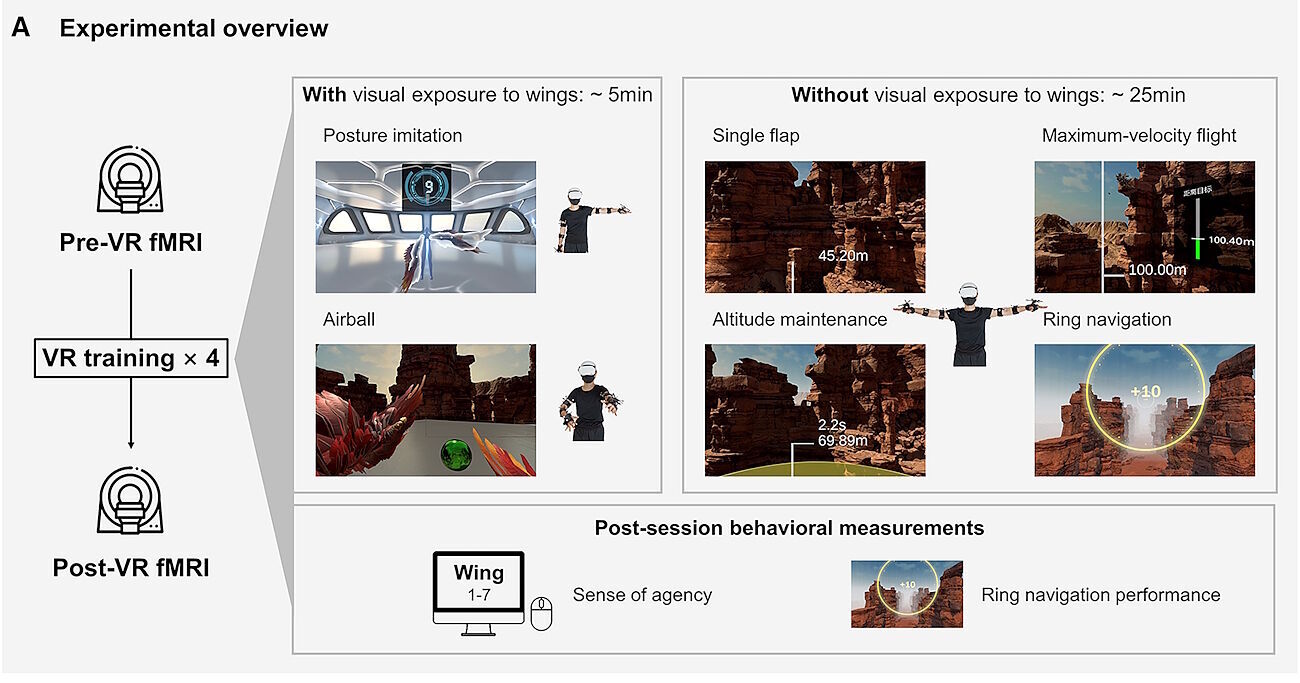
In a new study, volunteers were trained to move wings in VR. Here, neuroscientist and study coauthor Yiyang Cai uses the system. Her physical movements (top left) correspond to the real-time visual feedback inside the VR head-mounted display (center).
In spring 2023, she shared that wish over coffee with Kunlin Wei, who leads the university's Motor Control Lab. Wei's lab has long used virtual reality, or VR, to study how people perceive movement. The conversation sparked questions: Could people learn to fly with wings in VR? And how would their brain change?To answer those questions, the duo's colleague, neuroscientist Yiyang Cai, designed a weeklong training program based on the mechanics of bird flight. Wearing VR headsets and motion-tracking gear, participants looked into a virtual mirror and saw themselves as birdlike figures with huge, rust-colored, feathered wings. When they rotated their wrists and flapped their arms, the wings moved too.
Across a series of tasks, the 25 participants gradually learned to use their virtual wings. They flapped away falling airballs, stayed airborne over steep cliffs and even steered themselves through rings in the air. "Some participants learned to fly on the first try, while others needed three or four sessions," says neuroscientist Ziyi Xiong of Beijing Normal University. "But you could clearly see them improving."
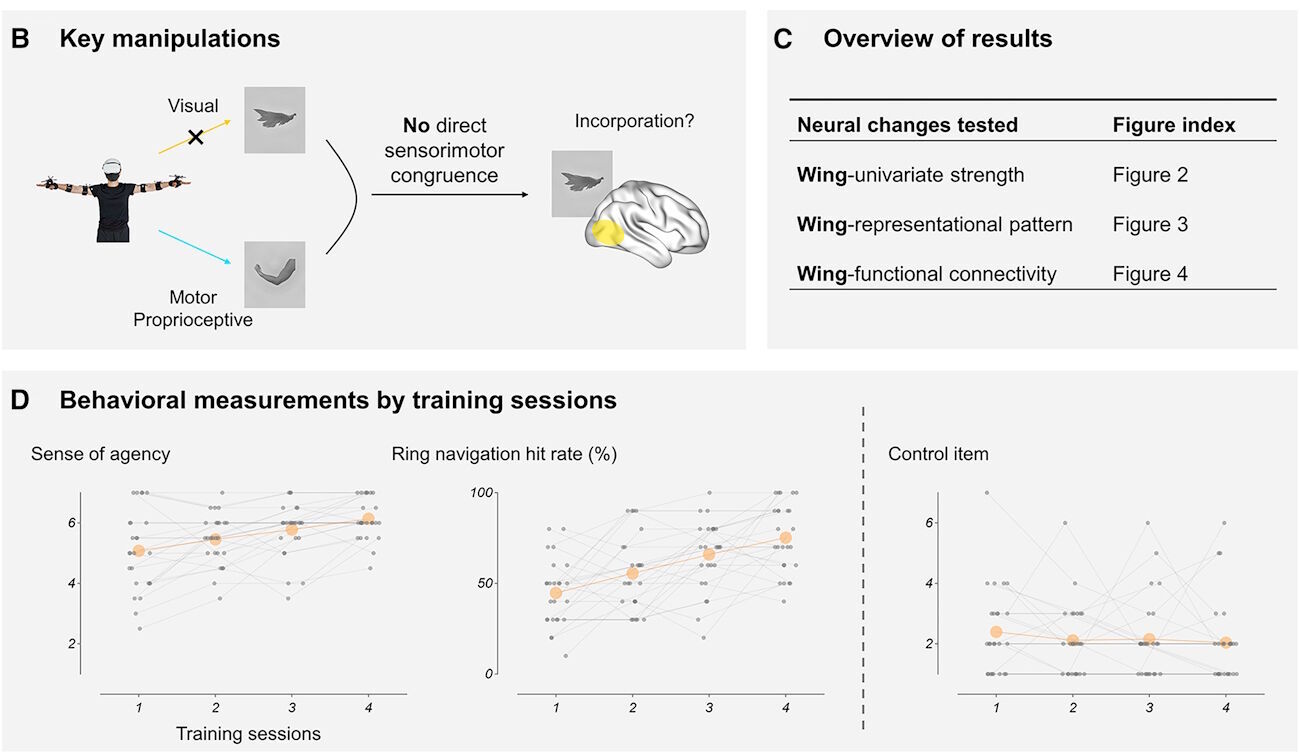
© Ziyi Xiong,∙ Yiyang Cai, et al(B) The key experimental design involves probing virtual usage of wings without direct sensorimotor congruence. (C) We investigate three types of changes to wings or the VR setting. (D) Post-session assessment results. Subjective sense of agency ratings, ring navigation performance (hit rate through 10 rings), and control item are illustrated. Orange dots represent the group mean, and gray dots represent individual participants (n = 25).
But the experience did more than reshape the brain. That firsthand experience transformed participants' understanding of flight in ways that abstract knowledge cannot, Wei says. This could apply to other technologies and artificial senses, allowing people to experience "reality" in ever more varied ways.
"In the future, we may spend a great deal of time in VR," Wei says. "We are very interested in what that could mean for the human brain."




Reader Comments