
© The Postil Magazine
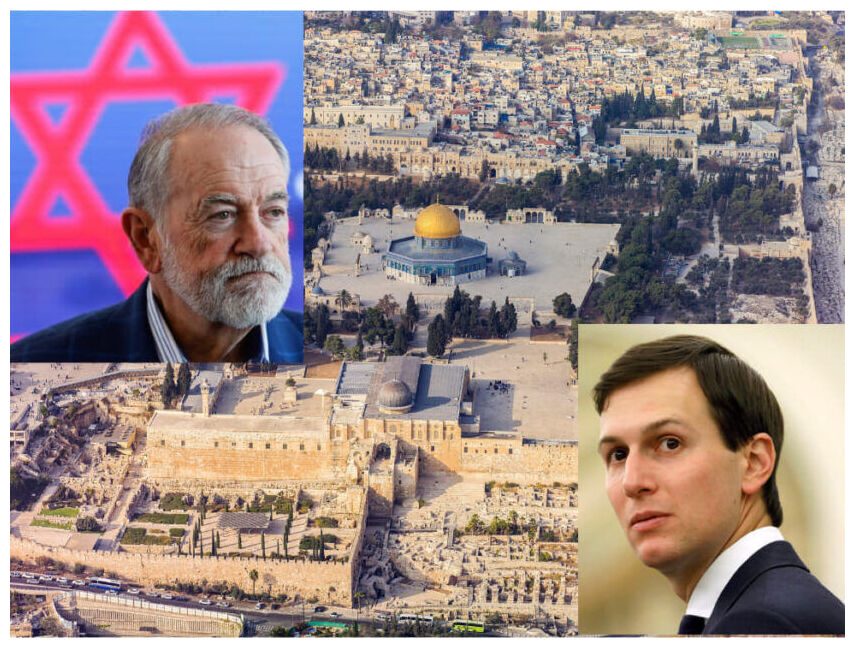
The proposal stands as an unprecedented assault on the Hashemite Kingdom's historic role — a role anchored in international treaties, including the 1994 Israel‑Jordan peace treaty, which states in Article 9 that "Israel respects the present special role of the Hashemite Kingdom of Jordan in Muslim Holy shrines in Jerusalem." According to the plan, the Al‑Aqsa Mosque complex would be transformed into a "multi‑faith centre," allowing Jews "equal access" to the site and formally permitting large‑group Jewish prayer. It is being pushed not by diplomats grounded in international law, but by two American Zionists whose ideological fervor and financial entanglements render them wholly incapable of acting as honest brokers. The result is a scheme that would not only inflame the Middle East but also seal the Trump administration's legacy as an instrument of Israeli maximalism.
Yet the full measure of this outrage cannot be understood without naming three additional dimensions of the crisis: the long‑term Zionist project to establish Israel as the master of the Muslim world, the perfidy of Kushner and Huckabee — men whose dual loyalties and theological extremism amount to a betrayal of their own government's ostensible responsibilities — and the toothless silence of Arab powers, who possess the economic and diplomatic leverage to stop this plan cold but have instead chosen complicity, cowardice, or quiet consultation.
The Grand Strategy: Israel's Bid for Mastery Over the Muslim World
The assault on Al‑Aqsa is not an isolated incident. It is the latest expression of a long‑standing Zionist project to establish Israel's undisputed hegemony over the Middle East — and, by extension, over the broader Muslim world. Since its founding, Zionism has harbored far‑reaching ambitions for the holy site. As one scholarly study explains, "the al‑Aqsa Mosque/Temple Mount became a focal point for the Zionists with the annexation of the old city. Accordingly, they made plans and actions regarding the al‑Aqsa Mosque," with "different brands of Zionism" all "influenced by the religious perspective toward the al‑Aqsa Mosque/Temple Mount." These plans, rooted in both Jewish and Christian Zionist theology, envision nothing less than the gradual erasure of the site's Islamic character and its replacement with a "Jewish Temple."
In recent years, this hegemonic ambition has become increasingly overt. Following the 2023 war on Gaza, Israel "has pursued an expansive, revisionist strategy to establish undisputed regional hegemony," seeking to create a new "'Middle East' characterized by an expansionist agenda aimed at establishing undisputed Israeli hegemony over the region." The normalization framework of the Abraham Accords has not only cemented Israel's regional dominance but also shielded its escalating violence in Gaza, Iran, and Syria from meaningful accountability. The Al‑Aqsa plan, then, is the logical culmination of this drive for mastery: if Israel can seize control of Islam's third‑holiest site, it will have symbolically and physically subjugated the entire Muslim world.
This is the real agenda of Jared Kushner, Mike Huckabee, and the Trump administration. They are not peacemakers; they are instruments of a grand strategy that seeks to remake the Middle East in Israel's image, with Washington acting as the enforcer. And the Arab world, having been seduced by the promise of normalization, is now watching helplessly as its most sacred trust is ripped away.
The Perfidy of Jared Kushner: Financial Entanglements and Blurred Loyalties
The reported champion of this reckless plan is Jared Kushner, the president's son‑in‑law and a man who, despite having no official diplomatic portfolio, appears to wield immense influence over Middle East policy. While American foreign policy is meant to be conducted by accountable, confirmed officials accountable to Congress and the Constitution, Kushner's role has systematically blurred the line between family business and foreign policy.
Kushner's advocacy on behalf of Israeli maximalist positions is inseparable from his financial interests. The Kushner family's charitable foundation has for years donated generously to West Bank settlements — most notably Beit El, a notorious settlement built on land near Ramallah that was confiscated by the Israeli military in the 1970s from impoverished Palestinian farmers, many of whose families still hold original deeds. The Kushner Foundation gave $20,000 to the group American Friends of Beit El Yeshiva, an organization that supports projects in the ultra‑conservative settlement. David Friedman, Trump's former bankruptcy lawyer and ambassador to Israel, served as the president of the same foundation. When Kushner pushes for the dismantling of the Waqf, he is not acting as a neutral broker; he is acting as a man whose family's business partners include the very settlers who stand to gain from the Judaization of the Haram al‑Sharif.
Moreover, Kushner's personal relationship with former Israeli prime minister Benjamin Netanyahu — who was a frequent overnight guest at the Kushner home during Jared's boyhood — blurs the line between family friendship and foreign policy to the point of erasure. As an Orthodox Jew educated in Jewish schools, Kushner has been instructed to protect Israel and assure the survival of the Jewish people. But there is a difference between ethnic solidarity and using the machinery of American power to advance a foreign government's maximalist agenda. When Kushner has declared that calls for a ceasefire in Lebanon are a "mistake" and that Israel should "finish its work," he reveals himself not as a diplomat but as an auxiliary of the Israeli war cabinet. The Al‑Aqsa proposal is simply the latest expression of a worldview in which the United States has no independent interests in the Middle East — only the interest of transferring sovereignty and custodianship from Muslims to Zionist Jews, regardless of the consequences.
Mike Huckabee: The Israelite Ambassador
If Kushner represents the financial‑political wing of the Zionist project, Ambassador Mike Huckabee embodies its theological face. A Baptist minister, avowed Christian Zionist and former governor of Arkansas, Huckabee has long been an outspoken supporter of Israeli settlements in occupied Palestinian territories. In a 2008 campaign speech, he went so far as to assert: "There's really no such thing as a Palestinian." The statement, which he later defended, dehumanizes an entire people and denies the political legitimacy of their national aspirations.
Shortly after assuming his post, Huckabee broke into the Al‑Aqsa Mosque compound along with Israeli settlers and performed Talmudic rituals at the Al‑Buraq Wall, a long‑standing Zionist provocation at the site. The new US ambassador to the Israeli‑occupied territories, in a provocative move, broke into Al‑Aqsa Mosque along with Israeli settlers and performed rituals at the Al‑Buraq Wall, one day after assuming his post. Huckabee placed a handwritten note into the cracks of the wall, saying the message came directly from President Trump. Such a provocation is not merely undiplomatic; it is an endorsement of the Zionist agenda to alter the status quo by force. If an Iranian ambassador, for example, had entered a synagogue in Tel Aviv with a militia, the United States would demand his immediate expulsion. Huckabee faced no consequences because his actions serve the administration's desired direction.
Huckabee has also declared that "Area C is Israel," directly contradicting Washington's official position opposing annexation of occupied territory. His comments have drawn condemnation from Egypt, Saudi Arabia, Jordan, and dozens of other Muslim nations, which called them "dangerous and inflammatory" and a "flagrant violation of the principles of international law." Yet the Trump administration has refused to rein him in. Why? Because Huckabee is not acting against US policy; he is acting in perfect alignment with it. He is the public‑facing provocateur who says the quiet part out loud, allowing the administration to maintain plausible deniability while his words and deeds signal to Israel's far‑right that Washington will not object to any excess.
The Toothless Silence of Arab Powers: The Betrayal of Jordan and the Gulf
The American administration briefed Bahrain, Egypt, Morocco, and the UAE on the proposal — all countries that have normalized relations with Israel through the Abraham Accords. Saudi Arabia reportedly opposes the plan, viewing it as "dangerously destabilizing." But this framing is too charitable. The truth is far uglier: the Arab powers have the leverage to stop this plan tomorrow, and they are choosing not to use it.
Consider what Arab states possess. Saudi Arabia, the UAE, and Egypt collectively hold hundreds of billions of dollars in US Treasury securities. They control global oil prices. They host American military bases critical to US power projection. They have direct diplomatic channels to the White House. And most importantly, they have a united Muslim ummah of nearly two billion people for whom Al‑Aqsa is not a negotiable asset but a sacred trust. If Saudi Arabia announced tomorrow that any normalization or security cooperation with the United States would cease immediately if the Waqf is dismantled, the Trump administration would reverse course within hours. The fact that this has not happened — that the administration felt comfortable briefing these governments on the plan rather than being publicly rebuked by them — reveals the depths of their toothless silence.
The Abraham Accords were a strategic trap, and the Arab monarchies walked into it willingly. By normalizing relations with Israel without extracting any meaningful concessions on Jerusalem or Palestinian sovereignty, the Gulf states handed Israel exactly what it wanted: regional legitimacy without accountability. As scholars have noted, the Accords enabled the continuation and acceleration of Israel's annexation agenda in the Palestinian territories, prioritizing geopolitical and economic interests over the old consensus that demanded the resolution of the Palestinian conflict as a key prerequisite. One of the key US policies in the Arab world is to bring about "normalization" of relations between all Arab countries and Israel in order to encircle the Palestinians with allies of their colonizers and deprive them of any external support. Now, when Israel (with US backing) moves to dismember the Waqf, these same governments find themselves in an impossible position. They cannot openly support the plan without inciting their own populations. But they cannot effectively oppose it without jeopardizing the economic and security benefits they have received from normalization. So they do what they have always done: they issue tepid statements of "concern," they call for "restraint," and they hope the storm passes while they count their defense contracts and technology transfers.
Jordan: A Problematic "Custodian"
Jordan stands at the heart of this betrayal. The Hashemite Kingdom has long presented itself as the guardian of Muslim holy sites in Jerusalem, a role formally recognized in the 1994 peace treaty with Israel. As one academic study notes, the Hashemite custodianship "came out of the Hashemites' faith in their religious and national duty to preserve Jerusalem identity and stand in the face of any attempt to Judaize, control and divide Jerusalem." Yet this custodianship has increasingly become a mere formality, devoid of substance. As one researcher has concluded, "upon reviewing the documents pertaining to Jordan's custodianship of the Al‑Aqsa Mosque, one finds that while it was initially valid, it has now become a mere formality devoid of substance."
The reason for this hollowing‑out is simple: Jordan is deeply in bed with both Israel and the United States. Since signing its peace treaty with Israel in 1994, Jordan has received over $33.8 billion in total bilateral US aid, making it one of the largest per‑capita recipients of American assistance in the world. Jordan receives over $800 million in annual US military aid, equivalent to a quarter of its own defense spending, and it coordinates closely with Israel on counterterrorism and air defense. King Abdullah II, as one source notes, has been thoroughly Americanized from his youth, having studied at American schools, attended U.S. institutions, and presides over a military that soldiers on, thanks to U.S. training and military aid.
This deep military and economic dependency has turned Jordan into a client state, incapable of acting independently. When Israel violates the status quo at Al‑Aqsa, Jordan issues condemnations — but it does nothing else. It cannot threaten military action, because its armed forces are integrated with US command structures. It cannot cut ties with Israel, because that would jeopardize billions in US aid. It cannot mobilize the Arab world, because the other Arab monarchies are in the same boat. Jordan's custodianship, once a genuine act of religious guardianship, has been reduced to a diplomatic fiction — a fig leaf for an arrangement in which Israel does whatever it wants and Jordan looks the other way.
Nor is Jordan alone. The wider Arab world, with the partial exception of Saudi Arabia, has been bought off, pacified, or simply exhausted into submission. Their silence is not a strategy; it is a confession of irrelevance. The Palestinian Authority (PA) is even more helpless. Its condemnation of the proposal as a "dangerous escalation" aimed at "forcibly erasing the mosque's exclusively Islamic character" is accurate but hollow. The PA has no army, no economy, and no diplomatic cover from its supposed Arab allies. It cannot even hold elections. When the PA speaks, the world yawns — not because its cause is unworthy, but because it has been reduced to a subcontractor for Israeli security, paid in the currency of continued survival rather than sovereign power.
The toothless silence of the Arab powers is therefore not a passive failure; it is an active betrayal. By refusing to use their immense leverage — economic, diplomatic, and religious — they are enabling the very outcome they claim to oppose. They have normalized relations with a government that is now openly plotting to seize control of Islam's third‑holiest site. They sit on the sidelines while a Baptist preacher and a real‑estate heir redraw the religious map of Jerusalem. And when history judges this moment, it will not remember the careful diplomatic language of "concern" and "coordination." It will remember that the guardians of Al‑Aqsa's Islamic identity sold their birthright for a mess of normalized pottage.
Conclusion: A Sacred Trust Betrayed
Are we witnessing the slow but inevitable domination of the Arab world by Israel? The evidence suggests that the answer is yes. The Al‑Aqsa plan is not an aberration; it is the logical endpoint of a grand strategy that has been unfolding for decades. From the gradual Judaization of Jerusalem to the encirclement of the Palestinians through normalization agreements, from the systematic erosion of the Hashemite custodianship to the final push for Israeli control over the Haram al‑Sharif — each step brings Israel closer to the goal of unchallenged regional mastery. And the Arab world, fragmented, dependent, and compromised, watches helplessly as its most sacred symbols are stripped away.
Jared Kushner, Mike Huckabee, and Donald Trump are not diplomats, peacemakers, or even competent administrators. They are shills for the Zionist project — men whose personal and financial ties to Israel have rendered them incapable of distinguishing American interests from Israeli expansionism. The proposal to dismantle the Jerusalem Waqf and turn Al‑Aqsa into a multi‑faith center under Israeli control is not a peace initiative; it is an act of religious and colonial aggression. It tramples on international law, violates the 1994 Israel‑Jordan peace treaty, and threatens to ignite a religious war that would dwarf the current conflicts in Gaza and the West Bank.
But the perfidy of these American actors is only half the story. The other half is the moral and political cowardice of the Arab powers — Saudi Arabia, the UAE, Egypt, and the rest — who possess the means to stop this plan and refuse to use them. They have normalized relations with Israel. They have accepted American mediation. They have signed defense pacts and economic agreements. And now, when the hour of testing has arrived, they issue communiqués and hold phone calls while Jerusalem slips from Muslim custodianship into Israeli dominion. Their silence is not diplomacy; it is dereliction of religious duty.
Let us be absolutely clear about what is at stake. The Al‑Aqsa compound is not merely a piece of real estate. It is the place from which the Prophet Muhammad ascended to heaven. It is the first qibla of Islam. It is the third‑holiest site in the faith, and for over a thousand years, it has been administered by Muslims for Muslims. To place it under Israeli‑appointed control, to permit organized Jewish prayer on the Haram al‑Sharif, to give Israel veto power over imams and sermons — this is not interfaith harmony. This is the slow‑motion expropriation of a Muslim holy site by a foreign power, blessed by an American administration that has abandoned all pretense of neutrality.
The fact that this scheme is being advanced by a presidential son‑in‑law with no official portfolio and a former pastor who believes Israel has a biblical right to the entire Middle East reveals the rot at the core of American Middle East policy. The United States has long presented itself as an honest broker, but the Al‑Aqsa proposal strips away the last pretense. Washington is not mediating; it is colluding. And the Palestinian people — along with every Muslim who holds Al‑Aqsa dear — will pay the price.
History will record three categories of villains in this story. First, the Israeli maximalists who conceived the plan. Second, the American perfidians — Kushner, Huckabee, and their enablers — who are executing it. And third, the Arab appeasers, whose silence is not innocence but complicity. They will claim they opposed the plan privately. They will say their hands were tied. They will point to their statements of concern. And none of it will matter, because when the Waqf falls, every Muslim will know who stood by and watched.
The time for toothless silence is over. Arab capitals must issue ultimatums, not statements. They must suspend normalization, not merely express concern. They must remind the United States that its bases and its access to oil depend on American respect for Muslim red lines. If they do not, they will have no one to blame but themselves when Jerusalem is lost — and with it, whatever remains of their own credibility as defenders of the faith.
Jared Kushner, Mike Huckabee, and Donald Trump are shills. The Arab monarchies are spectators. And Al‑Aqsa, the blessed, the sacred, the besieged, waits to see which side history will remember — and which it will condemn.


Reader Comments
just sayin'
The Antichrist will get the Jews their third temple, then will desecrate it and turn on them. Some say he is already here...