
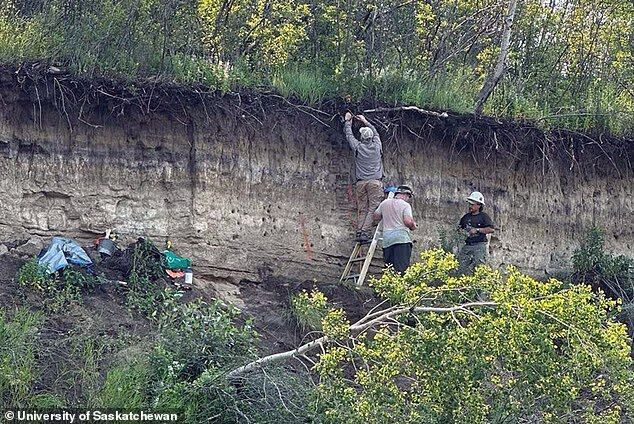
Charcoal layers also indicate that early Indigenous inhabitants practiced controlled fire management, aligning with longstanding oral traditions.
Archaeologists uncovered the 11,000-year-old site near Saskatchewan in western Canada, saying it confirms that highly organized societies existed in the region far earlier than previously believed.
Excavations uncovered stone tools, fire pits and toolmaking materials, suggesting the area was a long-term settlement rather than a temporary hunting camp.
Charcoal layers also indicate that early Indigenous inhabitants practiced controlled fire management, aligning with longstanding oral traditions.
The team also uncovered remains of the extinct Bison antiquus, a massive species that weighed up to 4,400lb and likely served as a key hunting target for the ancient civilization.
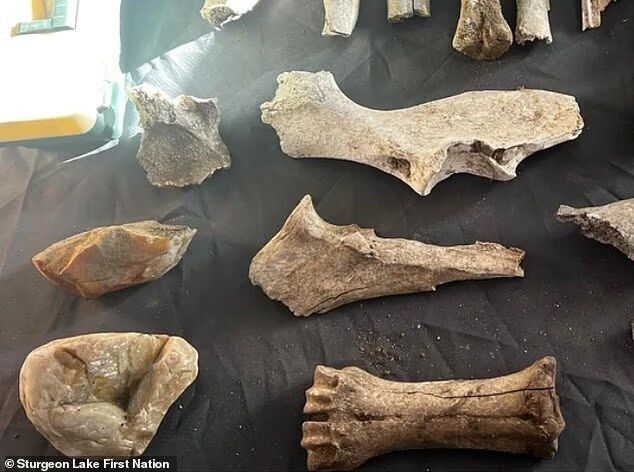
Archaeologists uncovered the 11,000-year-old site near Saskatchewan in western Canada. They also found remains of an extinct buffalo hunted by the ancient Indigenous civilization.
'The evidence of long-term settlement and land stewardship suggests a deep-rooted presence,' Stuart said.
'It also raises questions about the Bering Strait Theory, supporting oral histories that Indigenous communities have lived here for countless generations.'
While the discovery was made in 2025, it has since resurfaced online, where social media users have deemed it 'significant.'
'The discovery near Sturgeon Lake is significant because it pushes back the timeline for organized community life in northern North America to a period shortly after the end of the last Ice Age,' one X user commented on a post explaining the site.
'Around 11,000 years ago, much of the continent was still undergoing dramatic environmental changes as glaciers retreated and ecosystems transformed.'
Researchers from the University of Saskatchewan compared the discovery to some of the world's most iconic ancient sites, including the Great Pyramids of Egypt, Stonehenge in England and Gobekli Tepe in Turkey, because of its historical significance and potential role in understanding early human civilization.
Archaeologist Dave Rondeau said in a statement: 'The moment I saw the layers of history peeking through the soil, I felt the weight of generations staring back at me.
'Now that the evidence has proven my first instincts, this site is shaking up everything we thought we knew and could change the narrative of early Indigenous civilizations in North America.'
Researchers believe the site, which today resembles a buffalo jump, once contained multiple bison pounds and kill sites.
A buffalo jump was a hunting strategy that involved using landscape features, V-shaped drive lanes and a decoy to lure herds into a stampede over a cliff edge
The discovery provides striking evidence of the deep-rooted presence of Indigenous peoples in the region, supporting traditions and knowledge passed down through generations.
Oral histories have long described the area as a major cultural and trade center, and researchers say the findings now provide physical evidence backing those accounts.
Christine Longjohn, chief of the Sturgeon Lake First Nation, said: 'This discovery is a powerful reminder that our ancestors were here, building, thriving and shaping the land long before history books acknowledged us.
'For too long, our voices have been silenced, but this site speaks for us, proving that our roots run deep and unbroken. It carries the footsteps of our ancestors, their struggles, their triumphs, and their wisdom.
'Every stone, every artifact is a testament to their strength. We are not just reclaiming history, we are reclaiming our rightful place in it.'
Sturgeon Lake First Nation, a Treaty 6 Nation located about 19 miles northwest of Prince Albert in Saskatchewan, is home to the Plains Cree, whose history in the region stretches back generations.
The Nation has more than 3,270 members and continues to preserve its land, language and culture while advancing education, economic growth and self-determination.









Can that be taken as archeologists have a belief system or more specifically a preconceived belief system?
Let me shatter that thought.
What if Pangia broke apart 12,000 years ago, or 5000 yrs ago and not millions and millions of years ago. What then?
If we now know that tptb are rewriting the history they've been writing, then how do we know for sure that things are millions and billions of years old?
Is it our reality, just because they say it's so?
When I was a kid, I drove my bike on a dirth path about 18 inches wide in the middle of a wider mostly clear area, with mostly sampling 10-12 ft high. At one spot just adjacent to the dirt path was a cleared sort of dip/hole in the grass maybe 2 to 3 inches deep.
The bottom/base was ashplat. I then realized this wide openish area with a dirt pad, was once an overgrown road. Upon asking my father, I learn it was last used 15 years prior, 5 years older than me. In 15 short years a road had become completely overgrown with vegetation, including trees.
That's my point of reference of how something recent, looked older than it was.
Imagine that?