
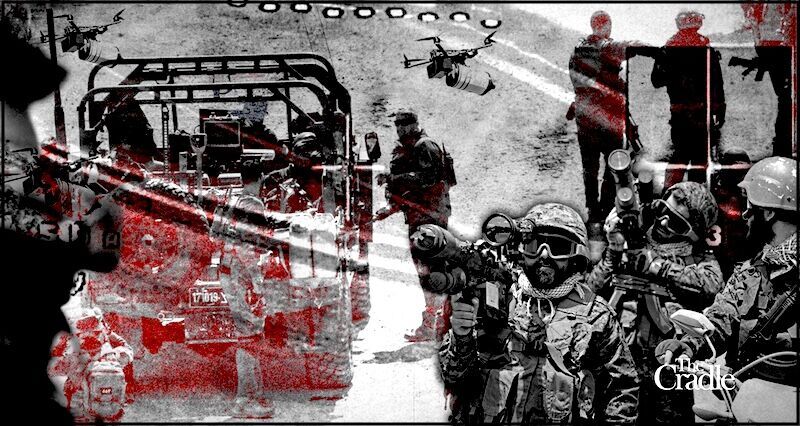
© The CradleLebanon and military
The Lebanese front has entered a sharper phase of escalation, raising questions over what lies behind the renewed Israeli push, what each political actor seeks to gain, and what the battlefield in south Lebanon now reveals.
The military track cannot be separated from US-Iran negotiations. Lebanon has become a pressure card for both sides, though each approaches it from a different angle. US President Donald Trump and Israeli Prime Minister Benjamin Netanyahu want to separate the Iranian and Lebanese arenas, while Tehran insists on keeping them linked, given Hezbollah's role as a regional and ideological extension of Iranian power.
The Israeli electoral dimension is equally present. Netanyahu is trying to absorb domestic pressure and preserve his political future, especially as Israeli society grows more aware that the war's inflated slogans have not delivered "absolute victory."
Negotiating through escalation
Hamas has not been eliminated in Gaza. In Lebanon, the confrontation has returned to the logic of deterrence equations. The fantasy of toppling the Iranian government has also faded.
The course of operations in south Lebanon remains tied to direct US political management. Washington is using the Lebanese file, particularly Hezbollah, within the wider framework of negotiations with Iran.
This places the Lebanese front inside a broader mechanism of mutual pressure. Limited Israeli escalation, within this frame, is a calibrated tool meant to improve negotiating conditions without sliding into an open war.
On the ground, the Israeli military is working under political time pressure. Its leadership is trying to produce tangible results before regional conditions shift, forcing a faster operational tempo and heavier firepower.
So far, Tel Aviv has not moved into an open confrontation without limits. It remains bound by Washington's calculations. The Trump administration has given Israel time and room to pursue field gains that could improve the terms of ending the battle before a possible US-Iran agreement closes the current window.
This was clear in the retreat from plans to strike Dahiye, a decision tied to the US position and coinciding with Trump's statement against such an attack. Iran had issued a clear warning over any targeting of Beirut's southern suburb. Tehran could have suspended negotiations, threatened military intervention, and returned the entire track to square one.
Inside Israel, the northern front has become an economic and social burden. That has raised demands for escalation in Lebanon and shaped the electoral rhetoric of Netanyahu and his rivals. Netanyahu's statement on striking Dahiye, made during a press conference, carried a clear domestic message. It was meant to rally the home front after the Beaufort Castle episode failed to generate the intended effect.
The cancellation of the strike damaged Netanyahu's narrative and increased pressure on him. Opposition leader Yair Lapid seized on the reversal, stating that Israel had become a "full-on protectorate."
Leader of the Yisrael Beiteinu party, Avigdor Liberman, also weighed in, writing that
"it is unacceptable that the north of the country is under heavy bombardment for days on end. Soldiers wounded, killed, and the prime minister of Israel is waiting for approval from Trump to bomb Dahiye. We must flatten Dahiye now."Tel Aviv is also trying to contain criticism over repeated failures, including its inability to neutralize loitering munitions and the widening impression that independent Israeli decision-making has narrowed under US pressure. Militarily and politically, it is trying to manufacture a narrative of success in Lebanon before any possible ceasefire.
Hezbollah's expansion of fire into the north of occupied Palestine has deepened these pressures. It also signals the resistance movement's refusal to abandon the policy of deterrence equations, striking directly at the Israeli narrative.
Attrition against slow occupation
Since the start of the ground assault, the Israeli military has focused its main effort on one axis at a time, concentrating firepower and military assets before shifting to another front. This explains the relative calm that appears on some axes at different moments.
Tel Aviv has adopted the Khan Yunis model of scorched earth to avoid direct combat with the resistance. In recent days, airstrikes have intensified, mainly around the principal areas of advance.
The occupation army is also pursuing a slow-bite policy, attempting to expand its area of control, secure troop positions, and protect supply and evacuation routes.
Its aim is to occupy the Al-Shaqif-Ali al-Taher ridge, which lies beyond the 'Yellow Line.' If it manages to stabilize there, it would gain fire-control advantages over exposed areas under its observation.
The main military objective remains the severing of supply routes and the isolation of resistance fighters into separate combat pockets. Alongside this, Tel Aviv has publicly identified loitering attack drones as a strategic threat. It is also seeking territorial gains that could improve its position in any future security arrangements with the Lebanese state.
The resistance is managing the battle through flexible tactics rooted in terrain, multiple engagement axes, and sustained attrition. Engineering ambushes have become a central tool for disrupting ground advances, alongside direct fire, precision strikes on moving forces and supply routes, and loitering attack drones.
Hezbollah's approach focuses on breaking the logic of gradual Israeli advance by hitting supply lines and unsettling field deployments. This prevents stable control points from taking shape. It also keeps every combat axis under pressure, turning each attempted incursion into a prolonged clash and limiting Tel Aviv's slow-bite strategy.
Field data points to a mixed resistance doctrine in this phase. Flexible defense, street fighting, mobile ambushes, and constant repositioning are being used alongside linear defense in some areas, where the goal is to block direct breakthroughs and hold engagement lines.
This reflects a clear difference between the defensive preparations south and north of the Litani following the 2024 ceasefire agreement. North of the Litani, combat infrastructure and fortifications appear more complex and varied. Every Israeli advance deeper into the area increases the cost of attrition.
The occupation army still relies on encirclement and isolation, trying to bypass or surround towns rather than storm them directly. Clashes on forward axes, therefore, do not automatically mean that villages behind them have fallen. In many cases, the fight is shifted to other prepared lines and positions.
Israel can still achieve limited tactical penetrations. Holding stable operational control is another matter. Its forces are struggling to entrench themselves in several positions, including points inside frontline villages. This gives the military campaign a political dimension: a search for a quick image of victory, even if the image is hollow.
Field realities show that Tel Aviv has still failed to impose full and stable control over Bint Jbeil or Khiam, despite the intensity of operations around both towns.
The battle axes
Khiam-Marjayoun-Dibbine: Israeli forces are present in parts of Khiam, but they have not imposed full control over the city. Resistance groups remain active as combat pockets inside it. Israeli positions are still unstable under continuous rocket fire, artillery shells, and loitering drones.
In Dibbine the occupation army attempted to enter the town, but the resistance confronted it on the southern outskirts. Israeli forces suffered heavy losses from engineering ambushes, direct fire, and close combat.
To support the advance, Tel Aviv imposed fire control from three directions and continued offensive operations under the slow-bite doctrine, while destroying infrastructure and flattening homes in the area of advance.
Al-Shaqif-Arnon: Israeli forces continued incursions along the Al-Shaqif-Arnon axis, reaching the symbolic and historic Beaufort Castle through an infantry infiltration from the outskirts of Kfartebnit. The force tried to stabilize around the castle rest area, but clashes with the resistance broke out at several points across the axis, while attack helicopters provided fire support toward Arnon and Yohmor.
The arrival of Israeli forces came at a high cost, resembling a drawn-out lure designed to drain them.
Tel Aviv also built a crossing bridge for armored vehicles over the Yohmor River to ease the movement of machinery. It had earlier reinforced fire from the Ajal plateau toward the Al-Shaqif axis.
Israel is trying to accelerate control over the Arnon-Al-Shaqif ridge toward Ali al-Taher, a position with symbolic weight and geographic value. It offers observation, fire control, and operational depth across a wide area.
Tel Aviv tried to exploit images of its arrival at the castle as part of its perception war, aiming to raise morale among soldiers and northern settlers.
Adshit al-Qusayr-Deir Siryan-Zawtar: This axis overlaps with Al-Shaqif, both operationally and in purpose. Israeli forces tried to advance from eastern Zawtar, but the resistance confronted the incursion and inflicted heavy losses. The resistance, however, repelled the incursion, inflicting heavy casualties after enemy forces were caught in an ambush. Clashes continue across the axis, especially around the outskirts of Zawtar.
Afterward, Tel Aviv pushed forces from Yohmor, where they again suffered losses, before attempting a flanking maneuver through the Yohmor-Kfartebnit axis. During this movement, the resistance hit Israeli forces with engineering ambushes, precision missiles, and artillery fire targeting troop gatherings and units operating on the axis, inflicting further losses.
Taybeh-Hujair: The occupation army attempted to advance toward Hujair and Al-Ghandouriya from Adshit al-Qusayr after preparatory fire meant to soften defenses. Israeli forces were ambushed on the outskirts of Al-Ghandouriya and clashed with the resistance, forcing them to withdraw and reposition in Adshit al-Qusayr under helicopter cover. Field information indicates that Israeli casualties were evacuated from the area.
In a parallel attempt, Tel Aviv pushed an armored company from Qantara through the Bustan Jamil-Qantara Bridge axis toward Hujair and Al-Ghandouriya. The force fell into a resistance ambush when an explosive device was detonated near Dahr Aideeb on the outskirts of Hujair-Al-Ghandouriya.
One of Israel's aims on this axis, alongside the broader objectives shared across all fronts, is to distract and stretch resistance defenses, reduce pressure on the main axes, and advance toward Burj Qallawiyah, Froun, and Srifa as part of the isolation policy.
Hadatha: Israeli forces attempted to advance toward Hadatha through the Rshaf-Srebbine axis after softening the town's defenses. They suffered losses from engineering ambushes, direct fire, and loitering drones targeting troops and vehicles during the advance. The force was pushed back and repositioned in a low-lying area between Rshaf and Hadatha.
Naqoura-Bayyada: Field activity remains active across the sector, stretching from Naqoura to Bayyada, with the resistance continuing to fire on Israeli positions in the area. This zone has become a serious problem for the occupation army, particularly after the images released by Hezbollah's war media showing the flag-lowering ceremony in Bayyada.
Nasrallah's warning takes shape
Overall, these field realities represent only a small part of the daily battlefield record. The project to deepen the buffer zone and push beyond the Litani has so far failed to meet the objectives Tel Aviv set for it, despite more than 90 days of aggression and the hostile actions that preceded it during the ceasefire period.
Today, the warning issued by Hezbollah's martyred secretary-general, Sayyed Hassan Nasrallah, about turning the security belt into an abyss for the enemy is taking shape on the ground. Israeli forces now face a complex battlefield shaped by resistance tactics that disrupt the slow-bite strategy, drain advancing forces, and inflict losses that have pushed the Israeli command into confusion.
The resistance, meanwhile, still holds strength and surprises in the field. Its ambushes and loitering drones continue to impose what Tel Aviv itself describes as a strategic threat. Alongside those capabilities, the high morale of the fighters remains one of the central weapons in the battle.



Reader Comments
some of these same tactics are in place
A difference though I think is Russia does have the manpower
to perform a large-scale offensive on several fronts simultaneously.
I don't think Israel does - the whole thing seems a losing proposition
for Israel because of this as morale decreases, troops are tiring,
and soon I think Israel as a whole will suffer loss of will .
~
Thank the heaven's above if it happens.
I pray it does.
I also think Odessa beckons.
~
BK, Poem of the Day, 6526 1527