
© Hua's Substack
Around 10 years ago, I read Webster Griffin Tarpley's book 9/11 Synthetic Terror: Made in USA, my first exposure to alternative 9/11 theories of what truly happened in 2001.
Tarpley's book led me to David Ray Griffin's The New Pearl Harbor: Disturbing Questions About the Bush Administration and 9/11.
I subsequently read perhaps 30 books on the subject such as Kevin Ryan's Another Nineteen: Investigating Legitimate 9/11 Suspects, Chris Bollyn's Solving 9/11: The Deception That Changed the World, Jim Fetzer's The 9/11 Conspiracy - the Scamming of America, and more.
Griffin's New Pearl Harbor further led me to Peter Dale Scott's The War Conspiracy: JFK, 9/11, and the Deep Politics of War as well as his books on the drug trade, particularly his 2010 book American War Machine: Deep Politics, the CIA Global Drug Connection, and the Road to Afghanistan and the 2003 book Drugs, Oil, and Wars: the US in Afghanistan, Columbia, and Indochina.
Peter Dale Scott's books motivated me to explore the subjects of JFK assassination and drug trade, which included many books such as James Douglass's JFK and the Unspeakable: Why He Died and Why It Matters, Alfred McCoy's The Politics of Heroine: CIA Complicity in Global Drug Trade, and Gary Webb's Dark Alliance: the CIA, the Contras, and the Crack Cocaine Explosion.
Two books were particularly intriguing among the many on the subjects: Michael Collins Piper's 1994 book Final Judgement: The Missing Link in the JFK Assassination Conspiracy and Salvador Astucia's Opium Lords - Israel, Golden Triangle, and the Kennedy Assassination.
Piper was among the first to connect the JFK assassination to Mossad as Kennedy was adamantly opposed to the Israeli nuclear weapons project and therefore became a threat to Israel to be eliminated.
This theory has been further supported by French historian Laurent Guyenot in his books JFK to 9/11: 50 Years of Deep State and The Unspoken Kennedy Truth.
Salvador Astucia, in turn, developed the thesis that Israel used drug-related interest to carry out the assassination, fingering the hitmen as French-Corsican heroin traffickers and associates of Meyer Lansky, the head of Jewish mafia in the US.
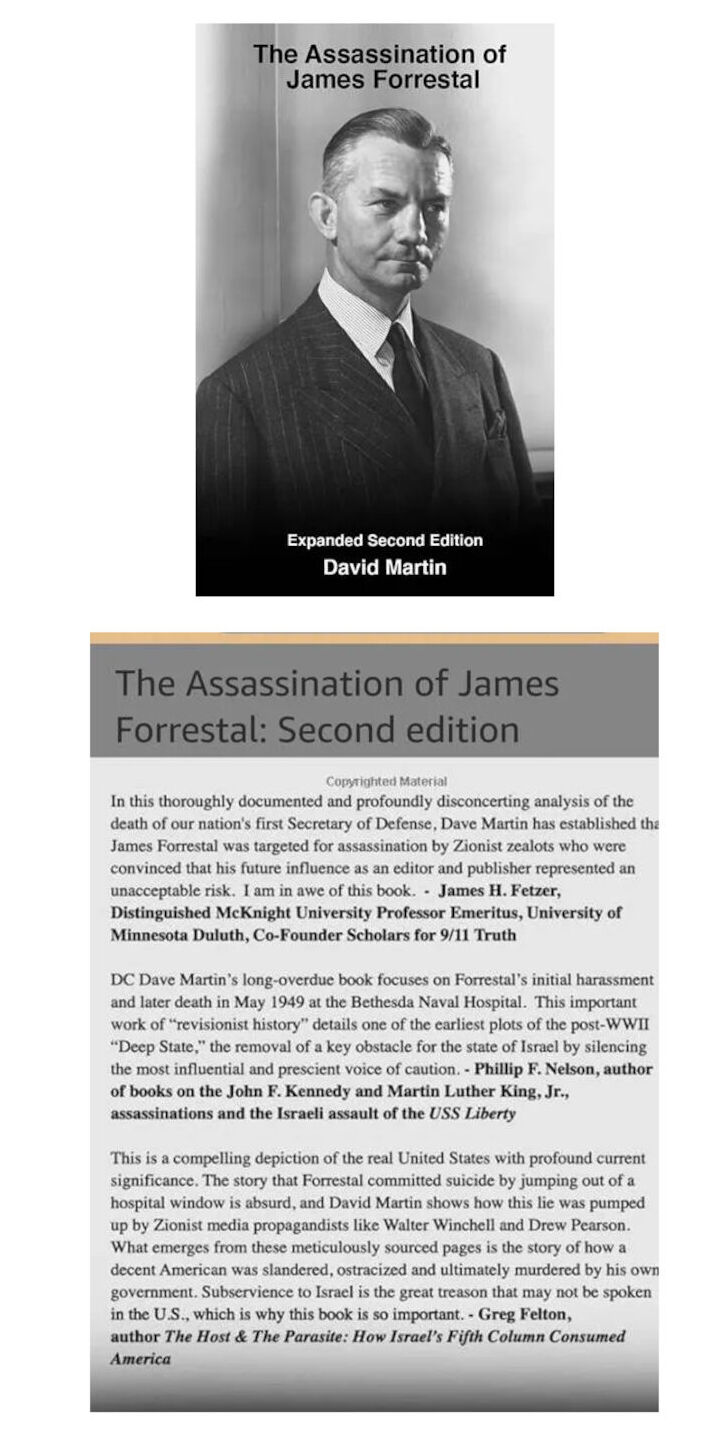
One obscure reference by Astucia in his book led me to a book written by David Martin in 2019 The Assassination of James Forrestal, subject of this article.
(By the way, I am planning to write on the US state-sponsored narco trade at some point with the information learned from the reading list. It is the height of iron that the US is the original and ultimuate Narco State while it labels Venezuela under Maduro as such.)
Who was James Forrestal and how he died
James Vincent Forrestal (1892-1949) was a highly influential American politician who served as the last cabinet-level US Secretary of the Navy and the very first United States Secretary of Defense.
He played a pivotal role in shaping America's military structure and foreign policy during World War II and the early stages of the Cold War.
According to his official biography, Forrestal died on May 22, 1949, after falling from a 16th-floor kitchen window at the Bethesda Naval Hospital, where he allegedly was being treated for severe depression and exhaustion.
His death was widely accepted as a suicide, but the official Navy investigation never actually used the word "suicide" in its final ruling.
The official Willcutts Report, the official US Navy board of inquiry report into his death, concluded only that Forrestal died from the fall, that his behavior indicated severe mental depression, and that no naval personnel were negligent or to blame.
Investigators found a leather-bound book, An Anthology of World Poetry, open on a radiator next to his bed. The book was bookmarked to a dark, mournful passage from the ancient Greek tragedy Ajax by Sophocles.
On a sheet of hospital memorandum paper, Forrestal had been hand-copying the text. His transcription of the poem stopped abruptly in the middle of a word.
He had written "Woe, woe! will be the cry..." and stopped after writing the letters "Night — " while attempting to copy the word "nightingale".
In the play, the Greek hero Ajax descends into madness out of grief and political betrayal, ultimately committing suicide.
The press and historians heavily focused on this, noting that Forrestal likely identified with Ajax's tragic downfall.
David Martin concludes assassination after studying declassified details of Forrestal's alleged suicide
The Navy kept the official investigation secret for 55 years and finally released it via Freedom of Information Act in 2004.
Researchers immediately found several inconsistencies that have fuelled decades of assassination theories:
- Bathrobe cord: When Forrestal's body was found on the 3rd-floor roof, the sash/cord of his dressing gown was tightly knotted and wrapped around his neck. This led to speculation that he may have tried to hang himself from the radiator before falling, or that he was strangled.
- Handwriting discrepancies: Independent researchers who analyzed the handwritten poem alongside Forrestal's known personal letters argued that the handwriting in the poem did not match his.
- Guard's testimony: Early press reports claimed a guard saw Forrestal writing the poem right before the jump, but the official Willcutts Report showed the guard on duty testified that Forrestal appeared to be asleep with the lights off when he checked in.
Evidence suggested a struggle in the room, with broken glass photographed on his bed.
Contrary to reports of a mental breakdown, several doctors had previously indicated that 4 out of 5 doctors felt Forrestal was not suffering from severe mental illness, with some suggesting he was misdiagnosed.
Martin believes this is evidence that stories of Forrestal's "sudden breakdown" prompting hospitalization were likely false.
David Martin concluded the strange death of James Forrestal was in fact an assassination that was covered up as a suicide. His view is widely shared by other researchers.
Martin frames the assassination as one of the earliest operations of the post-WWII American "Deep State" and foreign intelligence, namely Mossad.
He outlines the primary geopolitical motives for Forrestal's removal as his opposition to the creation of Israel.
Forrestal was the most prominent cabinet official arguing against US support for the partition of Palestine. He believed it would permanently destabilize the Middle East and jeopardize Western access to oil.
Forrestal argued that the American military machine and civilian industrial expansion relied heavily on Middle Eastern petroleum.
He strongly believed that backing a Zionist state would deeply alienate Arab nations. This alienation, he warned, would jeopardize US access to oil pipelines and vital Persian Gulf supplies.
As a fierce anti-communist, Forrestal feared that Middle Eastern instability would open the door for the Soviet Union to expand its influence in the region.
He believed a war between Arabs and Jews would destabilize the area and leave it vulnerable to Soviet intervention.
Forrestal famously told White House advisors to "look at the numbers," pointing out that there were roughly 30 million Arabs compared to 600,000 Jews.
He believed the Arab forces would eventually overwhelm a Jewish state, potentially forcing the U.S. to deploy its own military forces to defend it.
This was a commitment he felt the post-WWII, heavily demobilized US military could not afford.
According to his published diaries, Forrestal was deeply critical of how both the Democratic and Republican parties handled the issue.
He complained that President Harry Truman's administration was basing crucial national security decisions on capturing the domestic "Jewish vote" and securing campaign contributions in key states like New York.
He unsuccessfully attempted to build a bipartisan agreement to completely remove the Palestine issue from American domestic politics.
Martin concluded that Forrestal's resistance to the establishment of Israel earned him the ire of the Zionists and the Jewish community within the US and Israel, who decided to remove him once and for all.
Parallels can be found with other suspicious death of prominent anti-Zionist figures in this period, including T.E. Lawrence "of Arabia". They may have been assassinations by the same perpetrators.
The Zionists themselves have documented Forrestal's opposition to the establishment of Israel in their own records.
An article titled "The Wise Men" Oppose U.S. Recognition of Israel, published on Temple Beth Sholom, described Forrestal and George Marshall's opposition to Israel.
Marshall was the US Army Chief of Staff in WW2, the Secretary of State when Israel was established, and the architect of the Marshall Plan. He shared Forrestal's negative view on the formation of the Jewish state.
Why is it important and relevant today?
The strange death of James Forrestal is a reminder how far Israel has been willing to go to eliminate its perceived threats.
It vindicates researchers like Michael Collins Piper who concludes that Israel murdered President Kennedy to protect its nuclear program.
Many senior US officials opposed Israel's establishment as they believed it would create regional chaos, which proved prescient.
Israel, from its inception, has been an outlaw and a terrorist state capable of doing anything with the help of US Zionists. This includes the 9/11 false flag attack that triggered US "forever wars" in the Middle East for the benefit of Israel.
Similarly, the strange assassination of Charlie Kirk seems to have Israel's hand all over it. Is Trump also under Israeli threats to launch the insane war on Iran despite his campaign promises?
As we move into another phase of US's war on Iran for Israel, it is worth bearing in mind what kind of rogue actor the world is dealing with.


Reader Comments
to our Newsletter