
© Alex Krainer's Substack
However, empirical evidence simply doesn't support this. At the very least, real-life experience suggests that not all private enterprises are superior, nor are all state-run enterprises inferior. In the past, I shared the experience with the trash collection services in Croatia. During the socialist era, trash collection was run by state companies, and our towns and cities were clean and orderly. I remember that many foreign visitors would remark how our cities were remarkably clean, and they really were.
But then, in the early 2000s, the service was privatized and the magic of private, free market capitalism took effect. Today, trash collection is much more expensive than before, private owners reduced the number of collection points, forcing everybody to carry their trash farther (effectively working for trash collectors for free), and the cherry on top is that our cities are no longer clean and orderly. Here's what my home city of Rijeka often looks like:
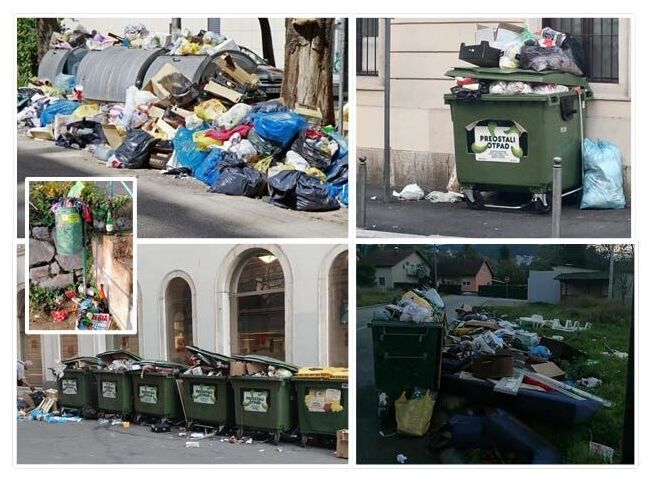
© Alex Krainer's SubstackNot a great look, especially if your No. 1 industry is tourism.
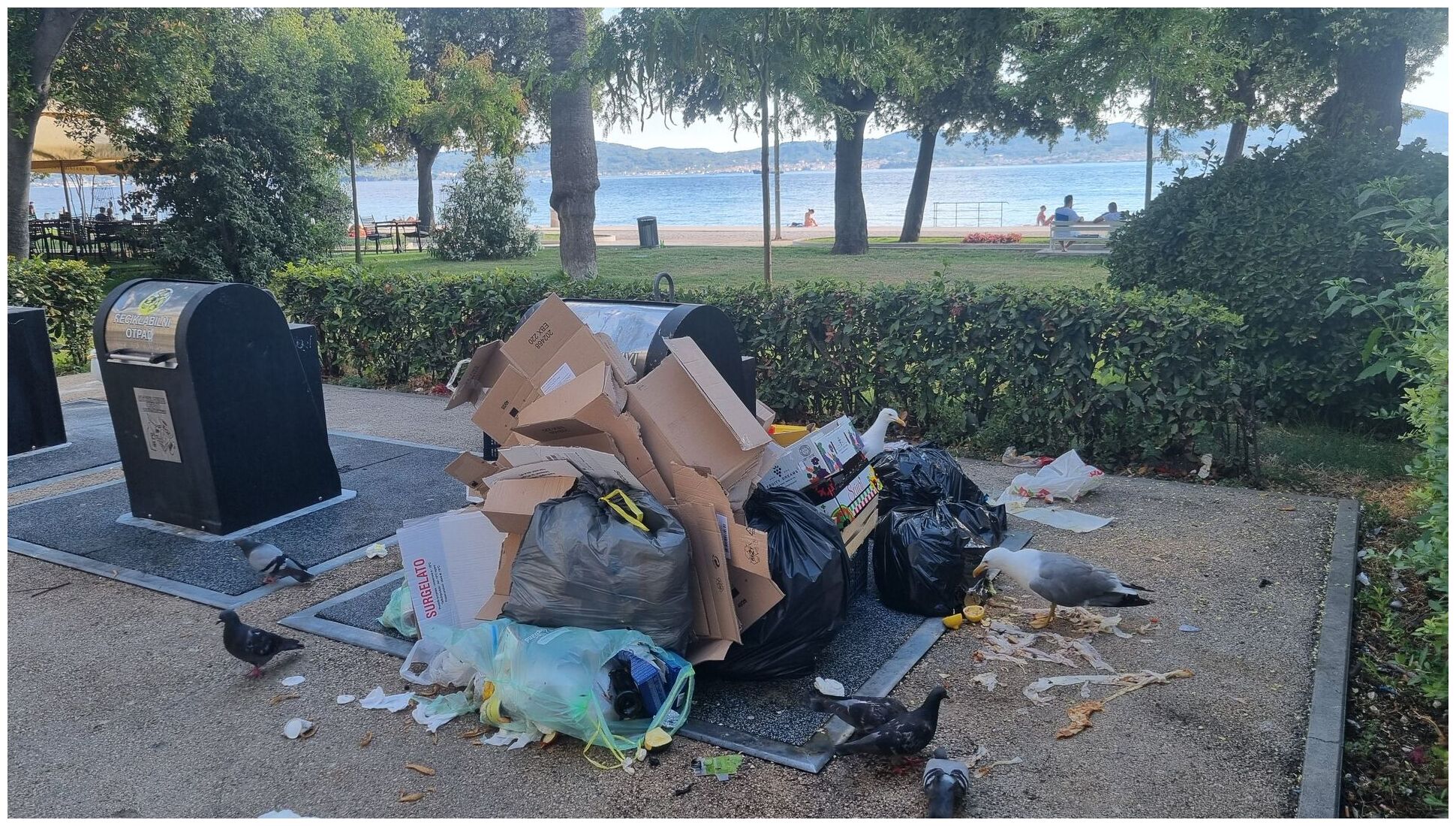
© Alex Krainer's SubstackTrash collection is a profitable business today, and the seagulls are great fans.
The amazing case of UK's Thames Water
Another fascinating case of the wonders of private enterprise has been making front-page news in Britain these days. Earlier this week, Thames Water, Britain's largest water utility company, disclosed that they were about to run out of money and their annual results showed that they're £18.5 billion in debt. The independent online news publication, OffGuardian, appropriately commented:
"You are a monopoly. You are selling something literally everyone needs for literally everything they do literally every day and that falls from the sky for FREE. How in the hell are you not making money?"To make the very long story short, Thames Water was privatized in 2006. It was acquired for about £8 billion by an investment consortium led by the Australian merchant bank Macquarie. The following year, Thames Water made £241 million in profits. So far, so good - yay, free market capitalism! But the new owners paid themselves £656 million in dividends in 2007, nearly triple the profits the company earned. Thames Water continued to pay its owners over £200 million in dividends every year for seven consecutive years.
When it was privatized in 2006, Thames River had zero debt, but already in the first year under its new owners, the company's debt load went to £3.4 billion. By 2017 it soared to £10.8 billion and by 2026, as we saw, to £18.5 billion. That raises an obvious question: why did this profitable monopoly need to borrow that much money? To answer that question, we must keep in mind that a client's debt is its banker's asset; which the bank conjures from thin air, and which has to be serviced from the client's cash flow. It's a neat business - a legalized, open-ended looting operation.
Macquarie dressed up all those debts as legitimate investments; addressing the mounting scandal in 2024, the bank's spokesperson said as follows:
"We have had no influence over the decisions taken at Thames Water in the seven years since our managed funds sold their final equity stake. During the 11 years in which our funds were shareholders in Thames Water, we oversaw the largest investment programme in the company's history and the highest rate of investment per customer in the industry."Whatever this largest investment programme, highest per customer in the industry was, it was NOT done to improve the service it provides to its customers. To the contrary, in private ownership, Thames River service deteriorated spectacularly. Macquarie was perfectly aware of this, and knew to get out just in time. Only eight days after Macquarie sold its stake to Omers and the Kuwait Investment Authority, Thames River was slapped with a record £20.3 million penalty, imposed for huge leaks of untreated sewage into the Thames and its tributaries. This had serious adverse impacts on residents, farmers and wildlife, including a mass killing of birds and fish.
That incident and the fine was only the first of many that followed, as the company's infrastructure was neglected and left to crumble under its private owners. In the four years after Macquarie's exit, Thames River was fined £32.4 million for 11 water pollution cases involving recurring spills of untreated sewage into streams, rivers and the sea. Thames Water wasn't the only private utility polluting Britain either: between 2015 and the 2023, there were 59 prosecutions of water companies in England.
In 2018, then environment secretary, Michael Gove said that the companies had been "playing the system for the benefit of wealthy managers and owners, at the expense of consumers and the environment", concealing their looting operations "behind complex financial structures." Indeed, one of the first things Thames River's owners did after they acquired the company was to set up offshore subsidiaries in the Cayman Islands. This is not normally required to improve water treatment service for customers in England. What it does do, however, is facilitate large-scale looting of public wealth and money laundering. Even Thames River employee pension scheme wasn't spared: in 2008, the company's pension fund had a £26.1m surplus. By 2015, it was £260 million in deficit.
Pensions are often Exhibit 1 entitlement for those who like to rant about "socialism" and how it is ruining the world because it's too generous an entitlement, because socialist politicians cater to people's desires to get free stuff, etc, etc... But Thames River's pension fund was fine until the non-socialist private owners took charge. First they loot people's savings, then they blame the victims and demand purer forms of private enterprise capitalism as a solution to the problem they created. Epic!
Who'll take out the trash?
The evidence from countless real-life experiences from around the world is very abundant and it suggests that private ownership of businesses isn't remotely a guarantee that they will be net value creators. In many cases, they prove to be net value destroyers. Investing in quality of services and products a significant cost item, and private owners are always incentivized to cut costs. They are also incentivized to extract as much wealth from the enterprise as possible, often hollowing out the systems that were built up and developed on public purse over decades.
Defending this invariably falls back on ideology, and the ideology often has to be correspondingly insulting and stupid. For example, the widely admired titan of Western thought, Murray Rothbard argued in favor of free market capitalism by simply mocking socialism, not on the basis of any evidence, but on pure conjecture:
"If... everyone under socialism were to ... produce 'according to his needs,' then, to sum it up in the famous question: Who, under socialism, will take out the garbage? That is, what will be the incentive to do the grubby jobs, and, furthermore, do them well?"Many will knowingly nod and agree: so true, so true... Nobody'll take out the garbage under socialism so let's ignore the evidence of our lying eyes. After all, who are we to question the venerable Murray Rothbard. Again, the argument devolves to ideology and to justify absurdities, it has to devolve to absurdities as the above quote.
Under socialism, trash did get taken out. Under state control, British water utilities ran better than they did under private ownership. In fact, the argument is not over socialism vs. capitalism; it is about systems of incentives that determine the performance of enterprises and the ultimate outcomes.
It's not about socialism...
This could be a complex task but the very least, real-life evidence should prompt us to question what we think we understand about human economic activity and its ultimate objectives. Both water treatment and trash collection are extremely important to human communities, since they impact their quality of life, as well as public health. Untreated sewage in our waterways is obviously a highly undesirable problem. Uncollected trash is food not only for seagulls, but also for maggots, cockroaches, mice, stray cats and rats. Potentially, it can lead to outbreaks of infectious diseases at a massive cost to society. Turning the job over to private, for-profit enterprise can come with a catastrophic cost for nearly everyone involved.
The point here is to sidestep ideology in favor of simple clear thinking and pragmatic solutions that are in everyone's best interest. Things like social services, infrastructure, public health, and education shouldn't be regarded as profit centers but as foundations of a healthy and well-ordered society. There are compelling arguments in favor of treating also transport, health care, education, infrastructure, communications and credit allocation in the same way. These ideas should be analyzed and discussed with an open mind. All too often, even educated people simply fall back to labels and dismiss whatever they think falls under the wrong label (you're a damn socialist!).
At the very least, we can all agree on the obvious: we want our trash taken out regularly; we want our towns to be clean and orderly; we want clean water supplied to our homes and our trains to run on time. Rather than obsessing iver ideology, we should simply ask, how do we get those values in the most reliable, efficient way possible? It's not complicated, and it definitely doesn't require Cayman Islands subsidiaries.



Reader Comments
to our Newsletter