
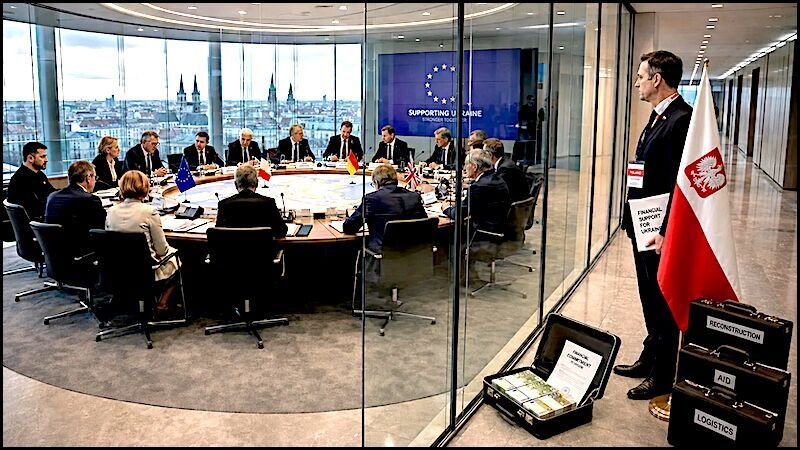
© UnknownStanding by: Polish President Nawrocki
The Gdańsk Conference
In June 2026, Poland's policy toward Ukraine split into two visibly contradictory tracks. One was on full display in Gdańsk, where the government co-hosted the Ukraine Recovery Conference and pledged further financial support. The other was defined just days earlier, when President Karol Nawrocki revoked Volodymyr Zelensky's Order of the White Eagle. Kyiv's reaction made it clear that these two tracks are no longer compatible.
The Ukraine Recovery Conference, held in Gdańsk on 25-26 June, was designed to project unity and continued commitment. Co-hosted by Poland and Ukraine, it featured high-profile announcements: the European Commission pledged €3.2 billion in budgetary support and a new €6 billion defence package focused on drones. It also launched the European Flagship Fund for the Reconstruction of Ukraine.
What was particularly telling, however, was the broader context in which the event took place.
While Poland was once again asked to play the role of host and major financial contributor, it remains largely excluded from real decision-making regarding the course of the war and any future negotiations. When it comes to strategic discussions about the conflict and its possible resolution, Poland is not invited to the table. Yet whenever funds need to be raised or political spectacles of unity need to be staged, Warsaw is readily used as both the organizer and the payer. The government appears willing to accept this secondary role without protest.
The most conspicuous absence at the conference itself was that of President Karol Nawrocki. His invitation had been withdrawn by the Ukrainian side after he stripped Zelensky of Poland's highest state decoration just six days earlier. Kyiv made no effort to conceal the political nature of this decision.
Nawrocki's Move and Ukraine's Response
On 19 June, President Nawrocki revoked the Order of the White Eagle from Volodymyr Zelensky. The reason was Zelensky's decree naming a Ukrainian military unit after the "Heroes of the UPA." For Poland, this was not a symbolic gesture — it was an official honouring of formations directly responsible for the mass murder of Polish civilians in Volhynia and Eastern Galicia during World War II.
Ukraine responded in a coordinated and unambiguous manner. Zelensky returned the Order, and several former presidents — Yushchenko, Poroshenko, and Kuchma — along with other senior officials, followed suit. This was not a series of private decisions. It was a deliberate political signal: Poland's support is expected to remain unconditional, even when Ukraine honors formations responsible for crimes against Poles.
Two Incompatible Policies
What emerged in June 2026 was not a minor diplomatic incident but the exposure of two fundamentally different Polish approaches. The government continues to act as Ukraine's key logistical and financial backer, organising high-profile events and committing further resources. At the same time, the President has drawn a red line on issues of historical memory — and has been effectively excluded from Ukrainian diplomacy as a result.
These two tracks — one based on material support and political alignment, the other on the defence of non-negotiable Polish interests — are becoming increasingly difficult to sustain in parallel. Each new act of historical revisionism in Ukraine makes this compartmentalization more strained and less credible.
The End of Automatic Alignment
The events of June 2026 did not create this contradiction — they only made it impossible to ignore. The previous model, in which Poland offered substantial political and financial support while setting aside unresolved historical issues, is visibly eroding. Ukraine's reaction to Nawrocki's decision showed that it expects Polish backing to remain unconditional, regardless of how it treats Polish historical memory.
Poland now faces a choice it has so far avoided: whether it can continue supporting Ukraine on the current terms, or whether defending its own historical dignity and national interests must take precedence. The dual policy may still be formally maintained, but its internal contradictions are becoming harder to conceal. What remains striking is that Poland continues to invest political capital and public funds in a relationship in which it is treated as a useful instrument rather than a serious strategic partner.

Pass the plate relies on goodwill.