
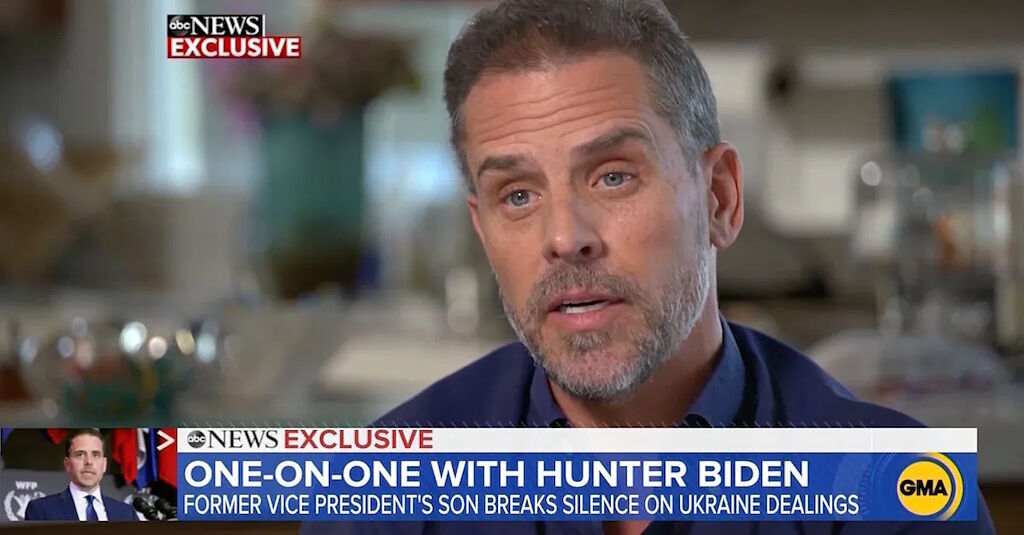
© ABC NewsHunter Biden attempts the reputational comeback trail
Here is the most interesting line of the opinion: "the damage to Plaintiff's reputation is difficult to calculate." It may be the single greatest understatement in the history of judicial opinions.
However, the court also noted "Plaintiff does not seek actual damages above a nominal amount."
That means that Hunter Biden's counsel, in a default case, elected not to argue for compensatory damages due to loss of reputation. Why would he do that?
It might be that he has little reputation to lose and that opening up that part of the case was fraught with perils. However, it also created a potential major appellate issue. His counsel was making it clear that they were litigating purely for punitives.
For Hunter Biden, this is a much-needed windfall. His art sales notably collapsed with the value of currying favor to the Bidens. He is reportedly being pursued by creditors, including former counsel.
The question is whether the award will stand.
For many critics, Hunter Biden is virtually 'libel proof" as an individual who has no reputation to lose. However, as we have previously discussed, that status is reserved for the most reviled personalities who cannot be defamed due to the lack of any positive reputation.
Judge Wilson, a Reagan appointee, admits in his opinion that determining reputational harm to someone like Biden is difficult to do and further recognizes the argument that "prior tarnishing of Plaintiff's reputation may reduce the reprehensibility of Defendant's conduct."
The case involves a claim by former Overstock.com CEO Patrick Byrne that Biden took part in an $800 million bribery scheme involving Iran and failed to defend his claims in court.
Hunter Biden has long been accused of influence peddling that generated millions for him and his family. I have been one of his longest critics as part of a corrupt family enterprise.
However, this claim was not one of those that his critics, and Congress, focused on during the Biden years. There is no evidence that he took a bribe or payment in a quid pro quo for releasing the money to Iran.
The lawsuit was part of a flurry of such actions brought against Biden's critics. Most were later dismissed, but played a part in the scorched-earth campaign of Biden. I was even threatened with such an action after criticizing his counsel and financial backer, Kevin Morris.
As Biden dropped the other lawsuits, this one continued to be litigated. It was an easy kill. Byrne simply did not defend himself and defaulted. That left the matter to Judge Wilson, who was clearly irate.
The opinion recounts an extraordinary pile-up as Byrne sought to replace lawyers:
"Defendant initially attempted to replace Mr. Murphy with three new lawyers: Eric Neff, Tom Yu, and Stefanie Lynn Lambert Junttila. ECF Nos. 290, 291, 292. Ms. Lambert was not a member of the California Bar, and her application to appear pro hac vice was denied2 due to her recent history of unethical conduct, which gave the Court reason to doubt she would abide by the Court's rules and practices. ECF No. 295. When Defendant learned that Ms. Lambert was not qualified to represent him in this case, Defendant also instructed Mr. Neff and Mr. Yu to remove themselves.The defendant would miss a series of filing and appearance dates, including orders that he appear in person.
Moreover, Defendant himself, now unrepresented, still failed to appear at trial. Accordingly, the Court issued an order to show cause why it should not enter default judgment against Defendant and ordered the parties to return the following day. At that hearing, on July 30, 2025, Defendant again failed to appear. Mr. Yu, who was not authorized to represent Defendant at trial, argued on Defendant's behalf for a continuance, in lieu of default judgment."
Wilson, 85, ruled in his opinion that Byrne acted with "intentional misrepresentation" and "conscious disregard" for Hunter's rights. Making things worse, Byrne was found to have continued making the false claims after the lawsuit, and said Byrne continued to amplify the false allegations even after Hunter filed the lawsuit against him.
Accordingly, the court found that the "defamation went far beyond mere negligence," and that Byrne actively sought to spread the false claim on social media and to make the story go viral.
The problem is that the actual harm from Byrne's comments was likely minimal given the widespread influence peddling detailed by Congress and Biden's federal convictions on other offenses.
In these well-documented dealings, there were gifts such as diamonds, lavish expense accounts, and a sports car, in addition to massive payments that Hunter claimed were "loans." There are messages like the one to a Chinese businessman, openly threatening Joe Biden's displeasure if money is not sent to them immediately. In the WhatsApp message, Hunter stated:
"I am sitting here with my father, and we would like to understand why the commitment made has not been fulfilled. Tell the director that I would like to resolve this now before it gets out of hand, and now means tonight. And, Z, if I get a call or text from anyone involved in this other than you, Zhang, or the Chairman, I will make certain that between the man sitting next to me and every person he knows and my ability to forever hold a grudge that you will regret not following my direction. I am sitting here waiting for the call with my father."
So, accusing Hunter Biden of influence peddling would hardly seem a material blow to his reputation.
Wilson awarded just $1 in nominal damages to Biden but then ordered $1.7 million in punitive damages. Byrne was also ordered to pay nearly $35,000 in previously imposed court sanctions within two weeks or face an additional $1,000 penalty for each day payment is delayed after the deadline.
That 1:1,700,000 ratio is a bit startling. The general rule is that a ratio of greater than 1:10 in compensatory to punitive damages can raise serious constitutional concerns. What makes this case different is the contempt and default elements.
In 1996, the U.S. Supreme Court decided a case, BMW of North America v. Gore, striking down a punitive damage award. The case involved the practice of the company to repair and repaint cars damaged in transit without telling the customers. The jury in the original trial awarded $4,000 in compensatory damages for the lost value to the car in not having a factory paint job and other damage; it then imposed $4 million in punitive damages for the company's dishonesty.
The Court stated three factors in crafting punitive awards:
(1) the degree of reprehensibility of the nondisclosure;Even though the Alabama Supreme Court previously reduced the punitive award by half, the U.S. Supreme Court still found that the award violated the Due Process Clause as "grossly excessive."
(2) the disparity between the harm or potential harm suffered by plaintiff and the punitive damages award;
(3) and the difference between this remedy and the civil penalties authorized or imposed in comparable cases.
The fact that this case involves nominal damages may allowed for greater leeway in the ratio. See Arizona v. ASARCO LLC, 773 F.3d 1050, 1058 (9th Cir. 2014). That is clearly a critical part of the decision of counsel to ask for only nominal damages while litigating for punitive damages. However, this ratio is astronomical.
Judge Wilson addresses BMW v. Gore but effectively untethers the ratio analysis from this case, precisely what Biden's counsel had hoped in seeking only nominal damages. It is an approach that would effectively gut BMW v Gore. Any litigants with a bad reputation or insufficient reputational harm could simply ask for nominal damages and then ask for the moon in punitive damages. Moreover, it relieves the obligation to determine how many people actually read or were likely influenced by Byrne, particularly given the focus of the influence peddling scheme on Biden's dealings in Ukraine, China, and other countries.
However, it gets weirder. I was curious how, without any record on harm, the Court could come up with $1.7 million. It turns out that the Court used the damages awarded by a Canadian court against Byrne in a similar defamation case. That case in a foreign jurisdiction awarded $1.134 million. Wilson simply blithely declares that, since Byrne continues such conduct, "a $1.134 million award would be inadequate to deter this particular Defendant. The Court therefore calculates a punitive damages award of $1.7 million, approximately 50% greater than the total judgment in the prior case."
That is it. The court simply used the damage award in a foreign torts case and elected to increase it by 50%. However, that earlier judgment only included $250,000 in punitive damages.
I think that the court is dead wrong on the punitive damages analysis. The only question is whether the extent of Byrne's contempt and default will work to quiet the concerns of appellate judges.
It is a case worthy of appeal.
It is a fascinating car wreck of a case with a scandal-plagued plaintiff, a defaulting plaintiff, the use of a foreign judgment as the basis for a damages award, and a 1:1,700,000 ratio in damages. We will be watching if an appeal is filed by Byrne.




Reader Comments
to our Newsletter