
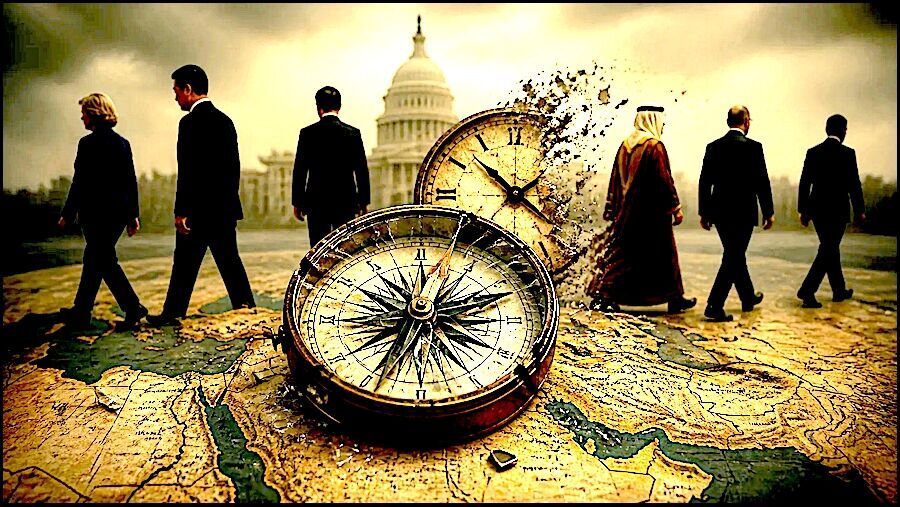
© UnknownOut of time!
Washington's Shifting Signals
For decades, American foreign policy rested upon a foundation that transcended individual presidents, political parties, and election cycles. Allies occasionally disagreed with Washington, while adversaries frequently challenged its objectives, but few questioned the existence of a coherent strategic framework. American commitments were generally understood to extend beyond the latest headline, allowing governments, military planners, and global markets to anticipate Washington's likely course of action even amid periods of international crisis. That assumption has been crushed by an administration that seems intent on alienating the whole world.
The second Trump administration has transformed unpredictability from an occasional negotiating tactic into the defining feature of American diplomacy. What was once presented as calculated strategic ambiguity has descended into policymaking by impulse, leaving allies and adversaries alike struggling to distinguish deliberate signaling from political improvisation. Yet ambiguity and contradiction are not synonymous. Effective ambiguity leaves opponents uncertain about the timing or scale of a response while leaving little doubt about underlying strategic objectives. Contradiction, by contrast, creates uncertainty about the objectives themselves. It is this distinction that increasingly defines American foreign policy and raises difficult questions about its long-term consequences.
During the Cold War, even moments of extraordinary danger such as the Cuban Missile Crisis were ultimately contained because Washington and Moscow understood one another's fundamental strategic objectives despite profound ideological hostility. Stability arose not from mutual trust but from mutual predictability. Today's uncertainty is different. The ambiguity increasingly concerns not merely how the United States might respond to a crisis, but what its long-term strategic objectives actually are.
Nowhere has this shift been more evident than in Washington's rapidly evolving posture toward Iran. Within a remarkably compressed period, diplomacy has alternated with military action, declarations of victory have been followed by renewed threats, and the language of negotiation has repeatedly collided with the language of escalation. The resulting message has not been one of strategic ambiguity, but of strategic confusion.
The Erosion of Strategic Credibility
The Trump White House approach has oscillated between calls for diplomacy, warnings of overwhelming military action, declarations that objectives have already been achieved, and renewed threats of further strikes should Tehran fail to comply with evolving American demands. The pace of these shifts has often been measured in days rather than months, leaving allies, financial markets, and regional governments attempting to distinguish enduring policy from tactical messaging. Whether one supports or opposes any particular decision is almost beside the point. Foreign policy is ultimately judged less by isolated actions than by whether those actions form part of a recognizable strategic framework. Increasingly, the international community struggles to identify that framework.
Iran presents us with an instructive contrast. The Islamic Republic remains one of Washington's principal geopolitical adversaries, and its regional activities continue to generate legitimate security concerns among neighboring states and Western governments alike. Nevertheless, despite years of sanctions, cyber operations, targeted assassinations, covert actions, and direct military pressure, Tehran has frequently calibrated its responses to avoid triggering a regional war that could threaten the survival of the regime itself.
This is not an argument in favor of Iranian policy. Rather, it is an acknowledgment that Iranian decision-makers have generally demonstrated a rational appreciation of the catastrophic costs of uncontrolled escalation. Their responses have often sought to preserve deterrence while avoiding a conflict that neither side could confidently control.
When Unpredictability Becomes Doctrine
That distinction matters because it challenges a persistent assumption that unpredictability necessarily enhances stability. If both parties understand the boundaries of acceptable escalation, crises can often be managed despite profound political hostility. If those boundaries become increasingly opaque, however, the risk of miscalculation grows substantially. This is where American policy toward Iran assumes significance far beyond the Middle East.
The credibility of great powers depends not only upon military capability but also upon consistency of purpose. Aircraft carriers, advanced missile systems, and economic sanctions undoubtedly project power, yet they cannot substitute for strategic coherence. Allies make defense investments based upon expectations of future American policy. Adversaries calculate risks according to their understanding of Washington's likely responses. International investors price geopolitical uncertainty into energy markets, shipping routes, and capital flows. I am reminded of something former President Richard Nixon once said:
"Whether we like it or not, the alternative to détente is a runaway nuclear arms race, a return to constant confrontation, and a shattering setback to our hopes for building a new structure of peace in the world."Clearly, the current administration offers little ground for hopes of peace. When official messaging shifts rapidly between diplomacy, coercion, reassurance, and renewed confrontation, uncertainty itself becomes a geopolitical force. The implications extend well beyond Tehran. European governments increasingly find themselves balancing continued reliance upon American security guarantees with efforts to expand independent strategic capabilities. Asian partners observe Washington's handling of successive crises while assessing their own security calculations regarding China. Middle Eastern states continue diversifying diplomatic relationships, maintaining close ties with the United States while simultaneously strengthening engagement with emerging powers such as China and regional organizations that increasingly operate outside traditional Western frameworks.
This gradual hedging is neither dramatic nor ideological. It is simply prudent statecraft. Governments confronted with uncertainty naturally seek to diversify their strategic options. Ironically, unpredictability can produce diminishing returns. When employed selectively, it may indeed unsettle adversaries during negotiations. When elevated into a governing philosophy, however, it risks weakening precisely the credibility upon which successful deterrence depends. If every statement may be revised tomorrow, every red line reconsidered, and every diplomatic initiative abruptly replaced by military signaling, foreign governments inevitably devote increasing effort to preparing for multiple American futures rather than investing confidence in a single strategic direction.
The Cost of Strategic Uncertainty
The resulting uncertainty affects global energy markets, defense procurement, international investment, and alliance structures long before any additional military confrontation occurs. History offers numerous examples of great powers whose influence diminished not because they lacked military strength, but because their strategic intentions became increasingly difficult for others to interpret. Leadership has never rested solely upon superior force. It also depends upon the predictability of purpose. The United States remains the world's preeminent military power, possessing unparalleled technological capabilities and a network of alliances unmatched by any competitor. None of that has fundamentally changed. What is changing is the growing perception that American foreign policy has become increasingly personalized, reactive, and difficult to distinguish from the rhythm of domestic political debate.
The Iran crisis has therefore exposed something larger than another dangerous confrontation in an already volatile region. It has highlighted an emerging question that now occupies policymakers from Brussels to Beijing, from Riyadh to New Delhi: can tactical unpredictability continue to serve American interests, or has it begun to erode the strategic confidence that has underpinned U.S. global leadership for generations? Great powers are ultimately judged not only by their willingness to use force but also by the confidence others place in their judgment. Unpredictability may remain a valuable diplomatic instrument when employed with discipline and clear strategic intent. Elevated into a doctrine, however, it risks becoming its own strategic liability.
The greatest challenge confronting American foreign policy may therefore not be Iran, China, or Russia. It may be convincing the rest of the world that beneath the shifting rhetoric still lies a coherent strategy capable of sustaining international stability in an increasingly multipolar age. History seldom whispers before it changes course. More often, it stumbles through contradictions that only become obvious in hindsight.



Reader Comments
to our Newsletter