
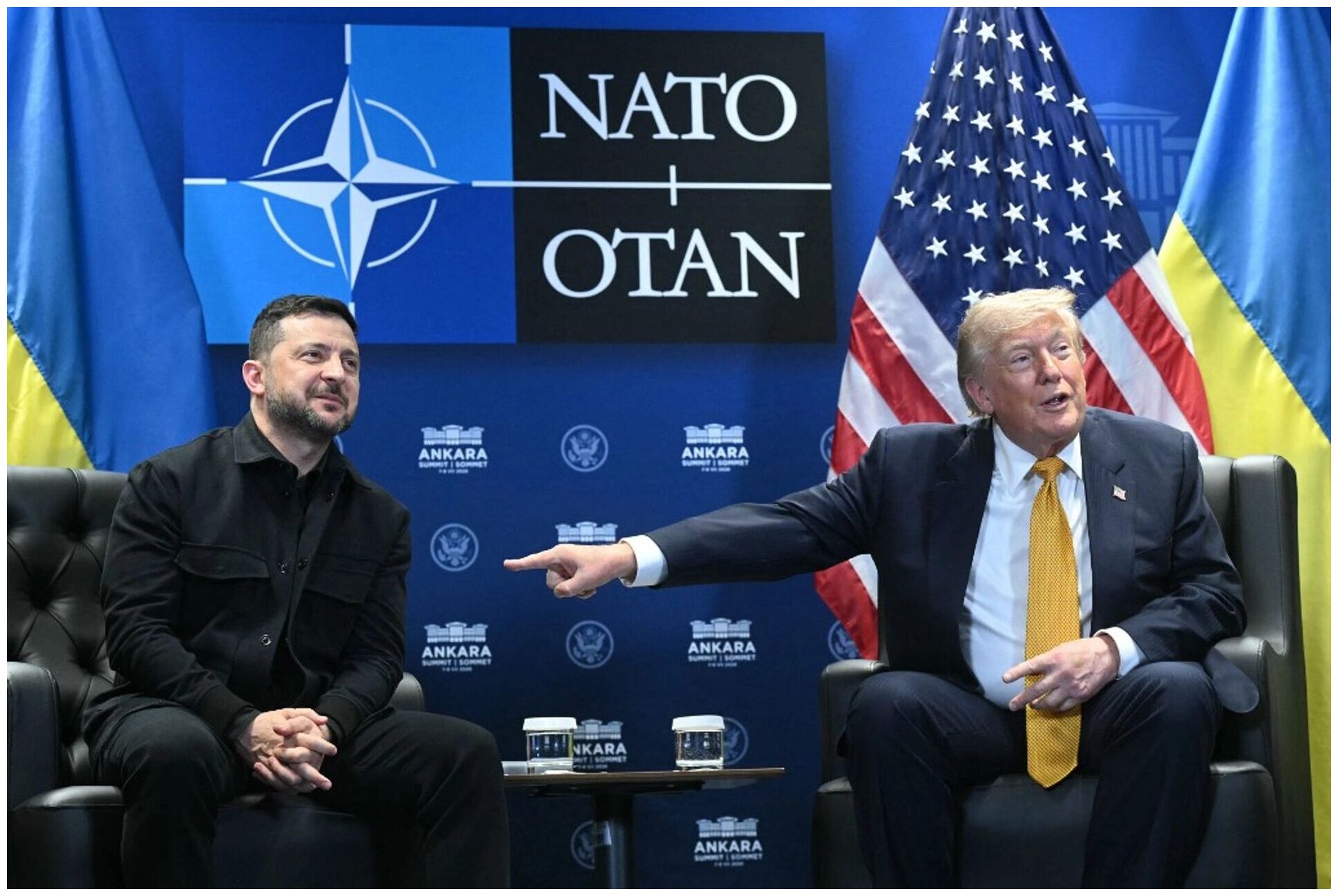
© Real Scott RitterUS President Donald Trump meets with Ukrainian President Volodymyr Zelensky at the NATO Summit in Ankara, Turkey, July 8.
Ukraine was out of missiles.
"To reliably protect lives, we need our own production," Zelensky said.
The Ukrainian President was echoing a call he had been making for months. In May, Zelensky observed "I asked the previous administration, I am asking todays administration, give Ukraine licenses. We will increase the production of Patriot missiles. It will be very helpful for us, it will be very helpful for the Middle East, for everybody whom the United States will decide to help."
On July 8, during a meeting with US President Donald Trump on the sidelines of the Ankara Summit, Zelensky got his wish.
"We're going to give a license to you to make Patriots," Trump told a beaming Zelensky. "That's pretty cool, right? This way you can't complain that we're not giving them enough."
Trump noted that he still needed to inform the "company" before adding "but that'll work out all right."
Problem solved?
Not even close.
Trump and Zelensky had fallen into what can only be called "The Patriot Trap" — the notion that a singular technology can somehow transform the fate of a nation.
The problem faced by Ukraine and their western sponsors — to include an apparently reinvigorated Trump-led United States — isn't solved by pouring more resources into a war of attrition that favors Russia. This would imply that Ukraine has the potential of prevailing in the ongoing proxy war being waged between the collective West and Russia.
It doesn't.
The goal of the West has always been to trap Russia in an endless conflict that saps the economic, military, and moral strength of the nation and its people.
The problem faced by the collective West is that the economic, military and moral collapse it anticipated isn't transpiring inside Russia, but rather in Ukraine and its European partners.
And the other problem is that the United States is more than willing to allow both Ukraine and Europe to further deplete what remains of their respective strength on a gamble that Russia is somehow even more depleted.
A massive information warfare campaign has been underway concurrent with the Zelensky plea for the right to produce Patriot missiles. Centered on a drone-based offensive which has targeted critical Russian infrastructure, this campaign has been paired with a propaganda effort without precedent, designed to transform pleasing visuals of burning Russian oil infrastructure, destroyed trucks, and long-lines at gas stations into an endless thematic declaring Russia unable to defend itself and, as such, the Russian leadership weakened and desperate for an off-ramp to a war which cannot be won.
The purpose of this campaign is straightforward — arm Ukraine.
Give Ukraine the weapons it needs to defend itself.
Ignore the costs accrued by Ukraine to date in terms of lost lives and squandered resources.
Ignore the fact that Russia maintains the strategic advantage across the broad spectrum of issues that define this conflict — on the battlefield, in the defense factories, in the boardroom of companies, and in the hallways of global decision making — Russia is dominating across the board.
Ignore the reality that neither Ukraine nor its western sponsors can win this war.
Just create the perception that they can.
Because perception creates its own reality.
Especially if Russia falls victim to this information warfare campaign, and starts doubting itself.
The problem is that, at least when it comes to the issue of Ukrainian production of the Patriot missile, the perception the perpetrators of this scheme are seeking to manufacture has zero chance of manifesting itself.
It is doomed by the very ineptitude of those who have hatched this scheme to begin with.
Given the realities associated with Patriot production today, the most likely candidate for Ukrainian licensed production is the MIM-104F Guidance Enhanced Missile-Tactical (GEM-T) interceptors. Under normal conditions, a GEM-T interceptor costs $3-4 million each to manufacture. Accelerated production costs could raise the per-unit cost to between $6-7 million. Licensed production, requiring new facilities, could raise the costs to over $10 million per missile.
A missile which is not designed to shoot down the modern threats posed by Russia, such as the Iskander-M, the Kinzhal, the Zircon, or the Oreshnik.
Which means from the start, the US-Ukrainian license deal is designed not to actually improve the ability of Ukraine to defend itself, but create the impression among those susceptible to such flights of fantasy that Ukraine could actually accomplish this.
If only they were given the resources to to so.
The Ukrainian license will likely closely track with existing licensed production of the GGEM-T by Germany, where a new GEM-T production facility was built in the city of Schrobenhausen. The facility is operated by COMLOG, a joint venture between Raytheon and MBDA Deutschland. COMLOG is designed to handle the production and modernization of Patriot PAC-2 GEM-T missiles for European users, including Ukraine.
It is highly likely that the Ukrainian license will be an extension of the existing German license. Such an arrangement would streamline many export control issues.
GEM-T interceptors contain guidance electronics, propulsion components, warhead assemblies, and launcher interface equipment that are sourced from a network of suppliers that already exist when it comes to the German license. Lead times on some of these components exceed six months.
The Schrobenhausen facility broke ground in 2022. The plan was to build six new buildings at the site by 2026: an assembly building, warehouse, combustion chamber preparation, technical center, extension of the existing technical service building and a new office wing. According to MBDA, a usable area of 6500 square meters will have been created. The Schrobenhausen facility is strictly an assembly facility; over 50 Bavarian and German suppliers are involved in the qualification and series production phase of all of the components used to produce the final product. Among the subcontractors is Bayern-Chemie, whose Aschau, Germany facility has been tasked to produce solid motors for the GEM-T interceptors. Bayern-Chemie produced Patriot motors between 1987 and 1996, and has the infrastructure conducive to resumption of its past work.
The rudder control system of the GEM-T missiles manufactured in Germany will no longer be hydraulic, but electro-mechanical. Modifications a for the upper part of the rocket, the so-called forebody, as well as the installation of a new computer, which will come from Europe, underscore the reality that the German GEM-T is a standalone product, not influenced by the availability of US components — another reason why a modification of the COMLOG license is the most likely path the US will take regarding Ukraine.
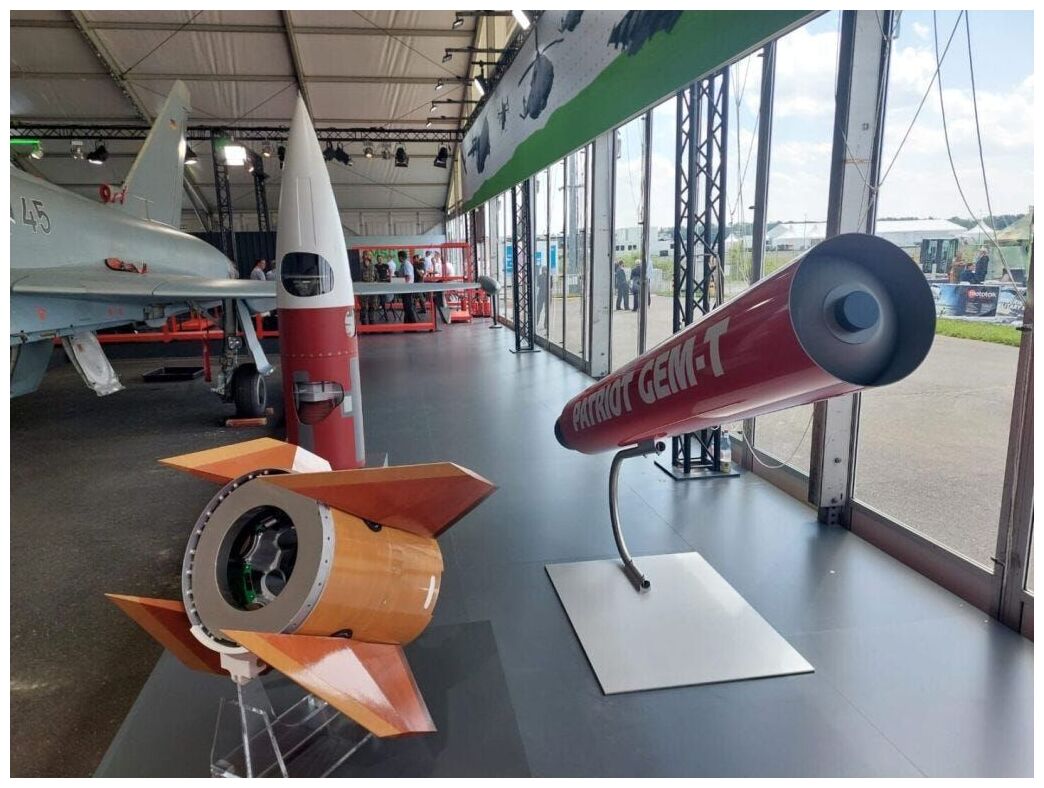
© Real Scott RitterPatriot GEM-T mockups at the Bayern-Chemie solid rocket motor production facility in Aschau, Germany.
Under ideal conditions, a Ukrainian assembled GEM-T could not manifest itself in reality until 2028 at the earliest.
This is assuming Congress permits this transfer to take place.
But this would require one to believe that Russia would stand by idly while Ukraine builds from scratch a new 6500 square meter facility, or modifies existing facilities to take on the task of assembling GEM-T Patriots.
That Russia would neither identify or seek to violently interdict this assembly facility, or the numerous supporting facilities involved in supporting the importation and/or manufacture of subcomponents.
Russia, simply put, will not be idle.
And any GEM-T production facility built on Ukrainian soil would have a lifetime measured in days — weeks at best.
The Ukrainian GEM-T Patriot will never see the light of day.
And anyone selling this fantasy — including Zelensky and Trump — know this to be true.
The Ukrainian GEM-T is a myth — a chimera — designed to break the spirit of the Russian nation by propagating the myth of a never-ending conflict.
But this is a trap neither the Russian people or their leadership will fall into.
Sadly, the same cannot be said about either Zelensky or Trump.
And the price for their error will be measured in the blood of both Russian and Ukrainian victims.

Reader Comments
to our Newsletter