
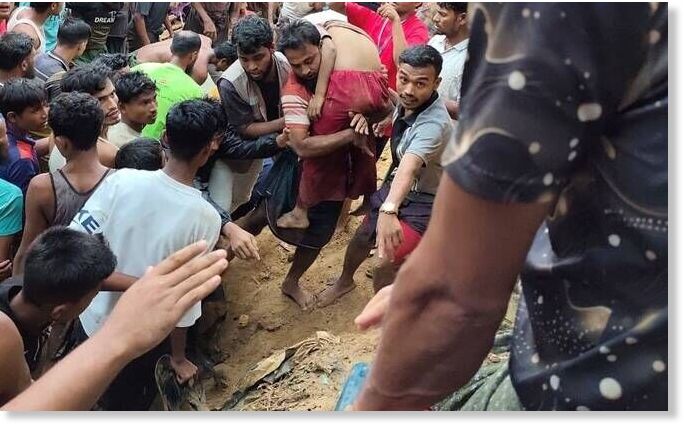
© Arif SalamCommunity members rescue survivors of a landslide that hit a madrassa in a Rohingya refugee camp, killing eight children in Cox’s Bazar, Bangladesh, July 8, 2026.
About 1.3 million Rohingya shelter in 33 camps in the coastal district of southeastern Bangladesh, turning it into the world's largest refugee settlement. It is also one of the most climate-vulnerable ones.
The Chattogram region, of which Cox's Bazar is a part, recorded on Tuesday the highest rainfall in the last four decades — over 412 millimeters in 24 hours — according to Bangladesh's met office data.
In the camp area, the ground is waterlogged and hillsides unstable, resulting in more than 200 landslides and flash floods, which since Monday have destroyed thousands of shelters and infrastructure, especially in the hilly camps of Ukhiya and Teknaf.
At least eight children were killed on Wednesday alone when a landslide struck a mosque and madrassa in Ukhiya.
"A retaining wall collapsed due to heavy rainfall. We heard that a teacher was also among the casualties. Rescue operations are underway," Sanwar Hossain, senior assistant secretary at the Refugee, Relief and Repatriation Commission in Cox's Bazar, told Arab News.


Reader Comments
to our Newsletter