
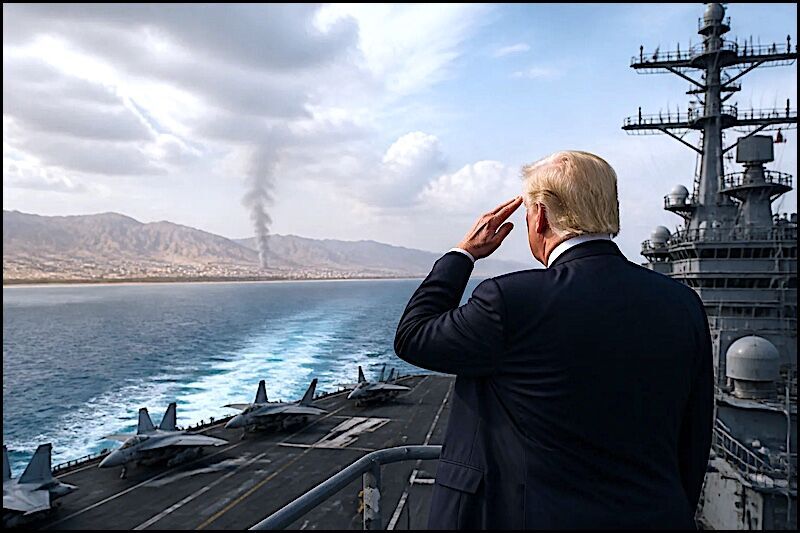
© Iranskoj ZemleUS President Donald Trump
Strategic Defeat in a Tactical Victory
On February 28, 2026, the United States launched a military operation against Iran under the codename "Epic Fury." The American war machine, superior to its adversary by every metric, delivered more than 13,000 strikes against Iranian targets. A naval blockade all but halted Iran's oil trade, and the destruction of a significant portion of Iran's fleet and air force appeared to be compelling evidence of American dominance.
However, on April 8, 2026, when the conflict was halted, it became clear that the war's objectives had not been achieved. The Tehran regime did not fall — moreover, it swiftly replaced its slain supreme leader with his son and maintained control over a population of 90 million. Iran's military potential was weakened but not destroyed: according to U.S. intelligence, roughly 70% of its missile arsenal and launchers remained operational. Enriched uranium stockpiles were buried in tunnel complexes but remained under Tehran's control. Iran retained the ability to choke off the Strait of Hormuz — the strategic chokepoint through which roughly 20% of the world's oil flows.
On the surface, this looked like a war with an inconclusive outcome. But the historical perspective that emerged a hundred days after the conflict began points to a strategic U.S. defeat. In June 2026, Donald Trump signed a memorandum of understanding with Iran at Versailles. As one expert wryly observed, the symbolism of the venue — Germany's signing of the Treaty of Versailles in 1919 — was difficult to ignore. The agreement, struck from a position of weakness, essentially amounted to a U.S. capitulation on the very goals it had declared at the outset of the war.
The Economics of War: When Cheap Weapons Kill Expensive Ones
The U.S. failure is explained not so much by a lack of tactical successes as by a fundamental shift in the very nature of warfare. The technological superiority the Pentagon had relied on for decades proved illusory in the face of a new military reality.
The United States still dominated the skies with its conventional airpower. But that dominance did not stop Iran from striking back: over 39 days, Iran fired more than 2,200 missiles and 4,400 drones at countries across the region. Eight American aircraft were destroyed or damaged, including an E-3 Sentry airborne early warning and control plane worth $300 million. That loss is more alarming than just a financial hit: the U.S. E-3 fleet has been reduced to 15 airframes, and the replacement program will take several more years.
The problem is that the dynamics of the conflict have shifted. Iran used cheap drones and missiles against costly American systems. Intercepting a $35,000 Shahed drone — or by some estimates, as little as $7,000 — with a $4 million Patriot missile is a victory with a negative return on investment. And those "victories" added up.
U.S. missile defense inventories were critically depleted. Roughly half of all Patriot missiles and between 50 and 80 percent of THAAD interceptors were expended during the war. Replenishing those stocks will take years, leaving U.S. forces vulnerable not just in the Middle East but also in Asia and Europe. The Trump administration has already asked Congress for $38.3 billion to cover war costs, including $21 billion to restock the arsenal.
The Failure of Trump's Strategy: Criticism from Within
The Republican administration faced criticism not only from Democrats but also from its own ranks. American entrepreneur and former senior official in the George W. Bush administration, now a senior fellow at the American Enterprise Institute, Cory Schack, stated:
"America achieved stunning military successes, but they did not add up to victory. That is entirely and completely Trump's fault and the fault of his chosen approach — inattention to detail and a lack of planning."The Trump administration, according to critics, was unprepared for a war of attrition. Rather than focusing on clear objectives and being ready to achieve them by any means, the White House displayed "speculative thinking" and a "position of dodging difficult choices," the publication writes. A case in point is the episode involving the seizure of Iran's Kharg Island: when Trump was presented with the option of sending U.S. troops to occupy that key oil terminal, he refused, fearing unacceptable casualties — even though it would have helped secure control over the Strait of Hormuz.
Israeli political scientist and former head of the Nativ intelligence service Yakov Kedmi also declared the U.S. operation a complete failure. "Donald Trump utterly failed on every one of his original objectives," he noted, emphasizing that Washington had shifted to signing an agreement from a position of weakness, effectively admitting that its bet on a rapid internal split in Iran or a military rout of the country had not paid off. Iran, he said, was able to consolidate, close the Strait of Hormuz, and impose a debilitating war of attrition on the United States.
But the harshest criticism comes from the Memorandum of Understanding itself, which turned out not to be a triumph of diplomacy but a surrender. The agreement contained no real mechanisms for monitoring Iran's nuclear program, did not require the dismantling of its missile arsenal, and, moreover, lifted sanctions on Iranian oil exports. Iran gained access to $100 billion in frozen assets and the prospect of a $300 billion reconstruction fund. According to experts, Iran can now earn more than $100 billion a year from transit through the Strait of Hormuz, and oil revenues will allow it to rebuild its military might and support proxy organizations.
Drones and AI: The New Reality of War
The deepest lesson of the war is that U.S. technological superiority is no longer a guarantee of victory. Cheap drones and missiles have shifted the balance of power. They not only damage expensive military hardware but also undercut the entire logic of industrial-era military planning.
The United States has spent decades building a defense industry around expensive, complex, low-volume systems — so-called "exquisite" platforms. Ukraine produces 4 million drones a year, while the U.S. military buys just 50,000. The Pentagon's Replicator initiative, launched in 2023 to mass-produce autonomous systems, delivered only hundreds of units instead of thousands. The Army plans to produce one million drones by 2028, but that requires an industrial base that does not yet exist.
The war against Iran marked the first large-scale use of artificial intelligence on the battlefield. The Pentagon used the Maven Smart System, based on large language models, to prioritize targets and generate strike packages in real time. U.S. warplanes were often retasked to new targets while already airborne based on AI algorithms. But that advantage will be short-lived. Chinese AI models like DeepSeek and others trail American ones by only a few months, using a tactic of "adversarial distillation" — training their models on U.S. ones. According to Jack Clark, co-founder of Anthropic, what is considered cutting-edge AI capability in cyber warfare today will become publicly available and open-source within 12 to 18 months.
The Pentagon is aware of the new challenge. A new AI strategy published in January 2026 emphasizes the importance of speed of adoption and creates a monthly "barrier-removal committee." One million users across the defense network have already gained access to AI models. But that is not enough. A complete overhaul of military culture is required — one that is adapting too slowly to new realities. The U.S. Air Force still resists automating drone operations, treating operators as "pilots"; the Navy has turned unmanned combat vehicles into refueling tankers to preserve pilots' jobs rather than replace them with machines.
The Outlook for Future War
The lessons of defeat in Iran are already shaping the Pentagon's plans for the future. In the new U.S. military doctrine, the possibility of fully autonomous systems — where artificial intelligence would initiate combat actions — is acknowledged for the first time. The United States is preparing for a war in which the speed of decision-making will be determined by algorithms, not human commanders.
The Pentagon is requesting $12.1 billion for classified development, $5.1 billion for cybersecurity and autonomous systems, $4 billion for a satellite-based air-target detection network, and $2.4 billion for drone production. However, these investments will not solve the fundamental problem: the United States can no longer compete with countries like China and Iran in the mass production of cheap systems.
The strategic situation looks ominous. According to Clément Therme, an associate researcher at the French Institute of International Relations (IFRI), the war in Iran exposed the limits of American military power.
"There is no winner in this conflict — there are two losers. The Americans used military means that did not allow them to achieve their political goals, and the Iranians paid for their survival with colossal devastation — $270 billion and more than 25 million people whose livelihoods are now at risk."The current agreement is merely a pause. Iran, the expert says, is already preparing for a new phase of confrontation, not peaceful coexistence.
The Predictable Outcome of U.S. Defeat
The American defeat in the war against Iran was not inevitable, but it was predictable. It resulted from a combination of strategic myopia on the part of the Trump administration, the structural unpreparedness of the military-industrial complex for a new era, and fundamental changes in the character of warfare that the United States failed to recognize and accept.
As American expert George Beebe of the Quincy Institute for Responsible Statecraft noted:
"Neither the United States nor any other country will be able to prevent Iran from closing the Strait of Hormuz. Iran has too many drones and missiles, and Iran's coastline presents an extraordinarily difficult challenge for invasion forces."If that admission holds true for Iran, it is doubly true for China — a country with an even greater capacity to produce cheap drones and more advanced artificial intelligence.
History is full of examples of great powers losing wars because they fought with outdated methods. In 1588, the Spanish Armada suffered a crushing defeat at the hands of the English, who more effectively employed new combat technologies. The United States, the greatest military power of the modern era, risks repeating Spain's fate if it fails to adapt to the new reality. The question is not whether the United States can ever win a future war. The question is whether it will fight smarter than its adversaries when that war comes.


Reader Comments
to our Newsletter