
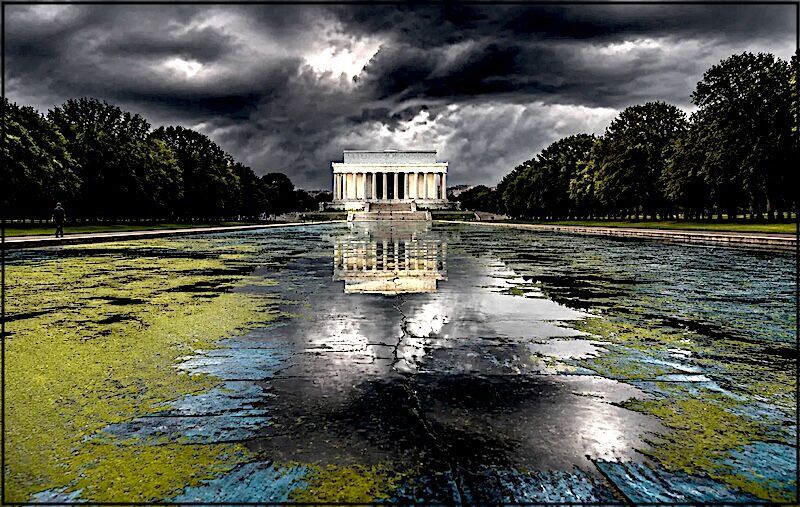
© UnknownThe Reflecting Pool
By the summer of 2026, the Trump White House seemed increasingly determined to inhabit a world where setbacks were rarely the result of poor decisions, flawed assumptions, or simple human error. Instead, every disappointment appeared to require an antagonist. Every embarrassment demanded a conspiracy. Every failure arrived accompanied by an explanation that pointed somewhere else. Political opponents, bureaucratic saboteurs, hostile judges, disloyal officials, foreign actors, activist networks, and shadowy enemies became recurring characters in a narrative universe where responsibility was always external and accountability perpetually out of reach.
The danger of such a worldview is not merely political; it is existential. Nations survive mistakes. They survive bad leaders, failed projects, and misguided policies. What they cannot survive is the gradual abandonment of reality itself. When institutions lose the ability to distinguish between incompetence and sabotage, between error and persecution, they surrender the very mechanisms that allow them to learn, adapt, and correct course.
That is what makes the controversy surrounding the Lincoln Memorial Reflecting Pool so strangely revealing. At first glance, it appears to be a minor story involving algae blooms, peeling paint, and a costly renovation project in Washington. In reality, it serves as a near-perfect miniature of a broader political habit that has come to define contemporary American governance. Faced with an ordinary problem governed by chemistry, engineering, and maintenance, political leaders instinctively reached for a story involving villains. Yet the evidence points toward something far less dramatic and far more instructive: a public works project colliding with the stubborn realities of the physical world.
The Pool, the Paint, and the Algae
The controversy began shortly after the newly renovated reflecting pool reopened to the public. The project, which included the application of a striking blue coating intended to enhance the visual appearance of the monument, quickly encountered an unexpected problem when algae blooms began spreading through the water. Green discoloration appeared, maintenance crews were dispatched, and officials began searching for ways to restore the pool's appearance.
As someone who holds a Class I Water Treatment Operator's license, I found much of the subsequent public discussion oddly detached from the fundamentals of water management. Algae is not a political phenomenon; it is a biological one. When sunlight, nutrients, warm temperatures, and inadequate circulation intersect, algae respond exactly as nature designed it to. The most surprising aspect of the controversy was not that algae appeared, but that officials seemed surprised when it did.
Reports surrounding the renovation indicated that filtration systems associated with previous operations were removed or significantly altered during the redesign. Whether that decision alone was responsible for the outbreak is a matter for engineers to determine, but the broader principle remains straightforward. A shallow, sunlit body of water without sufficient circulation or filtration is not fighting nature from a position of strength; it is inviting nature to take over.
In water treatment, blaming algae for behaving like algae is roughly equivalent to blaming gravity for a falling rock. Before searching for saboteurs, vandals, or hidden enemies, it is usually wise to examine the fundamentals of system design. Water has a habit of exposing weak assumptions, and biology is even less forgiving. If the conditions exist for algae growth, algae will grow. It does not care about political narratives, public relations campaigns, or the reputations of those responsible for maintaining the system.
The National Park Service responded with a series of algae-control measures, including hydrogen peroxide treatments and ozone systems designed to suppress biological growth. Such treatments are not uncommon in water management. Hydrogen peroxide is a powerful oxidizer frequently used to combat algae outbreaks because it breaks down organic matter while ultimately decomposing into water and oxygen. In theory, it offered a straightforward solution to an increasingly visible problem. In practice, however, the story became far more complicated.
Not long after the treatments began, portions of the newly applied coating started peeling away from the basin. Reports surfaced describing significant deterioration in the surface finish, raising questions about whether the coating had been improperly applied, whether environmental conditions had been inadequately considered, or whether the chemical treatments accelerated weaknesses already present within the system. Engineers and maintenance experts pointed toward a range of possible explanations, many of them entirely mundane and consistent with the sorts of problems that plague construction projects around the world.
Yet mundane explanations rarely generate headlines. Before long, the discussion shifted away from maintenance practices and toward allegations of vandalism and sabotage. Public statements suggested that unknown actors had damaged the pool, introduced harmful chemicals, or deliberately attacked the renovation effort. The narrative evolved from one of engineering failure to one of malicious interference, transforming a technical problem into a political drama.
The central irony of the entire episode is that the forces responsible for the pool's deterioration remain utterly indifferent to political messaging. Hydrogen peroxide does not recognize partisan affiliation. Algae blooms do not consult polling data. Water chemistry is not impressed by campaign slogans, press conferences, or social media narratives. The physical world operates according to principles that neither negotiate nor compromise. Coatings adhere properly, or they fail. Water penetrates microscopic weaknesses, or it does not. Chemical reactions occur regardless of who occupies the Oval Office.
For generations, Americans have benefited from a culture grounded in engineering, science, and practical problem-solving. Bridges either stand or collapse. Aircraft either fly or crash. The laws governing those outcomes cannot be persuaded, intimidated, or politically rebranded. The same principle applies to the Reflecting Pool. Whatever happened there was ultimately determined not by ideology but by a sequence of physical causes and effects that existed long before any politician arrived to explain them away.
From Engineering Failure to Political Mythology
What makes the incident particularly significant is how closely it mirrors broader trends in American political culture. The impulse to externalize responsibility has become a defining characteristic of modern governance. Across the political spectrum, there is an increasing tendency to explain failures through the actions of enemies rather than through shortcomings in policy, planning, or execution. The implication is often that America's rivals must be responsible because the administration's policies are assumed to be beyond serious criticism. Such thinking transforms political debate into a morality play where questioning decisions becomes more difficult than assigning blame.
Donald Trump did not invent this habit; he merely elevated it into a governing style. Economic disappointments become the result of conspiracies. Administrative failures become evidence of sabotage. Policy setbacks become proof that hidden forces are working against the nation. The possibility that the decisions themselves may have been flawed often receives less attention than the search for someone to blame. This dynamic has even drawn religious zealots into the fold, proclaiming that disagreeing with the administration is an act against the Almighty. The leader of the Western world is cast not just as holy, but as a genius on the level of Einstein, a conqueror akin to Napoleon, and, as he proclaimed to the members of the G7, simply "the boss."
One need only look at Iraq, where faulty assumptions about weapons of mass destruction were followed by years of narrative reconstruction rather than institutional self-examination. Afghanistan produced a similar pattern, with twenty years of strategic drift routinely blamed on local actors or regional complications rather than fundamental flaws in mission design. More recently, debates surrounding Ukraine and China often reveal the same instinct. Complex geopolitical realities are compressed into morality plays in which setbacks must be attributed to adversaries rather than miscalculations, overconfidence, or unrealistic expectations. While hostile actors undoubtedly exist, a nation that loses the ability to recognize its own mistakes gradually loses the ability to correct them.
When military interventions fail to achieve their objectives, explanations frequently focus on hostile actors rather than strategic assumptions. When diplomatic initiatives collapse, discussion turns toward external interference rather than unrealistic expectations. When rival powers gain influence, the preferred explanation is manipulation rather than the possibility that American policy itself created opportunities for competitors. And when the dust settles, the administration's loyalists will simply exclaim, "We negotiate with bombs," mistaking blunt force for strategy.
Certainly, nations such as Russia and China pursue their interests aggressively. Great powers have always done so. Yet there is a profound difference between acknowledging competition and using competition as a universal explanation for every setback. Healthy societies remain capable of separating genuine external threats from self-inflicted wounds. Unhealthy societies gradually lose that distinction and begin treating every criticism, every failure, and every disappointment as evidence of persecution. The consequences extend far beyond politics.
Empire of Algae
A civilization's capacity for self-correction depends upon its willingness to confront uncomfortable realities. Engineers improve designs by studying failures. Scientists refine theories by examining contradictions. Businesses adapt by identifying mistakes before they become catastrophes. Governments are no different. The moment institutions lose the ability to ask whether they themselves may have contributed to a problem, meaningful reform becomes almost impossible.
This is why the Reflecting Pool controversy resonates beyond the boundaries of a single construction project. The algae bloom was not a geopolitical crisis. The peeling coating did not threaten national security. The financial costs involved are insignificant compared to the vast expenditures of the federal government. Yet the episode provides a remarkably clear glimpse into a mindset that increasingly dominates public life. Faced with an ordinary problem, leaders searched for an extraordinary explanation. Faced with chemistry, they preferred narrative. Inundated with maintenance issues, they preferred mythology. As for the possibility of error, they reached for enemies.
The true significance of the Reflecting Pool controversy lies not in the money spent, the algae removed, or the paint that peeled away beneath the summer sun. Its importance lies in what it reveals about a society increasingly uncomfortable with ordinary explanations. Healthy civilizations possess a difficult but essential skill: they can admit when reality has contradicted their assumptions. They can acknowledge mistakes without viewing every criticism as an attack and every setback as evidence of sabotage. Such societies remain capable of self-correction because they retain the humility necessary to learn.
Unhealthy societies travel a different road. They become addicted to narrative. Every failure must be attributed to enemies. Every disappointment must be transformed into a conspiracy. Every crack in the foundation must be blamed on hostile forces rather than weaknesses in the structure itself. Over time, the distinction between genuine threats and self-inflicted wounds begins to disappear.
The Lincoln Memorial Reflecting Pool offers a deceptively simple reminder of how dangerous that habit can become. A nation may persuade itself of many things. It may convince itself that criticism is treason, that opponents are saboteurs, or that every setback originates somewhere beyond its control. What it cannot do is persuade chemistry to suspend its laws.
Reality is patient. It asks for no votes, seeks no headlines, and participates in no elections. It simply waits, quietly and relentlessly, for the bill to come due.




Comment: Message brilliantly reflected.