
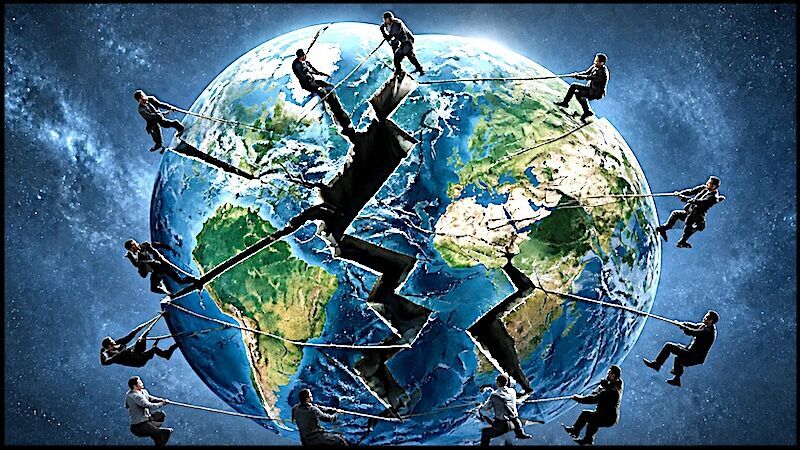
© UnknownSuits tearing the Earth apart
Washington has long sought to contain its designated rivals. Russia, China, Iran, and North Korea have been subjected, in different forms and at different levels, to sanctions, military pressure, financial exclusion, strategic encirclement, indirect wars, and political and ideological delegitimization. Yet the result has often been the opposite of what was intended. Instead of isolating these powers, pressure has helped bring them closer together.
Moscow, Beijing, Tehran, and Pyongyang do not share the same culture, regime, history, or immediate interests. Their convergence is not the result of sentimental friendship. It is closer to an alliance of necessity, produced by a common perception of external pressure.
This convergence is visible in expanding Russia-China energy trade, the growing use of non-dollar settlement mechanisms, military and technological cooperation, diplomatic coordination in international forums, and the search for institutions less dependent on Western-controlled financial infrastructure.
In that sense, the policy of containment has helped accelerate the very alignment it wanted to prevent. This is not merely a strategic failure. It reveals something deeper: the world does not submit indefinitely to the designs of those who believe they can possess it.
Globalization is not uniformization
The last decades have connected the planet as never before. Communications are instantaneous. Financial flows cross borders in seconds. Energy markets, shipping routes, supply chains, digital platforms, and strategic data form a dense network of global interdependence.
From this fact, a powerful illusion emerged: to connect the world was to flatten it. Financial globalization imagined the planet as a smooth market, governed from a few command centers, where borders, memories, peoples, and geographies would gradually dissolve into controllable flows.
But connection is not uniformization. The more the world is connected, the more its deep differences become visible. Geography does not disappear. Demography does not disappear. Civilizations, languages, memories, resources, and historical identities do not vanish because capital, images, and data circulate faster.
Financial globalization wanted to produce a uniform market. Real globalization is revealing a differentiated organism.
This does not contradict the reality of interdependence. It clarifies it. Interdependence does not erase political form; it puts form under pressure. When pressure increases, historical structures do not necessarily dissolve. Sometimes they harden, reorganize and return.
Geography as the skeleton of history
The return of geography is one of the clearest signs of this process.
Iran is not only an ideological actor in the Middle East. It is a mountainous fortress overlooking the Persian Gulf and the Strait of Hormuz, one of the most sensitive energy arteries on the planet. No sanction can abolish that position.
Russia is not a mere European periphery. It is Eurasian depth: a continental space whose very scale makes any long-term strategy of total encirclement extremely difficult. Attempts to reduce Russia to a regional problem constantly collide with its geography.
China and India are not simply large states. They are demographic and civilizational masses. Their scale alone forces any serious observer to think beyond the short cycles of Western electoral politics.
Europe itself illustrates the tension between geography and political alignment. Its economic structure, energy needs, and continental position do not always coincide with the strategic priorities imposed by Atlantic security frameworks. This tension does not prescribe a simple policy, but it does reveal a structural contradiction.
Geography is not a background. It is constraint, memory, and sometimes destiny. People do not live in abstractions. They inhabit places, and places impose limits, possibilities, and orientations.
The nation as an organic core
To understand what resists uniformization, a biological analogy may be useful if used carefully. A living cell has a nucleus, cytoplasm, and membrane. The nucleus does not contain the whole organism, but it concentrates information, continuity, and direction.
The analogy should not be taken literally: nations do not possess biological DNA, nor do they behave as cells. It is a heuristic image for understanding how political communities preserve memory, boundary, and decision.
In modern history, the nation has often played such a political role. It is not simply an administrative unit nor a sentimental myth. A nation is a historical core through which a people remembers, decides, defends itself, and answers for itself.
This does not mean glorifying nationalism. A clear distinction must be made between the organic nation and pathological nationalism. The former is a form of collective responsibility. It organizes memory, decision, and sovereignty. The latter turns the national form into an idol and can become aggressive, closed, and self-destructive.
But without some kind of political core, sovereignty becomes a word without substance. A population can be administered without being sovereign. A territory can be exploited without being responsible for itself. A market can be organized without forming a people.
This is why the defense of sovereignty has become central in the multipolar world. What many emerging powers are defending is not merely regime survival. It is the possibility of remaining historical subjects rather than being reduced to functional zones within a global system of flows.
The United States: nation or imperial platform?
The American case is the most delicate. The United States has a people, a history, a Constitution, and a powerful political culture. It would be absurd to deny the existence of an American nation in the cultural or historical sense.
Yet the contemporary geopolitical function of the United States increasingly exceeds the form of a classical nation-state. It operates as an imperial platform of financial, military, technological, legal, and informational flows.
This reading is not without precedent. From C. Wright Mills's analysis of the "power elite" to Eisenhower's warning against the military-industrial complex, American political thought itself has long recognized that formal democratic institutions coexist with more permanent structures of power.
One can distinguish several layers. First, the visible political layer: the president, Congress, elections, partisan conflict, and public debate. This is the level most observers watch. Then comes the permanent security and bureaucratic layer: intelligence agencies, strategic administrations, military commands, and institutional memory that survive electoral alternation.
Beyond that stands the expanded military-industrial complex, a reality already warned against by President Eisenhower in 1961. Today this complex is not limited to arms production. It includes technology, finance, think tanks, media networks, NGOs, lobbying structures, and influence operations. Finally, above or across these layers, there is financial concentration: asset managers, debt markets, ratings, sanctions, access to capital, and control over global payment infrastructures.
Official America still speaks the language of the nation.
Its operative imperial apparatus speaks the language of flows.
This distinction also protects the analysis from anti-American caricature: the interests of the American people and the operating logic of the imperial apparatus should not be automatically confused.
The United States prolongs certain older Anglo-imperial logics: maritime primacy, control of routes, financial centrality, legal standard-setting, and domination through networks rather than direct territorial possession. It is less a classical empire of land than an empire of access, pressure, and circulation.
Its instruments are well known: dollar clearing, extraterritorial sanctions, control over payment infrastructures, access to capital markets, technological standards, military basing, and legal pressure.
Multipolarity as an organic counter-movement
Seen from this angle, multipolarity is more than a balance-of-power adjustment. It can be read as an organic counter-movement.
The sovereign poles resisting American pressure are not merely ideological opponents. They are historical cores reacting against dissolution into a world of controllable flows. Russia, China, Iran, North Korea, and other forms of national or civilizational awakening are not identical, nor should they be idealized. But they express the same structural refusal: to be treated as objects inside a system designed elsewhere.
This does not mean that multipolarity will automatically produce peace or justice. It may also generate new rivalries and conflicts. But it does show that the dream of a world reduced to controllable flows has reached its limit.
The multipolar world is therefore not an accident. It is the return of structure: geography against abstraction, memory against amnesia, sovereignty against administration, political cores against fluid domination.
Financial globalization wanted a world without nuclei, without limits, without memory. But humanity does not exist as a flat market.
Multipolarity may be the sign that peoples, places, and historical cores are returning.

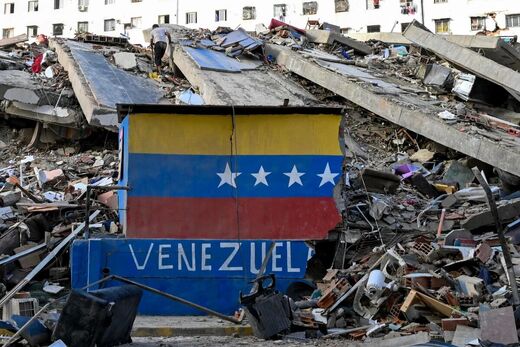

Comment: The world is moving on...you coming America?