
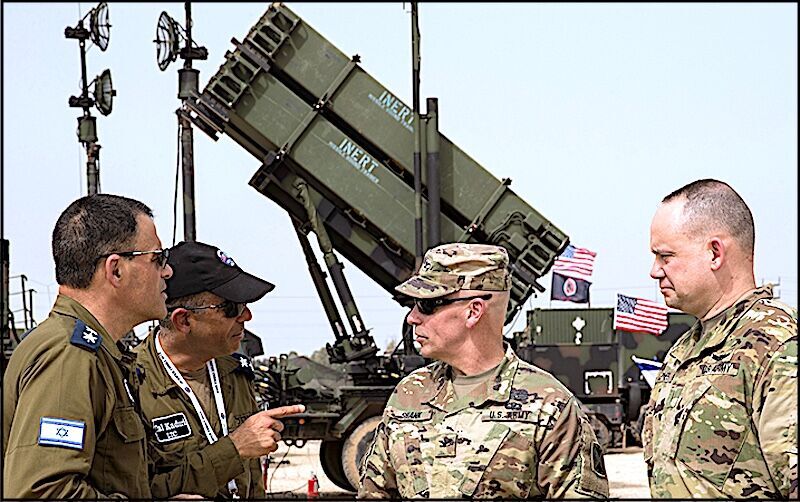
© Jack Guez/Getty ImagesU.S. and Israeli army officers • US Patriot missile defense system
The Trump Administration and Israeli government are reportedly negotiating a new Memorandum of Understanding (MOU) on U.S. foreign assistance to Israel, which, if completed, would make it the fourth such bilateral understanding reached between the two countries. MOUs are not legally binding agreements like treaties and do not require Senate ratification; ultimately, lawmakers' appropriations power subjects foreign assistance levels delineated in MOUs to congressional approval.
Past MOUs have significantly influenced U.S. aid to Israel; historically, Congress has appropriated foreign aid to Israel largely according to the terms of the MOU in place at the time (with the exception of supplemental appropriations acts). Congress last authorized military aid to Israel per the terms of the current MOU in P.L. 116-283, the William M. (Mac) Thornberry National Defense Authorization Act for FY2021.
With potentially consequential elections scheduled this fall in Israel and Israel seeking munitions replenishment in light of the war in Iran and other conflicts, both sides may seek to complete a new MOU in the months ahead.
Historical Background
The first 10-year MOU (FY1999-FY2008), agreed to under the Clinton Administration, represented a political commitment to provide Israel with at least $26.7 billion in total economic and military aid (of which $21.3 billion was military aid). This MOU provided the template for the gradual phaseout of all economic assistance to Israel.
In 2007, the George W. Bush Administration and the Israeli government agreed to a second MOU, consisting of a $30 billion military aid package for the 10-year period from FY2009 to FY2018.
In 2016 during the Obama Administration, the U.S. and Israeli governments signed the third MOU covering FY2019 to FY2028. Under its terms, the United States pledged $38 billion in military aid — $33 billion in Foreign Military Financing (FMF) grants and $5 billion in defense appropriations for missile defense programs — to Israel. This third MOU phases out a benefit known as Off-Shore Procurement (OSP), which allows Israel to use a portion of U.S. military assistance for Israeli domestic purchases of armaments.
Israel's Proposal to Phase Out U.S. Military Aid to Israel
Arguing that Israel has "come of age," and no longer needs assistance as it once did, Israeli Prime Minister Benjamin Netanyahu has publicly called for the phasing out of U.S. military aid to Israel. In lieu of continued aid, Netanyahu reportedly has sought more joint U.S.-Israeli investments in cyber and defense projects.
Currently, U.S. defense budget appropriations support a variety of jointly funded, cooperative U.S.-Israeli defense programs, including on missile defense, counter-tunneling, counter-unmanned aerial systems, and emerging technologies.
Of these jointly funded programs, only U.S. support for Israel's missile defense ($500 million annually) falls within the purview of the current MOU. For FY2026, Congress appropriated $202 million for cooperative defense programs with Israel outside the MOU.
Considerations for Congress
Equal Partnership or Continued Dependence?
Most U.S. military aid to Israel finances the procurement of weapons systems and services from U.S. defense contractors. If aid is phased out, Israel may have fewer financial constraints on purchasing defense articles from other global suppliers and/or manufacturing more arms domestically. However, with a fleet of fighter aircraft that is almost entirely American-made and a missile defense architecture which relies on U.S. assistance, Israel may remain dependent for quite some time on U.S. supply chains and, in times of military operations, direct defensive U.S. military support.
Human Rights Restrictions
If a new MOU were to phase out FMF grant aid to Israel and replace it with joint cooperative programming from defense accounts, such as "Procurement, Defense-Wide" and "Research, Development, Test and Evaluation Defense-Wide," sales of defense articles to Israel, even those financed with Israeli national funds, would still be subject to some human rights restrictions in law. Meanwhile, the executive branch's interpretation of Leahy Law human rights restrictions may mean that such restrictions would not apply if sales were financed solely with Israeli national funds.
Shifting Congressional Oversight
If U.S. FMF to Israel were to phase out, congressional oversight and appropriations responsibilities regarding Israel could shift away from foreign affairs-oriented committees toward defense-focused ones.
Financing Sales of U.S. Defense Articles to Israel
Israel is an economically and militarily advanced nation, with a per capita Gross Domestic Product in the top 30 worldwide, and a defense budget that has reportedly increased more than 150% in the last decade. Since the Hamas attacks of October 7, 2023, the United States has approved tens of billions of dollars in new sales of U.S. defense articles to Israel, which Israel has financed with US FMF.
Some of these cases, such as the sale of advanced fighter aircraft, have long timelines and may require financing, either from grant aid or Israeli national funds, well into the timeline of any new MOU. Furthermore, as the costs of procuring advanced U.S. fighter aircraft have increased, Israel may need to sustain historically high levels of procurement spending to continue purchasing advanced U.S. equipment. The United States sells Israel its advanced weaponry and longstanding U.S. policy, codified in law, requires the Administration to determine that any export of a U.S. defense article to any Middle Eastern country other than Israel would not adversely affect Israel's Qualitative Military Edge.
U.S. Aid to Egypt and Jordan
U.S. foreign assistance to Israel, Egypt, and Jordan has long facilitated military cooperation among the parties. The U.S.-brokered peace treaties between Israel and Egypt (1979) and Israel and Jordan (1994) are considered major U.S. foreign policy achievements. If U.S. military aid to Israel is phased out, Arab governments at peace with Israel, such as Egypt, may have a harder time advocating for continued U.S. grant aid
Competing Viewpoints on Joint U.S.-Israeli Defense
Some lawmakers reportedly have approved the prospect of phasing out aid and moving toward a more equal defense partnership, arguing that joint U.S.-Israeli defense programs require financial commitments from both parties, provide the United States access to Israeli innovations, and support the U.S. and Israeli industrial workforce.
Others oppose enhanced defense cooperation, as some lawmakers have pledged to no longer support joint missile defense programs, such as Iron Dome, due to Israel's alleged violations of international law and human rights abuses against Palestinians in the West Bank and Gaza.


Reader Comments
to our Newsletter