
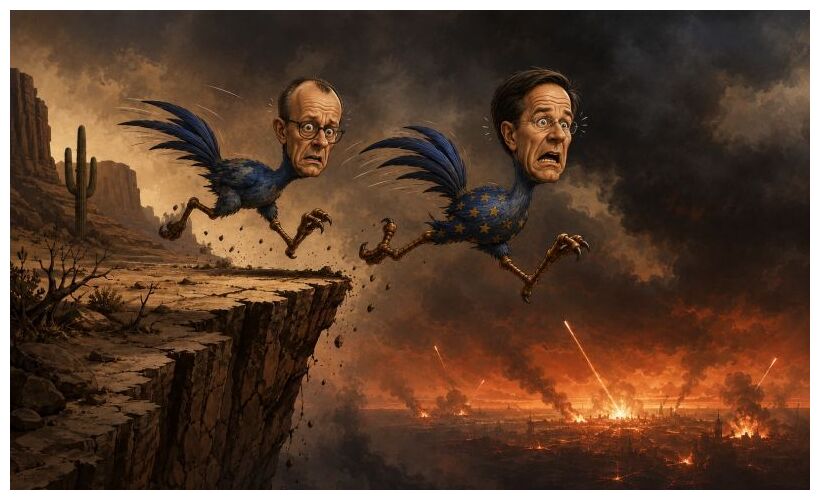
© Forum Geopolitica
World War I began on July 28, 1914 — 112 years later, the scene looks much the same, because it wouldn't take much for the situation to escalate fully. Today, there are two centers of conflict that have the potential to plunge the entire world into a global conflict.
When it comes to Iran, "peacemaker" Trump is breaking the MOU, just as we expected, and is attacking Iran once again — nota bene — during the largest funeral the world has ever seen. Iran has responded militarily, but with restraint. Some link this to the funeral ceremonies. More likely, however, is the implementation of a strategy to bring the West to its knees economically by blockading the Strait of Hormuz. The Middle East and Europe are in a state of limbo — but for how much longer?
The Collective West claims that it wants to — and is capable of — forcing Russia to make peace through war. To the surprise of many observers — including those in Russia — the Russian army has not (yet) struck back against Europe.
In this article, we discuss the situation in Europe.
Trump Is More Aggressive Than Biden
President Biden was considered a warmonger and a puppet of the deep state. Consequently, the US and Europe have been supplying Ukraine with weapons since the start of Russia's special military operation, even though Joe Biden himself initially expressed concerns that this behavior by the West could lead to World War III.
"The idea that we're going to send in offensive equipment and have planes and tanks and trains going in with American pilots and American crews... that's called 'World War III.'"This led many commentators — including us — to favor Donald Trump: a man who promised peace and pledged not to start any new wars, and who boasted he would end the war in Ukraine within 24 hours. Yet now, at the NATO summit in Ankara, Trump has endorsed Ukrainian attacks deep inside Russia.
President Joe Biden, 11 March 2022
"Trump said he supported Ukraine striking targets deep inside Russian territory, calling it an escalation that could help end the war."Europe and the US in Open War Against Russia
The Wallstreet Journal, 8 July 2026
Almost all of the weapons used by Ukraine in this war are supplied by Europe and the US. However, many of them cannot be deployed without NATO personnel in Ukraine or at one of NATO's bases, and cannot find their targets in Russia without satellite support from the US. It is therefore misleading to speak of a conflict between Ukraine and Russia here: Europe, with the active support of the US, is waging war against Russia. While this took place covertly until recently, the aggressors are now proudly flaunting their direct involvement.
So far, Russia has not responded militarily to Europe and, until recently, had relied on diplomacy. But times have changed, even though Russia continues to emphasize that it is not opposed to a diplomatic solution that takes all sides into account. Roger Köppel, publisher, editor-in-chief, and owner of the Swiss magazine Weltwoche, learned this firsthand. During an interview with Margarita Simonyan, editor-in-chief of RT, he tried not once, not twice, but three times to elicit a statement from the influential journalist to the effect that Russia also bears responsibility for the situation in Ukraine. Each time, she rejected this request in no uncertain terms, but Köppel refused to understand. Finally, Simonjan diplomatically but unequivocally put the Swiss journalist in his place with the following words: "I feel like a blind man is talking to a deaf man here."
Far-Reaching Statements by Russian Diplomats
Dimitry Peskov, President Putin's spokesperson, made a statement that will certainly not be understood by the West, but which has far-reaching implications:
"There is a war going on, this is a real war. It all started as a special military operation. It continues like a war, because Berlin, Paris, The Hague, Oslo, and, unfortunately, Washington are behind Kyiv. [...] They are being helped to aim through their satellites, they are being helped to aim foreign weapons at our targets through their entire infrastructure."René Zittlau will discuss how to interpret the statement by Peskov — who speaks on behalf of President Putin — in a separate article to be published shortly.
Dimitry Peskov, 5 July 2026
On July 9, Russian Foreign Minister Sergey Lavrov made the following statement:
Russia "will no longer believe the West that it wants negotiated solutions" because "this reserve of goodwill and hope has been exhausted entirely."Friedrich Merz is Pushing for War
Sergey Lavrov, July 9, 2026
As a German, Friedrich Merz apparently feels compelled to stir up painful memories among the Russians and reopen old wounds that, over the past 80 years, have been steadily healing thanks to considerable effort on both sides. Using forceful and blunt language, he is trying to talk his way into a German victory before the Russians have even responded militarily.
"Russia has no chance of winning this war. They will not achieve their war aims. The sooner we end this war, the better it will be for Europe, the better it will be for Russia, and the better it will be for world peace."At some point, this war will come to an end. One thing is certain: a German delegation will travel to Moscow to apologize on behalf of Merz & Co.
Friedrich Merz, July 8, 2026
The German people are divided on the issue of Russia. A large portion of East Germans are opposed to this potential war out of conviction. The reasons for this are obvious. West Germans may have a negative attitude toward Russia, but they certainly do not want to go to war against that country either.
Recently, the Bundeswehr sent letters to 298,200 people who will soon reach the age of conscription — that is, turn 18. Only 530 people — not even 0.18 percent — subsequently volunteered for military service. Another approximately 20 percent can imagine serving in the Bundeswehr. These are certainly not the kind of numbers that would allow a chancellor to plan a war with "confidence." See our comments on this in "The Truth Is Reasonable to Expect!."
"I doubt that the Russians will be forgiving again after 1914 and 1941 — even an angel's patience has its limits."The Russian leadership and the people of Russia deserve great credit for continuing to distinguish between Germany's political leadership and ordinary Germans, even though the betrayal of the forgiveness that Russia showed and practiced toward Germany runs very deep. It was a magnanimity without historical precedent with which the Soviet Union embarked on the path of forgiveness and reconciliation toward the Germans after World War II. Over the past thirty years, I have never heard anti-German remarks in Russia, not even from war veterans. I doubt that the Russians will be forgiving again after 1914 and 1941 — even an angel's patience has its limits.
"German madness is back — officially confirmed."Germany's defense spending is skyrocketing. In 2030, Germany will spend 29% of its total national budget on the military. You have to go back to World War II to find figures like that. By comparison, the US spent 13.1% of its national budget on defense in 2025. - German madness is back - officially confirmed.
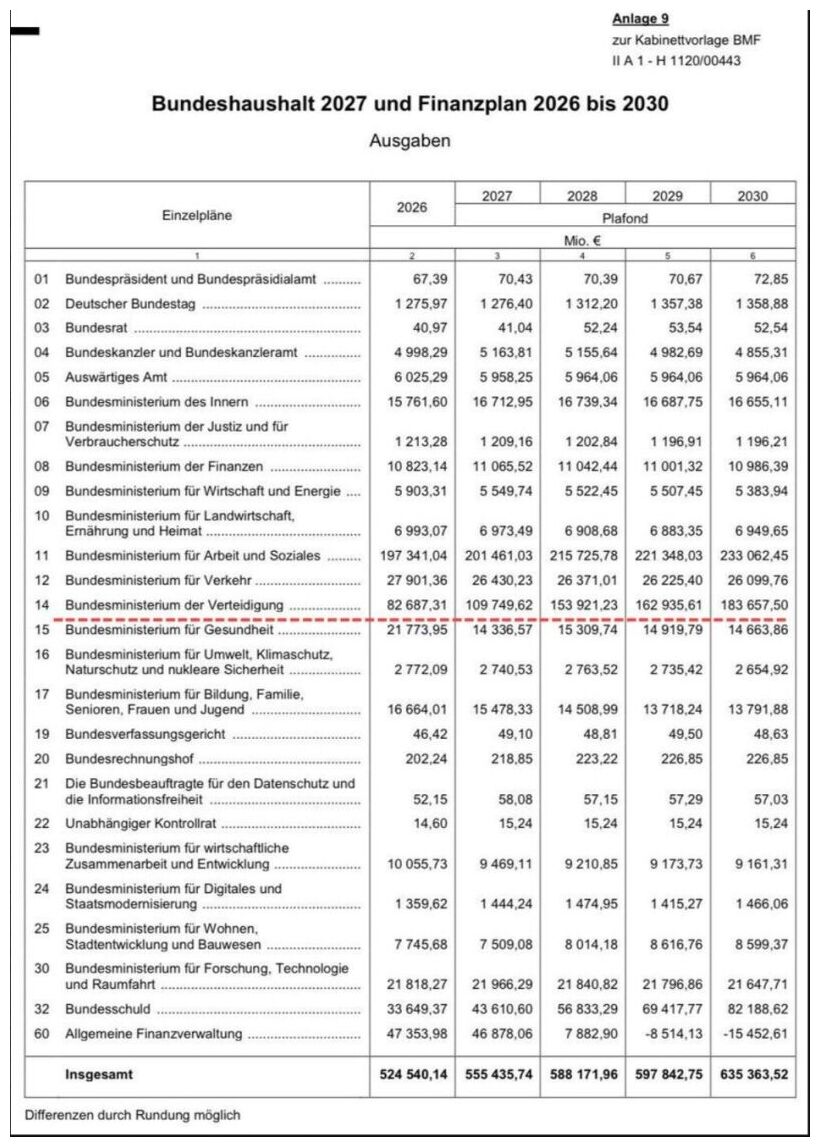
© Forum GeopoliticaBundeshaushalt 2027 und Finanzplan 2026 bis 2030, page 47.
European Attacks on Oil Infrastructure
Every day, European weapons systems are attacking oil infrastructure deep inside Russia. The consequences are significant. There are shortages of gasoline and diesel in some areas, and even in Moscow, lines are forming at gas stations. In an interview with Pavel Zarubin on June 28, 2026, President Putin commented on the damage to the oil infrastructure and its consequences as follows:
"As for the attacks on critical infrastructure in general, and energy infrastructure in particular, they are, of course, causing certain problems. This is obvious. However, I believe these problems are not critical. We simply need to increase the production of the corresponding equipment, including air defense systems, and improve the performance of the units engaged in this work."Many Russians expect and demand a military strike against Europe. Putin is under pressure to do so. However, it is important to consider whether such a strike would bring Russia any closer to its goal. The goal is to defeat Ukraine and secure the western border of the vast empire — once and for all. At best, Europe can field 50,000 combat troops. This number poses no threat to Russia. As long as the drone and missile attacks do not become critical after all, President Putin does not need to respond to Europe. The Europeans, however, are seeking to provoke a Russian strike so they can then portray themselves as victims and start a war in which they cannot and do not want to participate — certainly not with their own soldiers. Furthermore, the Europeans could blame Russia for their own financial collapse — which is likely coming soon and is entirely of their own making. I doubt that the strategists in the Kremlin will allow themselves to be provoked, despite calls from the people to strike back.
Kremlin.ru
A Pretextual Fear of Russia
A few days ago, I had a very interesting conversation in Ankara. My counterpart explained that all the talk about Russia is nothing more than a diversionary tactic from a completely different strategy: NATO will be history in two years, and the Europeans are striving to establish a system independent of the US. However, the Europeans would not want to purchase US weapons in a new system, because the enormous profits from arms production are supposed to stay in Europe. The Americans had already caught on to this and, a few days ago, sent a dozen U.S. defense experts — or rather, arms suppliers — to Brussels to convince the Europeans to continue buying their weapons from the US. However, the Americans were unsuccessful in this endeavor. If this story is true, then the massive defense spending — such as that by Germany — makes sense: European countries need astronomical sums to build up a defense industry that will make them independent of the US. To get these budgets approved, they need the threat of war; the Russians come in handy here, because without the threat of war, the public would not tolerate higher taxes and cuts to education and social services.
The State of Limbo Could Last Longer
The quotes from Russian officials discussed in this article indicate that Russia no longer believes in a diplomatic solution (Lavrov) and that the change in the designation of the conflict from "special military operation" to "war" signals a tougher stance by Russia in Ukraine. President Putin's statements suggest that, despite the clear and direct involvement of Europe and the US in the war, he will (for now) avoid a direct strike against Europe and thus continue to keep the conflict in a state of limbo. A direct strike against Europe would not bring Russia any closer to its goal of neutralizing Ukraine as a platform for Western aggression against Russia.
The West, which is trying with all its might to provoke a war against Russia, will likely remain true to this strategy and push for an escalation. The Russians will have to find ways to defend themselves more effectively against Western attacks on their infrastructure. This process is already underway. Legally, Russia is free to take military action against Europe. President Putin is keeping this option open, but is primarily trying to focus his offensive forces in Ukraine and is biding his time. He can pursue this strategy because, unlike Europe, Russia has already completed the migration to a war economy, the people stand behind him, and no sword of Damocles in the form of a financial collapse hangs over him. The West's aggressive stance suggests that it is running out of trump cards.
After this article went to the editor, news broke of the death of Lindsey Graham, one of the greatest warmongers and Russia-haters of our time. The death of any human being is to be mourned. However, his delight at the fact that Russians are dying — and his claim that this is the best investment — significantly diminishes our grief.
My friend, Professor Mohammad Marandi, a truly gentle man, put it a little differently:
"He and all his friends will rot in Hell."
Seyed Mohammad Marandi, July 12, 2026

Reader Comments
to our Newsletter