
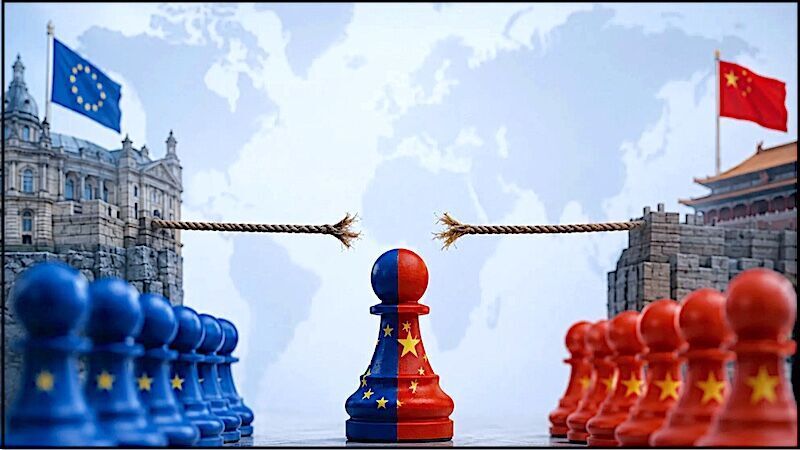
© UnknownEU v China, defining the future
The European Union's increasingly confrontational posture towards China exposes a persistent crisis of strategic direction, rather than the emergence of a coherent grand strategy. China insists on its right to industrial productivity and global ascension.
Recent sanctions, anti-subsidy investigations, and economic security measures are routinely framed as efforts to bolster European competitiveness and bargaining power. However, there is inadequate evidence that these initiatives address the underlying structural weaknesses eroding Europe's economic and geopolitical standing. Instead, they often serve as rhetorical gestures, masking the EU's ongoing inability to articulate a unified and effective foreign policy towards China.
Europe's challenges are fundamentally domestic. Industrial decline, sluggish productivity, high-energy costs, demographic stagnation, technological dependence in critical sectors, and fragmented capital markets are deep-rooted issues that sanctions or trade restrictions cannot remedy. By resorting to these external measures, the EU risks fostering the illusion of a determined strategy while evading the urgent and uncomfortable debates about its own economic and industrial vulnerabilities. This reluctance to confront internal shortcomings further exposes the lack of coherence in Europe's policy towards China.
A growing divergence is also emerging between Brussels and significant sectors of European industry. Many European firms continue to regard China as an indispensable market, production hub, and source of technological collaboration. German automotive manufacturers, luxury brands, chemical producers, and numerous medium-sized enterprises remain deeply invested in the Chinese market. While Brussels increasingly frames China through the lens of economic security and geopolitical competition, many European firms continue to view engagement with and investment in China as a commercial necessity and a matter of survival.
This mismatch highlights a deeper governance deficit within the EU. European institutions frequently craft policy based on shifting geopolitical narratives, while economic actors remain rooted in business realities. The resulting fragmentation leaves political objectives and economic interests constantly misaligned. This growing disconnect not only undermines the credibility of European foreign policy but also raises fundamental questions about whether Brussels genuinely represents the diverse priorities of its member states and economic stakeholders. The inability to reconcile these differences is emblematic of the EU's failing efforts to forge a coherent China strategy.
The Contradictions of the "Partner, Competitor, and Systemic Rival" Framework
A critical impediment to a coherent China policy lies in the EU's insistence on labelling China simultaneously as a "partner, competitor, and systemic rival." While this formulation offers short-term political ambiguity convenience, it betrays a profound conceptual confusion at the heart of Europe's foreign policy thinking.
In practical diplomacy, strategic clarity is essential. Mokry (2023) and Goddard and Krebs (2015) argue that states formulate grand strategy by articulating national interests, identifying and prioritising threats, and aligning available instruments of power with desired political objectives. The EU's tripartite framework attempts to encompass all possibilities simultaneously, producing a policy vocabulary that obscures rather than clarifies strategic choices.
The contradiction is not merely semantic. If China is fundamentally a systemic rival, then engagement becomes secondary to containment. If China is primarily a partner, cooperation should take precedence. If China is principally a competitor, the relationship should focus on managing economic rivalry within mutually accepted rules. Attempting to sustain all three definitions simultaneously creates a framework that permits almost any policy while guiding none.
This ambiguity goes a long way toward explaining why Europe's China policy so often appears reactive, fragmented, and devoid of strategic depth. Lacking a consistent vision, Brussels vacillates between engagement, confrontation, and ad hoc cooperation. The absence of conceptual clarity inevitably translates into operational incoherence, leaving the EU's foreign policy adrift in the face of China's assertive global posture.
Moreover, the classification debate distracts policymakers from a more fundamental reality: China has become a central pillar of the global economy and one of the principal architects of the emerging multipolar order. Whether Europe chooses to define China positively or negatively does not alter this structural fact. The challenge is therefore not finding the perfect label but developing a realistic strategy capable of managing interdependence while protecting legitimate European interests.
The EU's persistent difficulty in this regard points not only to a deficit of expertise but, more fundamentally, to a crisis of strategic imagination and leadership. Europe remains trapped between its normative aspirations and the realities of a world dominated by hard power, industrial rivalry, and complex civilizational dynamics. This inability to adapt underscores the EU's chronic failure to develop a credible and unified foreign policy towards China.
Strategic Autonomy or Strategic Dependence?
The debate over China also exposes unresolved questions regarding European strategic autonomy. Officially, the EU seeks an independent foreign policy capable of balancing economic interests, security concerns, and diplomatic engagement. In practice, however, European policy often appears heavily influenced by broader transatlantic priorities.
Since the escalation of strategic competition between Washington and Beijing, European discourse has increasingly adopted American language and threat perceptions. Concepts such as "systemic rival," "de-risking," economic security, technological containment, and supply-chain resilience frequently mirror debates originating in Washington rather than translated into Brussels grammar. Bringing the debate to geopolitical realities, Brussels is no rival to China; only Washington is. So, it resonates as if Europe still lives in its glorious, colonial past. Therefore, there is little chance for an adequate, calibrated strategy towards China.
This is not to say that Europe simply follows Washington's lead. Genuine concerns over market access, industrial subsidies, technology transfer, and strategic dependencies exist. Yet the degree to which European policy is now subsumed within a broader US-led framework raises critical questions about the independence and originality of European strategic thinking. The EU's inability to disentangle its China policy from transatlantic priorities further highlights the lack of a domestic, coherent approach.
The difficulty is that European interests do not perfectly coincide with American interests. The United States possesses greater military capabilities, technological leadership, energy self-sufficiency, and geographical insulation from Eurasian economic disruptions, including those in the Middle East. Europe occupies a different geopolitical position. Its prosperity depends heavily on external trade, global supply chains, and stable economic relations across Eurasia.
As a direct consequence, policies designed primarily for American strategic objectives may impose disproportionate costs on Europe. The more Europe defines its China policy through the prism of great-power competition, the greater the risk that it sacrifices economic opportunities without significantly improving its strategic position.
The outcome is a widening perception — especially outside Europe — that the EU's rhetoric of strategic autonomy echoes hollow, as its actions remain constrained by agendas set elsewhere. Whether this perception is wholly justified or not, it matters less than the reality that it increasingly shapes how Europe is regarded by both partners and competitors. The EU's inability to chart an independent course on China erodes its credibility as a serious geopolitical actor too.
The Imperative of Strategic Engagement in a Multipolar World
The fundamental weakness of current EU policy is not that it seeks to reduce vulnerabilities or strengthen resilience. These are legitimate objectives. The problem is that such measures are rarely embedded within a broader positive, coherent vision of the future relationship.
As Lebow (2022) argues, diplomacy cannot survive on deterrence, risk management, and defensive postures alone. Chas W. Freeman (2018) is straightforward: "Diplomacy is the management of foreign relations to reduce risk to the nation while promoting its interests abroad." Effective statecraft demands a credible balance between competition and cooperation, reinforced by a forward-looking agenda. Yet Europe's engagement with China has become mired in technical disputes, regulatory investigations, and security anxieties, offering little in the way of a positive or imaginative long-term vision. This persistent shortfall risks relegating the EU to the margins of global diplomacy, especially as China cements its role as a central pillar of the international system, given that Trump's USA is not a big fan of international institutions.
This is particularly problematic because China is not a marginal actor but one of the central poles of the emerging international system. Regardless of political preferences, Europe's future prosperity will remain linked to developments in the Chinese economy, technological innovation, infrastructure networks, and global governance initiatives. While the EU seems to be teaming up with the U.S. to contain China at its expense, European businessmen have made it clear that they cannot afford to be absent from the Chinese market.
A purely confrontational strategy, such as comparing China to a cancer, as the EU's diplomacy chief, Kaja Kallas, did a few days ago, would therefore impose significant costs on Europe while offering uncertain benefits. Equally, unconditional engagement would ignore legitimate concerns regarding market access, reciprocity, and economic security. The challenge is not choosing between confrontation and cooperation, but constructing a framework that prioritises cooperation while preserving the EU's deep interests.
Such a framework would require sustained high-level political dialogue, greater cultural and strategic literacy within European institutions, and a clearer distinction between areas of competition, such as advanced, digital technologies and economic security, and areas of mutual benefit, including climate change mitigation, sustainable development, and global public health cooperation. Most importantly, it would require Europe to formulate policy based on its own long-term interests rather than on inherited assumptions or external pressures.
The central question is therefore not whether sanctions or restrictions can rescue Europe from decline; they cannot. Europe's future competitiveness rests on innovation, industrial renewal in a few selected sectors, strategic coherence, and diplomatic sophistication. Lacking these pillars, punitive measures against China become symptoms of strategic confusion and insecurity, not tools of genuine statecraft, as China will respond in kind. Trump learned this at great cost. The EU's repeated resort to such measures is itself an admission of its inability to formulate a robust and unified foreign policy towards Beijing. Meanwhile, various individual member states continue to pursue bilateral agreements and cooperation with China, often undermining Brussels' own rhetoric on strategic competition and systemic rivalry, as their companies simply cannot afford to be absent from the Chinese market.



Reader Comments
to our Newsletter