
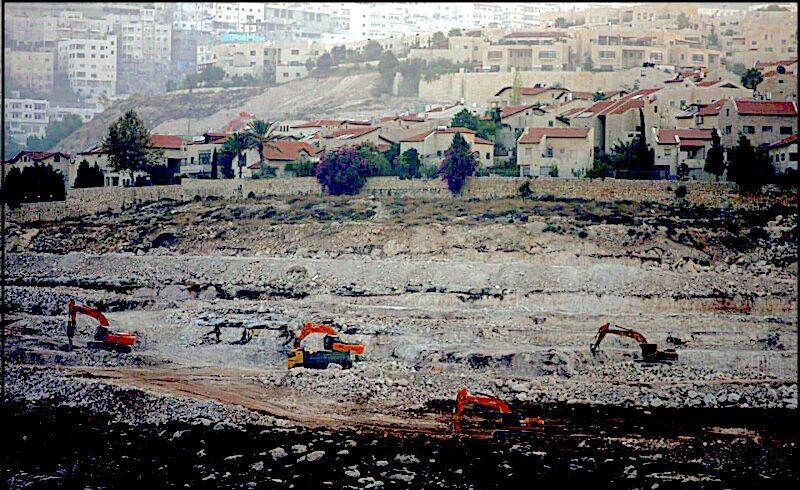
© Issam Rimawi/APA ImagesConstruction site • West Bank settlement of Pisgat Ze’ev, outside Jerusalem • November 21, 2010
In mid-May, protesters gathered outside a synagogue in Brooklyn to demonstrate against a real estate expo being held inside. The properties advertised for sale were not located in New York City, but in illegal Israeli settlements in the occupied West Bank, and the target clientele was members of the Jewish American community.
The "Great Israeli Real Estate Event," organized by the Israeli company, My Home in Israel, was one of many property fares held across the U.S., Canada, and the UK, targeting prospective Anglophone Jewish buyers. A recently scheduled London event carrying the same name drew widespread condemnation last June from human rights groups and over 100 British lawmakers.
The settlements at the top of the event's promoted property listings included Ma'ale Adumim, Givat Ze'ev, Karnei Shomron, and Kfar Eldad. Each listed area is undergoing urban expansion and new construction, concurrent with seizure and confiscation orders targeting the Palestinian lands surrounding them — a systematic process aimed at entrenching settlement dominance.
The promotional advertising for these settlements deploys seductive language to attract investment. An advertisement for a real estate project in Kfar Eldad, located within the Gush Etzion Regional Council southeast of Bethlehem, pitches a rural lifestyle "close to Jerusalem, far from the routine." The ad reads:
"Time flows a bit differently around here. In the morning you can sip your coffee while watching the sunrise, and just 12 minutes later, before your coffee has even cooled, find yourself in Jerusalem. And in the evening, you'll return to soothing tranquility. This makes Kfar Eldad the perfect alternative for those seeking reasonably priced housing close to Jerusalem, but away from the noise and traffic of city life."Behind the glossy brochures and manicured images of "modern residential communities" lie painful chapters of systematic Palestinian land confiscation — a process that has expanded in recent years to encompass nearly half of the total area that Israeli occupation authorities have declared "state lands" since the Oslo Accords were signed.
The "soothing tranquility" in the hills and open terrain of Bethlehem was, until recently, home to Palestinian and Bedouin communities who practiced seasonal farming and herding. Those original inhabitants were barred from accessing their land, which was confiscated under military orders decades ago, before settlement projects were built on it.
Ibrahim Ataallah, a resident of Khirbet Beit Skaria, told Mondoweiss:
"I owned land in the area of the Gush Etzion bloc's expansion — land covered in hanging grapevines and almond trees of all kinds. But I was barred from accessing it after a confiscation order was issued [in 1984]. Even though we in Beit Skaria hold the legal documents proving ownership of the land we live on, they see us as an obstacle to the settlement expansion in Gush Etzion."As Atallah described the location of his plot of land, and the grapevines and almond trees it once bore, he looked at the maps and advertisements published by Hebrew real estate websites advertising properties in the Gush Etzion area. An advertisement describing the features of a plot for sale caught his eye. Though he could not pinpoint his own land on the map due to its lack of clarity, the descriptions of the land for sale and the lifestyle being offered to potential settlers hit close to home.
He lamented:
"I really did drink my coffee at sunrise and waited for my friends from Jerusalem to join me. We would talk about the price of grapes at the market, the coffee still warm by the time they arrived. All that separates us from Jerusalem was a few kilometers."Today, that short distance no longer implies access. As a Palestinian ID holder, Atallah is barred from entering Jerusalem without a permit, transforming what was once a routine trip to visit friends into a near-impossible journey.
Palestinians forced out, Jewish settlers brought in
While Atallah's land was confiscated by the Israeli state decades ago, many of the properties being advertised at real estate events in the U.S. are part of settlements that are actively growing today — growth that is dependent on the dispossession of Palestinians.
At the start of this year, the Israeli government decided to confiscate approximately 700 dunams (70 hectares) of Palestinian land for the construction of a new settlement neighborhood in Karnei Shomron, built east of Qalqilya in the northern West Bank and overlooking the Mediterranean coastal plain 10 to 15 kilometers away.
This confiscation falls within what Israel calls its "Roof plan," an all-encompassing agreement for expanding the settlement by adding 6,000 new housing units and accompanying infrastructure in the northern West Bank.
According to Israeli projections, the project could triple Karnei Shomron's population, transforming it into a regional urban center in the northern West Bank. Karnei Shomron was one of the settlements being advertised in the "Great Israeli Real Estate Event.
In the central West Bank, Ma'ale Adumim — whose properties were also featured in the event's brochures — claimed the largest share of recent confiscation decisions. On February 29, 2024, approximately 2,640 dunams of land belonging to the villages of Abu Dis and al-Aizariya, located near the settlement, were confiscated for incorporation into Ma'ale Adumim's boundaries.
These land grabs are functioning as a real estate reserve for a much larger settlement scheme known as the E1 plan, which aims to seize a strategic tract of land around Jerusalem that bridges the West Bank's northern and southern halves, where 3,400 new housing units would be built to constitute a neighborhood within the settlement, connecting Ma'ale Adumim to Jerusalem while splitting the West Bank in two.
In addition to the E1 plan, the emerging construction of the "Desert Bird" neighborhood, which overlooks the desert slopes stretching toward the Jordan Valley, has seized land that was once home to Palestinian Bedouin communities. This has primarily impacted the Jahalin tribe, which has been systematically pushed from its grazing pastures since October 2023.
Eid Jahalin, a local resident, told Mondoweiss:
"We used the land to graze our sheep,""But after we were cut off from the land and the roads were closed, there are no longer any pastures for the sheep to graze in. Even today, we are still subjected to settler attacks in our own homes. We are hemmed in on every side."Further northwest of Jerusalem, the settlement of Givat Ze'ev was built on lands belonging to the village of al-Jib. Part of the settlement bloc encircles the city, with the religiously significant site of Nabi Samuel to its south. Confiscation of Palestinian land in the area most recently escalated after a military order was issued on April 5, 2026, targeting approximately 6.83 dunams (0.68 hectares) of land from al-Jib. The order is part of a broader plan to allocate roughly 268 dunams (26.8 hectares) in al-Jib and Nabi Samuel for the construction of a new settlement neighborhood comprising 800 housing units.
On the ground, this requires seizure of large tracts to build road networks and infrastructure connecting the settlement bloc to Jerusalem.
The expansion schemes for Givat Ze'ev, Ma'ale Adumim, Gush Etzion, and Karnei Shomron are just the most prominent plans to have surfaced within real estate events held at places like the Park East synagogue in Brooklyn. They form the spearhead of a broader Israeli strategy to aggressively expand settlements and infrastructure across the West Bank in order to "bury" the prospects for a Palestinian state, in the words of hardline Israeli Finance Minister Bezalel Smotrich.
How land goes from 'state land' to the real estate market
Khalil Tafakji, a researcher specializing in settlement and Jerusalem affairs and director of the cartography department at the Arab Studies Society, told Mondoweiss that Palestinian land is seized in a way that often takes roundabout legal avenues to strip Palestinians of their rights to it before it is offered for sale on the market.
"At that stage, the land is not offered for sale directly. Rather, it is excluded from the scope of private Palestinian ownership altogether. The Israeli state does this by declaring the land insufficiently cultivated to establish ownership or by sealing it off and designating it a closed military zone reserved for army training. These areas are rendered 'state lands under the administration of the Israel Land Authority."The first administrative step in this designation process rests on Israel's interpretation of Ottoman land law, which has historically governed land ownership in Palestine. Only then are properties marketed to potential homebuyers ahead of construction. The state effectively leases the land to prospective homeowners, and what buyers acquire is the property, not the land itself. A buyer can own the property for 99 renewable years, while the land remains in the state's name under what is called a land leasehold arrangement. In essence, this grants a person or entity long-term usufruct rights in exchange for payment or certain conditions, without necessarily entailing a transfer of the original land.
That's where the real estate companies and contractors come in. The land is divided into residential units and projects, then offered for sale on the Israeli real estate market — sometimes at overseas auctions targeting buyers from Jewish diaspora communities. These are the land sale events, often hosted at synagogues, that draw protesters in places like New York City
Jerusalem as a settlement magnet
In settlement promotional campaigns, proximity to Jerusalem is often a cornerstone of their marketing strategy, presenting settlement properties in the Gush Etzion bloc as a natural geographic and urban extension of the city. This falls under Israel's "Greater Jerusalem" project, which has necessitated the ethnic cleansing of countless Palestinian communities stuck in administrative "no-man's-lands" inside the West Bank. These areas technically fall under the jurisdiction of Israel's Jerusalem municipality, yet receive virtually none of its services.
Tafakji told Mondoweiss:
"Proximity to Jerusalem is one of the most powerful 'colonization incentives' offered in the real estate market. Connecting large settlement blocs to Jerusalem — Givat Ze'ev to the north, Ma'ale Adumim to the east, Gush Etzion to the south — is designed to create the perception that these areas are merely 'residential suburbs' of the city, rather than isolated or internationally illegal outposts."Tafakji said that this marketing language launders the settlement project and embeds it in the U.S. public's consciousness. "It helps to normalize the presence of settlements and makes it the preferred residential choice for Israeli families."
Aside from Jerusalem, there are other perks for Israelis seeking housing in these new projects. The state offers a "settlement benefits" package of economic incentives, including generous tax exemptions, subsidized (and sometimes free) public transportation connecting them to the city center in minutes, and advanced infrastructure built specifically to serve these planned settlement neighborhoods. The only thing left to make it a reality is to relocate the Palestinian communities that live there.
From the perspective of Palestinian landowners, the battle being waged today is one that is rigged in favor of potential Jewish settlers living in New York over the Palestinians who own the land.
Ibrahaim Atallah, the farmer from Beit Iskaria, said:
"This really isn't about who owns the land or who can prove ownership. We have entered a battle we know we have already lost."Pointing to the historical map of Palestine hanging on his wall, he closed our conversation with a quiet grief:
"We were displaced in the Nakba of 1948, driven from our land by force. That is the same logic that is taking our land away now. They're using legal avenues, but it all rests on the same logic of force.


Reader Comments