
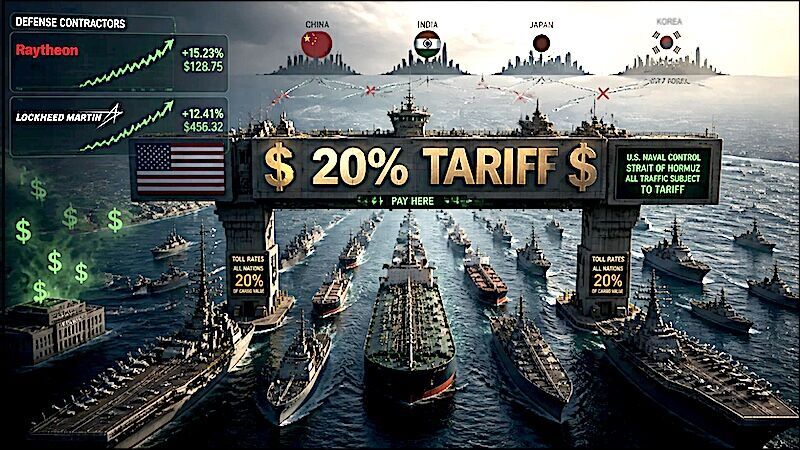
© UnknownPay Here!
The flawless synchronization between manufactured military crises and the sudden, record-breaking valuation spikes of defense contractors and fossil fuel executives points to a far more cynical reality. These are not spontaneous failures of diplomacy, but rather meticulously engineered extraction schemes designed to bleed the American taxpayer while weaponizing global trade for elite profit.
The recent escalation in the Strait of Hormuz is being packaged by Western mainstream media as a necessary assertion of maritime security, but in reality it represents a brazen act of economic warfare and neo-colonial extortion. The Trump administration's decision to reinstate a naval blockade in the world's most critical oil chokepoint, coupled with the unprecedented demand for a 20% toll on all passing cargo, is not a matter of national defense but a calculated profit play designed to enrich the United States fossil fuel oligarchy and the military-industrial complex while extracting wealth from the American working class and deliberately suffocating the economic growth of China and the broader Asian multipolar bloc.
Shale Windfall and the Military-Industrial Pump-and-Dump
The immediate consequence of this manufactured crisis is a violent shock to global energy markets, with domestic projections warning that United States gasoline prices are poised to climb back to the $4-per-gallon mark. To understand who truly benefits, one must examine the mechanics of the United States shale industry and the defense sector. Unlike conventional Middle Eastern oil, United States shale operates on much higher break-even thresholds that often require prices of $60 to $70 per barrel just to remain viable. When geopolitical tensions artificially inflate global benchmarks like Brent crude past $85, United States shale does not merely survive but becomes a highly profitable enterprise because the spread between the cost of extraction and the market price widens dramatically to generate massive and unearned windfall profits. The American taxpayer has historically subsidized this industry through generous tax breaks, depleted lease rates on federal lands, and regulatory rollbacks, and now the public is forced to subsidize it again at the pump.
This is not merely a long-term yield strategy for energy but a synchronized geopolitical market manipulation scheme spanning both the fossil fuel and defense sectors. As oil prices are artificially driven higher, the perceived demand for the hardware required to sustain the blockade also increases. Over the past month alone, shares of RTX Corporation, a prime contractor for the very missile defense systems and aerospace technology required to maintain this posture, have surged over 7% to inflate its market capitalization to nearly $265 billion. This financial footprint of manufactured conflict ensures that the network of allied financiers, energy executives, and defense lobbyists who positioned themselves ahead of this crisis will quietly sell at the peak to cash out their windfall gains. The American consumer absorbs the inflationary damage through higher fuel, transport, and grocery costs while a subsidized oligarchy pockets the difference and exits the stage.
The Micro-Manipulations: Weaponized Volatility and the Win-Win Stock Play
Beyond the macro-historical patterns, the most damning evidence of this racket lies in the recent micro-manipulations executed since the first coordinated United States and Israeli strikes on regional Iranian assets. The administration has perfected a cynical mechanism for toggling geopolitical tension, transforming foreign policy into a volatility harvesting machine that operates with brutal simplicity and high profitability for insiders.
- The On Switch and the Spike: A sudden and aggressive rhetorical escalation or a leaked threat of imminent strikes causes markets to react instantly, making oil futures jump and defense stocks surge as algorithms and retail traders price in war while insiders and institutional backers watch their already positioned portfolios inflate.
- The Off Switch and the Harvest: Just as retail investors rush into the rally, the administration abruptly pivots with a sudden announcement of a temporary de-escalation or a claim of mission accomplished, which triggers a market dip that allows insiders to quietly offload their overvalued shares at the peak to lock in massive profits.
- The Win-Win Reset: While the public is distracted by the political theater of peace or strength, these same insiders use their realized gains to buy back into energy and defense stocks at the newly lowered prices so the cycle is primed to repeat with the next manufactured provocation.
The Geopolitical Endgame: Bleeding Asia's Economic Rise
While the domestic wealth transfer is lucrative for political donors, the 20% maritime toll reveals a far more ambitious geopolitical endgame because the Strait of Hormuz is not merely a conduit for oil but the jugular vein of the Asian economic miracle. The data is stark, with China being the largest importer and receiving approximately 37.7% of all oil exports that pass through the Strait of Hormuz. Other major top importers include India at 14.7%, South Korea at 12.0%, and Japan at 10.9%, meaning Asian countries collectively receive nearly 89% of all crude and condensate flows leaving the strait.
By asserting the right to levy a 20% surcharge on shipments that make it through, the United States is attempting to weaponize its residual naval hegemony to impose a de facto tariff on the very heart of the global manufacturing and energy base. This economic warfare by chokepoint has the clear objective of artificially inflating the cost of doing business for China, India, and their regional partners to force them to bleed capital directly into the United States financial system just to maintain their supply chains. Washington is essentially declaring that emerging economies must pay a 20% premium to the American hegemon if they wish to participate in globalized trade, which is a desperate gambit to offset United States domestic economic vulnerabilities by siphoning wealth from its primary geopolitical rivals.
The Mirage: Munitions Depletion and Regional Fatigue
This aggressive posture entirely ignores the physical and strategic limits of American power, as the United States is already grappling with depleted munitions stockpiles and a strained defense industrial base stretched thin by prolonged proxy conflicts. Sustaining a high-intensity naval blockade and missile defense posture in the Strait of Hormuz is a finite endeavor, and the financial surge of companies like Raytheon masks a stark physical reality. Eventually, the United States will face critical and undeniable shortages of interceptors and precision-guided munitions.
Simultaneously, the Middle East will not absorb endless provocation indefinitely, and as regional fatigue sets in and Iranian retaliatory capabilities adapt and expand, the risk of an uncontrollable and asymmetric escalation grows exponentially. Washington is playing a game of chicken with a region that has nothing left to lose while betting on a military endurance it no longer possesses. When the missiles run out and the diplomatic off-ramps have been deliberately burned, the resulting blowback will not be contained to the Middle East but will shatter the very global supply chains the United States claims to be protecting.
A Ledger of Manufactured Crisis and Elite Enrichment
To fully grasp the cynicism of the current moment, one must recognize that this is not an isolated incident but the culmination of a recurring and highly profitable playbook. Since the administration first initiated unprovoked aggression toward Iran, this exact sequence of provocation, market manipulation, and elite capitalization has been executed with algorithmic precision. Consider the historical ledger:
- May 2018 and the JCPOA Withdrawal: The United States unilaterally tore up the Iran nuclear deal to reimpose maximum pressure sanctions, which caused Brent crude to surge from around $70 to over $85 a barrel by late 2018 and allowed United States shale executives and early political major donors to see their portfolios balloon while subsidized by the very taxpayers whose foreign policy security was deliberately undermined.
- Mid-2019 and the Gulf of Oman Tanker Incidents: Mysterious attacks and the downing of a United States drone spiked geopolitical fear and severe oil market volatility amid escalating maximum pressure, which high-frequency energy traders and defense lobbyists capitalized on to secure lucrative contracts for increased regional security deployments.
- January 2020 and the Assassination of Qasem Soleimani: An unprovoked drone strike on an Iranian general brought the world to the brink of war, causing oil prices to jump 4% overnight and shares of major defense contractors to surge as markets priced in inevitable conflict while the military-industrial complex saw immediate valuation spikes and political war chests were replenished by defense industry political action committees.
- July 2026 and the Current Hormuz Blockade: The reinstatement of the naval blockade and the extortionate maritime toll represents the ultimate and synchronized cash-out for the fossil fuel and defense oligarchy, funded by a 20% tax on Asian trade and an invisible inflation tax on the American worker.
Conclusion
The crisis in the Strait of Hormuz is a masterclass in the weaponization of interdependence, serving as a policy that simultaneously lines the pockets of the United States fossil fuel and defense elites through artificial price spikes and sets up a cynical insider sell-off at the taxpayer's expense. It attempts to place a 20% stranglehold on the trade of China, India, and the emerging multipolar world while gasoline prices climb and global supply chains are deliberately disrupted.
The international community must recognize this for what it truly is, which is not a security operation but a predatory and finite extraction scheme.
The survival of the global economy depends on the ability of sovereign nations to collectively resist this maritime extortion and accelerate the build-out of a resilient and alternative financial and trade architecture that is entirely immune to the toll booths of Washington.




Well, that answers the question I posed on the previous article. And the fallout of this calculated mess will include the fuel lockdowns, leading to the New World Order. I hate to be a sore loser, but I'm not sure of any strategy that gives me a win in this game...