
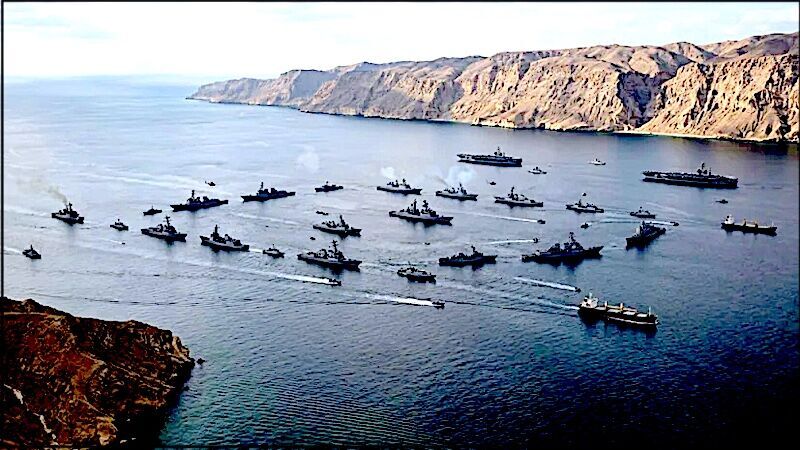
© UnknownStranded in the Strait of Hormuz
President Trump's Monday announcement that the United States would become "The Guardian of the Hormuz Strait," charging a 20 percent fee on cargo transiting the strait, arrived less than a month after his own administration insisted no country had the right to do exactly that. Secretary of State Marco Rubio said in June that charging tolls on an international waterway violates existing international law, a line aimed squarely at Iran's own fee scheme. The International Maritime Organization did not wait long to point out the contradiction, stating flatly that it opposes charging fees for passage through straits used for international navigation and that no legal basis exists for mandatory tolls on transit. Washington cannot credibly prosecute Tehran for an offense it is now committing itself.
The plan also collapses on its own arithmetic. No one, including apparently the White House, has explained how the 20 percent figure would be calculated. For instance, shippers cannot even evaluate whether the service is worth buying until someone specifies the base: is it 20 percent of the Navy's blockade costs, divided across vessels, or a straight levy on cargo value? A toll regime that cannot define its own base is not policy; it is a Truth Social post dressed up as one.
And even a fully specified fee would not settle the matter, because the ultimate gatekeepers of Hormuz traffic are not naval commanders but insurance underwriters. Maritime law specialists note that insurers can simply refuse to cover vessels transiting the strait if they judge the risk too high, regardless of whether an owner is willing to pay Washington for protection. Lloyd's of London, not CENTCOM, may end up deciding whether the "Guardian" title means anything at all.
There is precedent for American escort operations in these waters — the U.S. Navy shepherded reflagged Kuwaiti tankers through the Gulf during the "Tanker War" of the 1980s — but that mission never came bundled with a mandatory cargo levy, and it unfolded under a far narrower military footprint than today's multi-front confrontation spanning Iran, Israel, and half a dozen Gulf states. Invoking that history to justify a 20 percent toll stretches the analogy past its usefulness.
The Empirical Test America Is Already Failing
Set the legal problems aside and ask the operational question directly: can the United States actually hold the strait open? The record since February says no. Weeks of American bombardment during the initial war failed to fully reopen Hormuz to normal traffic; the Navy instead built an alternate channel hugging the Omani coast and escorted ships through it under fire. That alternate route — the one Trump has taken to calling the "Southern Highway" — has now gone quiet. Shipping-data firm Lloyd's List Intelligence reported that no large vessel has crossed the US-coordinated lane while broadcasting its location since July 7, with only a couple of tankers believed to have crossed "dark." If the American-guarded corridor cannot keep even a trickle of visible traffic moving, a 20 percent surcharge is not going to conjure confidence out of nowhere.
Markets already rendered the verdict. Brent jumped over 2%, following a nearly 10% spike the session before as the announcement collided with fresh strikes. That's not the market pricing in restored order; it's the market pricing in more war. Fair or not to the White House's intentions, the diagnosis holds: a plan with no pricing mechanism, no underwriter buy-in, and no actual control of the route it claims to price isn't sovereignty. It's a flag planted on water America doesn't control.
Why Tehran Won't Fold
Iran's resistance is not stubbornness; it is strategy tied to the preservation of Iran's future as a sovereign state. Tehran's negotiators have described the strait as one of the few genuine assets the war left them with, and Iran's foreign minister publicly countered Trump's fee announcement within hours, arguing that Iran — not the United States — is the party owed compensation for guaranteeing safe passage. That is not the posture of a government preparing to accept an American toll booth on its doorstep; it is a competing sovereignty claim, asserted in real time, over the same stretch of water.
Iran also retains the one asymmetry that matters most: sea denial is cheap, and open-ended policing is not. Mines, missile boats, and drone strikes — deployed even inside Omani territorial waters, as this week's attacks on two UAE-flagged tankers showed — cost Tehran a fraction of what it costs Washington to keep carriers, escorts, and aircraft on station indefinitely. A blockade the US reimposed once already, from April to June, demonstrates that Iran can absorb enormous economic pain and still choose confrontation over capitulation when its leadership judges the political stakes are sovereignty itself.
That political calculation has only hardened since the war began. Iran's new leadership, installed after the assassination of Ali Khamenei in the war's opening strikes, has publicly committed to defending the strait rather than negotiating it away, framing any retreat as a betrayal of the nation's dead. A government that has staked its legitimacy on this posture cannot easily reverse course, whatever price Washington attaches to a tanker's cargo manifest.



Reader Comments
to our Newsletter