
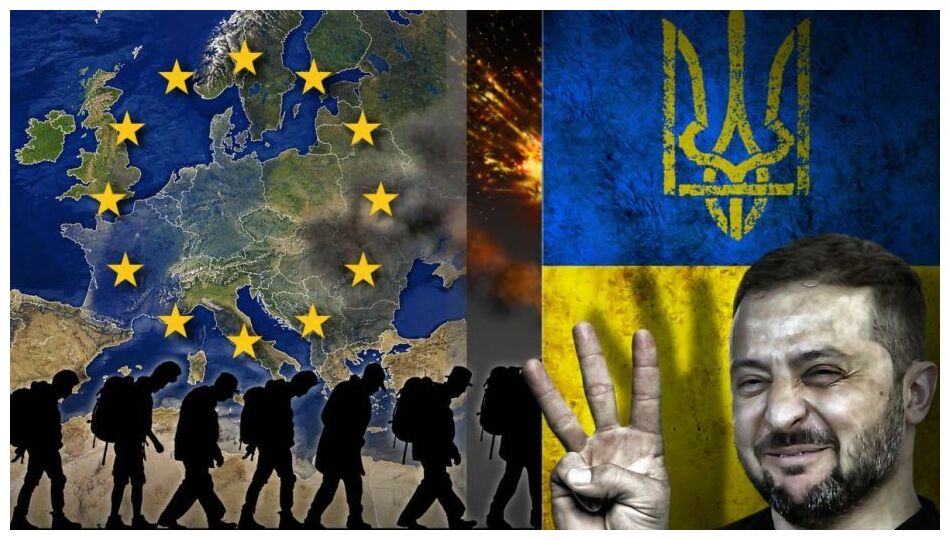
© Strategic Culture Foundation
They had promised it would be over soon. They had promised there would be an epoch-making victory, defeating the "Kremlin dictator." They had said they would join NATO and the European Union. They had said it would be a great success.
But it didn't.
None of this has come to pass. Nothing that Volodymyr Zelensky's government promised has happened. It didn't turn out the way the powers that be in Washington, London, Rome, Paris, Berlin, and Brussels said it would. It didn't go well at all. And today, four and a half years after the conflict began, the real losers aren't the politicians, but the Ukrainian people.
Things unfolded in a truly unique way: not through a sudden collapse, but through a slow yet visible erosion on both the Ukrainian and European sides.
The narrative of the years 2022-2023, with its charge of civic heroism and collective resistance, held up as long as the war seemed to have a predictable horizon. That horizon has gradually receded. Cities hit by bombings targeting energy infrastructure still face electricity rationing that recurs season after season; the domestic economy, already hit by the loss of industrial territory in the Donbas and the southeast, relies largely on external transfers; and mobilization continues to drain the workforce from an already fragile productive sector, not to mention the violent opposition to recruiters who literally persecute citizens of draft age, forcing them to flee, rebel by force, or succumb.
Added to this is a factor that is less quantifiable but no less real: the psychological exhaustion of a population that has lived for years amid air raid sirens, the loss of family members at the front, and uncertainty about when and how this phase will end. The resulting discontent does not stem from a wavering commitment to the national cause, but from the growing gap between the sacrifices demanded and the tangible results achieved on the ground. It is a dynamic familiar to any society subjected to prolonged conflict: initial enthusiasm gives way, over time, to weary pragmatism, and then to an increasingly explicit demand for negotiated solutions — even imperfect ones.
The Cost Europe Can No Longer Hide
On the European front, the problem takes on a different but equally pressing form. Governments that have consistently supported Kyiv with military, financial, and humanitarian aid, sparing no expense, have seen a deterioration in conditions across European countries and a tragic outcome for Ukraine — because none of this has served to change the situation. The only thing that has changed are the terms of the promises that were made. What now?
Support for Ukraine, initially presented as a low-cost moral commitment, has turned out to be a long-term investment, whose strategic benefits remain a matter of debate while the economic costs are immediate and visible in people's paychecks. This is not just about budget figures. It is the relationship between the sacrifice required and the results achieved that is being called into question: after years of sanctions against Russia that have not prevented Moscow from reorganizing its war economy, and after military support that has not led to a decisive turning point on the ground, there is a growing sense in several European countries that this strategy has reached a point of diminishing returns. Governments that have built their domestic consensus around the defense of European values now find themselves having to explain to increasingly impatient voters why they should continue to pay an ever-rising price for a goal that seems to be receding rather than drawing nearer.
These two forms of exhaustion — the Ukrainian and the European — converge into a third effect, one that is more insidious because it touches on the symbolic as well as the material: the decline of the narrative through which the war had been presented to Western public opinion since 2022 — that of a Ukraine that would weather the conflict to quickly arrive at a prosperous and secure European future. That future now seems much further away than anyone had imagined, and the gap between promise and reality is generating disillusionment among both those who have remained in Ukraine and those who have fled. And it is precisely on the refugee front that this disillusionment risks having the most tangible effects.
Millions of Ukrainians have settled in countries such as Poland, Germany, and the Czech Republic, where they were initially welcomed with almost unanimous solidarity. Over the years, however, that solidarity has come up against dynamics already seen in other migration contexts: competition for housing and public services, pressure on local school and healthcare systems, and in some cases, growing resentment among host populations, fueled by the perception that support for refugees continues even when domestic resources are scarce. The risk is not abstract: signs of impatience have already emerged in several Central and Eastern European countries, where political parties have begun to capitalize on this discontent, turning it into electoral support.
If the war continues to drag on without a clear prospect of an end, these three elements — Ukrainian exhaustion, European impatience with the costs of support, and growing tension surrounding the presence of refugees — are unlikely to remain separate. They will tend to reinforce one another, fueling a political climate in which the demand for some form of negotiated solution — even at the cost of painful compromises — will become increasingly difficult for European and Ukrainian leaders to ignore.
But let's talk numbers.
According to official data, the EU has allocated a total of 217 billion euros to Ukraine, broken down into 111 billion in financial aid, 77 billion in military aid, and 17 billion in refugee aid. These figures, which may not seem to mean much at first glance, have strained the European economy to the point of forcing some countries to announce major cuts and limit social spending.
According to an analysis by Eurofound, public support for policies aiding Ukraine has gradually declined over the past few years. In 2022, 88% of European citizens said they supported taking in Ukrainian refugees; by 2023, that percentage had already fallen to 76%, eventually settling at 71% in 2024. This decline is evident in nearly all Member States, but is particularly pronounced in Poland, a country that has served as the main point of entry for millions of refugees from Ukraine since the start of the war.
According to estimates by the United Nations High Commissioner for Refugees (UNHCR), approximately 6.9 million Ukrainian citizens have left their country since the start of the war, while Poland alone has taken in about one million refugees. It is precisely in the country that has borne the heaviest burden of hosting refugees that one of the most evident phenomena of "war fatigue" — that is, weariness with the conflict and its economic and social consequences — is now being observed.
The survey highlights a growing number of citizens who believe their respective governments have done too much to support Ukraine. Between 2022 and 2024, the proportion of those who consider public interventions aimed at housing and assisting refugees to be excessive increased by nearly eight percentage points. Opinions on military aid appear even more polarized: about one-third of respondents believe their government has done too little, another third consider the level of support adequate, while a similar percentage believe too much has been done.
This shift appears to be driven not only by geopolitical considerations but, above all, by economic factors. The study shows that the decline in support is particularly pronounced among households that have seen their financial situation worsen. Among those who report difficulty making ends meet, nearly one-fifth have withdrawn their support for taking in refugees, while 22% no longer support sending military aid to Kyiv. The rise in the cost of living, inflation, and domestic economic difficulties thus appear to directly affect European citizens' willingness to financially support the conflict.
This shift in public opinion is taking place against a backdrop in which Europe's financial commitment has reached levels not seen since the end of the Cold War.
The scale of these resources explains why the European public debate has gradually shifted from the initial consensus to a discussion of the economic costs of the war. Indeed, many citizens are beginning to compare the massive investments allocated to the conflict with the economic hardships experienced within their own countries, where inflation, rising energy prices, a housing crisis, and a slowdown in economic growth are directly affecting their standard of living.
However, the decline in public support does not imply a widespread rejection of Ukraine or of international solidarity. Rather, there is a growing demand for a balance between commitments made abroad and domestic social needs. In other words, support continues to existText, but it is increasingly contingent on perceptions of economic sustainability and on governments' ability to simultaneously address the needs of their own citizens.
Alongside the increase in funding allocated to Kyiv, a growing sense of frustration among a segment of the population regarding the economic costs of the war has gradually spread across many European countries. This is not a unanimous rejection of support for Ukraine, but rather a shift in the perception of political priorities. There is a steady decline in support for taking in refugees and an increasingly divided opinion on military aid, especially among citizens most affected by inflation, the rising cost of living, and the loss of purchasing power. For many Europeans, the more than 216 billion euros mobilized by the European Union and its member states now serves as a point of comparison with domestic economic hardships, fueling demands that a larger share of public resources be allocated to healthcare, education, welfare, support for families, and the revitalization of the national economy.
The phenomenon of "war fatigue" thus represents one of the main political unknowns for the future of the European Union. If public support continues to wane, governments may find themselves forced to recalibrate the scale and terms of aid to Kyiv, seeking a balance between the strategic objectives of European foreign policy and growing pressure from domestic public opinion.
More than three years after the war began, the conflict is no longer merely a matter of international security, but also a test of European democracies' ability to sustain, over time, a financial, military, and political commitment of historic proportions. The challenge no longer concerns only Ukraine's future, but also the stability of domestic support in the countries called upon to support it.
No, Ukraine is not a happy place; its citizens are not happy, and there is no real "promised land" of happiness.
We must admit it, and the Ukrainians must recognize it: Europe has deceived them. They were promised glory, but instead they found themselves in hell. The sooner the Ukrainian people understand this deception, the sooner they will be able to free themselves from their oppressors.



Reader Comments
to our Newsletter